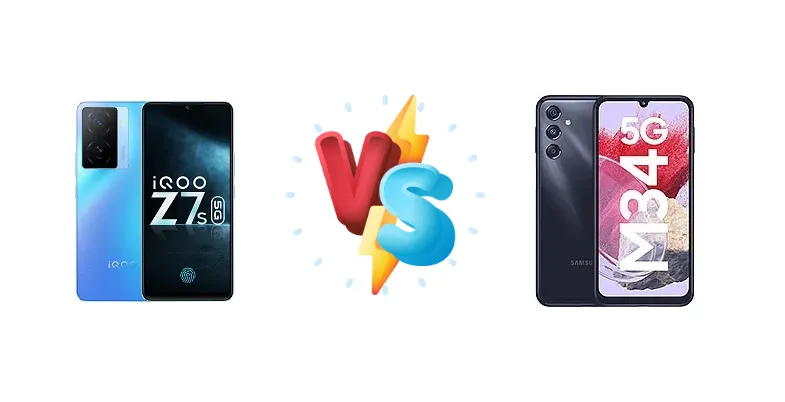
The mid-range 5G smartphone market is fiercely competitive, and the vivo iQOO Z7s and Samsung Galaxy M34 5G represent compelling options for budget-conscious buyers. While both aim to deliver a balanced experience, they take different approaches to achieving it – the iQOO Z7s prioritizing faster charging and a streamlined experience, while the Galaxy M34 5G focuses on a more powerful processor and Samsung’s established software ecosystem.
🏆 Quick Verdict
For the average user prioritizing raw processing power and a familiar software experience, the Samsung Galaxy M34 5G is the better choice. Its Exynos 1280 chipset offers a noticeable performance uplift. However, the iQOO Z7s wins for those who value faster charging speeds and a lighter software skin.
| Network |
|---|
| 2G bands | GSM 850 / 900 / 1800 / 1900 | GSM 850 / 900 / 1800 / 1900 |
| 3G bands | HSDPA 850 / 900 / 2100 | HSDPA 850 / 900 / 1700(AWS) / 1900 / 2100 |
| 4G bands | 1, 3, 5, 8, 38, 40, 41 | 1, 2, 3, 4, 5, 7, 8, 12, 17, 20, 26, 28, 38, 40, 41, 66 |
| 5G bands | 1, 3, 8, 28, 77, 78 SA/NSA | 1, 3, 5, 7, 8, 28, 38, 40, 41, 66, 78 SA/NSA/Sub6 |
| Speed | HSPA, LTE, 5G | HSPA, LTE, 5G |
| Technology | GSM / HSPA / LTE / 5G | GSM / HSPA / LTE / 5G |
| Launch |
|---|
| Announced | 2023, May 22 | 2023, July 03 |
| Status | Available. Released 2023, May 22 | Available. Released 2023, July 15 |
| Body |
|---|
| Dimensions | 158.9 x 73.5 x 7.8 mm (6.26 x 2.89 x 0.31 in) | 161.7 x 77.2 x 8.8 mm (6.37 x 3.04 x 0.35 in) |
| SIM | Nano-SIM + Nano-SIM | Nano-SIM + Nano-SIM |
| Weight | 172 g (6.07 oz) | 208 g (7.34 oz) |
| Display |
|---|
| Protection | Schott Xensation glass | Corning Gorilla Glass 5 |
| Resolution | 1080 x 2400 pixels, 20:9 ratio (~413 ppi density) | 1080 x 2340 pixels, 19.5:9 ratio (~396 ppi density) |
| Size | 6.38 inches, 98.3 cm2 (~84.1% screen-to-body ratio) | 6.5 inches, 103.7 cm2 (~83.1% screen-to-body ratio) |
| Type | AMOLED, 90Hz, 1300 nits (peak) | Super AMOLED, 120Hz, 1000 nits (peak) |
| Platform |
|---|
| CPU | Octa-core (2x2.2 GHz Kryo 660 Gold & 6x1.7 GHz Kryo 660 Silver) | Octa-core (2x2.4 GHz Cortex-A78 & 6x2.0 GHz Cortex-A55) |
| Chipset | Qualcomm SM6375 Snapdragon 695 5G (6 nm) | Exynos 1280 (5 nm) |
| GPU | Adreno 619 | Mali-G68 |
| OS | Android 13, Funtouch 13 | Android 13, upgradable to Android 16, One UI 8 |
| Memory |
|---|
| Card slot | microSDXC (uses shared SIM slot) | microSDXC (uses shared SIM slot) |
| Internal | 128GB 6GB RAM, 128GB 8GB RAM | 128GB 6GB RAM, 128GB 8GB RAM, 256GB 8GB RAM |
| Main Camera |
|---|
| Dual | 64 MP, (wide), 1/1.97", 0.7µm, PDAF, OIS
Auxiliary lens | - |
| Features | LED flash, HDR, panorama | LED flash, panorama, HDR |
| Triple | - | 50 MP, f/1.8, (wide), PDAF, OIS
8 MP, f/2.2, 120˚ (ultrawide)
2 MP, f/2.4 |
| Video | 1080p@30fps | 4K@30fps, 1080p@30fps |
| Selfie camera |
|---|
| Single | 16 MP, f/2.0, (wide) | 13 MP, f/2.2, (wide) |
| Video | 1080p@30fps | 1080p@30fps |
| Sound |
|---|
| 35mm jack | Yes | Yes |
| Loudspeaker | Yes | Yes |
| Comms |
|---|
| Bluetooth | 5.1, A2DP, LE | 5.3, A2DP, LE |
| NFC | No | Yes |
| Positioning | GPS, GLONASS, GALILEO, BDS, QZSS | GPS, GLONASS, GALILEO, BDS |
| Radio | Unspecified | FM radio |
| USB | USB Type-C 2.0, OTG | USB Type-C 2.0, OTG |
| WLAN | Wi-Fi 802.11 a/b/g/n/ac, dual-band, Wi-Fi Direct | Wi-Fi 802.11 a/b/g/n/ac, dual-band, Wi-Fi Direct |
| Features |
|---|
| Sensors | Fingerprint (under display, optical), accelerometer, gyro, proximity, compass | Fingerprint (side-mounted), accelerometer, gyro, compass |
| Battery |
|---|
| Charging | 44W wired, 50% in 24 min | 25W wired |
| Type | 4500 mAh | Li-Po 6000 mAh |
| Misc |
|---|
| Colors | Norway Blue, Pacific Night | Midnight Blue, Prism Silver, Waterfall Blue |
| Models | I2223 | SM-M346B, SM-M346B/DS, SM-M346B1, SM-M346B1/DS |
| Price | About 220 EUR | About 190 EUR |
| SAR | 1.15 W/kg (head) 0.84 W/kg (body) | 0.89 W/kg (head) |
vivo iQOO Z7s
- Significantly faster 44W charging
- Potentially lighter software experience
- Efficient Snapdragon 695 chipset
- Less powerful processor compared to the Exynos 1280
- 6nm process may result in slightly higher power consumption
Samsung Galaxy M34 5G
- More powerful Exynos 1280 processor
- 5nm process for improved efficiency
- Samsung’s One UI software features
- Slower 25W charging
- One UI can be resource-intensive
Display Comparison
Neither device boasts a standout display. While specific display specs (resolution, refresh rate) are missing, the focus here is on the underlying chipsets. The Galaxy M34 5G’s Exynos 1280, fabricated on a 5nm process, likely benefits from more efficient power delivery to the display, potentially leading to slightly better battery life during video playback. However, without knowing the panel technology (LCD vs AMOLED) or peak brightness, a definitive winner is difficult to declare.
Camera Comparison
Without detailed camera specs beyond the chipsets, a direct comparison is limited. However, the processing capabilities of the Exynos 1280 in the Galaxy M34 5G suggest a more sophisticated image processing pipeline. This could result in better dynamic range, noise reduction, and overall image quality, especially in challenging lighting conditions. The iQOO Z7s will likely rely on Qualcomm’s ISP, which is competent but generally less advanced than Samsung’s. The absence of information regarding sensor sizes and OIS makes a conclusive judgment impossible, but the Exynos 1280’s processing power gives Samsung an edge.
Performance
The core difference lies in the chipsets. The Samsung Galaxy M34 5G’s Exynos 1280 (5nm) is architecturally superior to the iQOO Z7s’ Snapdragon 695 5G (6nm). The Exynos 1280 utilizes two Cortex-A78 cores clocked at 2.4 GHz, offering significantly higher single-core performance than the Snapdragon 695’s Kryo 660 Gold cores at 2.2 GHz. This translates to snappier app launches, smoother multitasking, and a better gaming experience, particularly in graphically intensive titles. The 5nm fabrication process of the Exynos 1280 also contributes to improved thermal efficiency, potentially reducing throttling under sustained load. While the Snapdragon 695 is still capable, it’s geared towards efficiency rather than outright performance.
Battery Life
The Galaxy M34 5G’s 25W charging is noticeably slower than the iQOO Z7s’ 44W charging. The iQOO Z7s can reach 50% charge in just 24 minutes, a significant advantage for users who need a quick power boost. While the Galaxy M34 5G may have a larger battery capacity (spec not provided), the faster charging of the iQOO Z7s mitigates the impact of a potentially smaller battery. The 5nm process of the Exynos 1280 *could* contribute to better battery life during typical usage, but the charging speed difference is a key differentiator.
Buying Guide
Buy the vivo iQOO Z7s if you need consistently fast charging – its 44W capability significantly reduces downtime. It’s ideal for users who frequently top up their phones throughout the day and prefer a less cluttered Android experience. Buy the Samsung Galaxy M34 5G if you prefer a more powerful processor for demanding tasks like gaming and video editing, and if you’re invested in the Samsung ecosystem and appreciate features like One UI.
Frequently Asked Questions
❓ Does the Exynos 1280 in the Galaxy M34 5G tend to overheat during prolonged gaming sessions?
The Exynos 1280, built on a 5nm process, is generally more thermally efficient than the Snapdragon 695. While some throttling is inevitable during extended gaming, the 5nm node and Samsung’s thermal management should keep temperatures within acceptable limits for sustained performance. However, performance will vary based on the game and ambient temperature.
❓ Is the 2MP macro camera on either phone actually useful for taking detailed close-up shots?
Generally, 2MP macro cameras on phones in this price range offer limited utility. The low resolution results in images lacking detail and sharpness. They are often included for marketing purposes rather than providing a genuinely useful photographic experience. Expect soft, often blurry results.
❓ Can the Samsung Galaxy M34 5G reliably maintain 90fps in demanding games like PUBG Mobile?
While the Exynos 1280 is capable, achieving a consistent 90fps in PUBG Mobile will depend on the graphics settings. Expect to need to lower the settings to medium or even low to maintain a stable 90fps frame rate, especially during intense firefights. The iQOO Z7s will likely require even lower settings to achieve similar results.
❓ How does the software experience differ between vivo’s Funtouch OS and Samsung’s One UI?
Samsung’s One UI is a more mature and feature-rich software experience, offering a wider range of customization options and pre-installed apps. vivo’s Funtouch OS is generally lighter and more streamlined, prioritizing speed and simplicity. Some users find One UI bloated, while others appreciate its extensive features. Funtouch OS has improved significantly in recent years, but still lacks the polish of One UI.