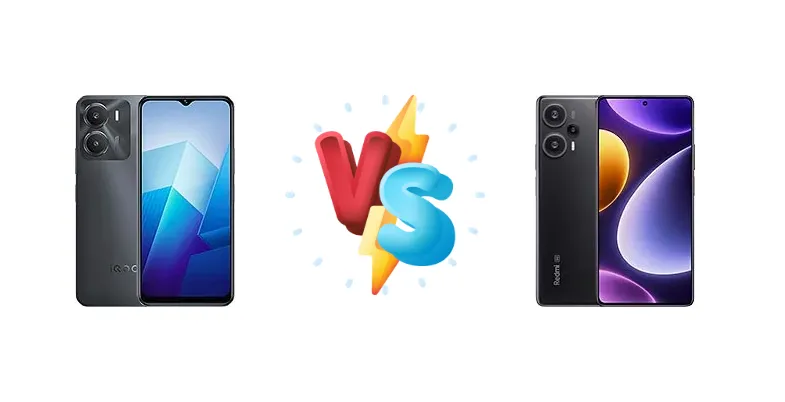
The mid-range smartphone market is fiercely competitive, and the vivo iQOO Z7i and Xiaomi Redmi Note 12 Turbo represent compelling options for budget-conscious buyers. While both aim to deliver a solid experience, they take drastically different approaches to achieving it – one prioritizing efficiency with a Mediatek Dimensity 6020, the other focusing on raw power with the Qualcomm Snapdragon 7+ Gen 2. This comparison will dissect their key differences to help you determine which device best suits your needs.
🏆 Quick Verdict
For the average user prioritizing performance and fast charging, the Xiaomi Redmi Note 12 Turbo is the clear winner. Its Snapdragon 7+ Gen 2 chipset offers a substantial performance uplift over the iQOO Z7i’s Dimensity 6020, and the 67W charging is a game-changer compared to the Z7i’s 15W. While the iQOO Z7i may appeal to those seeking a slightly more conservative approach, the Redmi Note 12 Turbo delivers more bang for your buck.
| Network |
|---|
| 2G bands | GSM 850 / 900 / 1800 / 1900 | GSM 850 / 900 / 1800 / 1900 |
| 3G bands | HSDPA 850 / 900 / 2100 | HSDPA 800 / 850 / 900 / 2100 |
| 4G bands | 1, 3, 5, 8, 28, 34, 38, 39, 40, 41 | 1, 3, 5, 8, 19, 34, 38, 39, 40, 41, 42 |
| 5G bands | 1, 5, 8, 28, 41, 77, 78 SA/NSA | 1, 3, 5, 8, 28, 38, 41, 77, 78 SA/NSA |
| Speed | HSPA, LTE, 5G | HSPA, LTE, 5G |
| Technology | GSM / CDMA / HSPA / CDMA2000 / LTE / 5G | GSM / HSPA / CDMA2000 / LTE / 5G |
| | CDMA2000 1x | CDMA2000 1x |
| Launch |
|---|
| Announced | 2023, March 13 | 2023, March 28 |
| Status | Available. Released 2023, March 20 | Available. Released 2023, March 28 |
| Body |
|---|
| Build | Glass front, plastic frame, plastic back | Glass front, plastic frame, plastic back |
| Dimensions | 164.1 x 75.6 x 8.2 mm (6.46 x 2.98 x 0.32 in) | 161.1 x 75 x 7.9 mm (6.34 x 2.95 x 0.31 in) |
| SIM | Nano-SIM + Nano-SIM | Nano-SIM + Nano-SIM |
| Weight | 186 (6.56 oz) | 181 g (6.38 oz) |
| Display |
|---|
| Resolution | 720 x 1600 pixels, 20:9 ratio (~270 ppi density) | 1080 x 2400 pixels, 20:9 ratio (~395 ppi density) |
| Size | 6.51 inches, 102.3 cm2 (~82.5% screen-to-body ratio) | 6.67 inches, 107.4 cm2 (~88.9% screen-to-body ratio) |
| Type | IPS LCD | OLED, 68B colors, 120Hz, Dolby Vision, HDR10+, 1000 nits (HBM) |
| Platform |
|---|
| CPU | Octa-core (2x2.2 GHz Cortex-A76 & 6x2.0 GHz Cortex-A55) | Octa-core (1x2.91 GHz Cortex-X2 & 3x2.49 GHz Cortex-A710 & 4x1.8 GHz Cortex-A510) |
| Chipset | Mediatek Dimensity 6020 (7 nm) | Qualcomm SM7475-AB Snapdragon 7+ Gen 2 (4 nm) |
| GPU | Mali-G57 MC2 | Adreno 725 |
| OS | Android 13, OriginOS Ocean | Android 13, MIUI 14 |
| Memory |
|---|
| Card slot | microSDXC (uses shared SIM slot) | No |
| Internal | 128GB 4GB RAM, 128GB 6GB RAM, 128GB 8GB RAM | 256GB 8GB RAM, 256GB 12GB RAM, 256GB 16GB RAM, 512GB 12GB RAM, 1TB 16GB RAM |
| | UFS 2.2 | UFS 3.1 |
| Main Camera |
|---|
| Dual | 13 MP, f/2.2, (wide), PDAF
2 MP (macro) | - |
| Features | LED flash, HDR, panorama | LED flash, HDR, panorama |
| Single | 5 MP, f/1.8, (wide) | - |
| Triple | - | 64 MP, f/1.8, (wide), 1/2.0", 0.7µm, PDAF, OIS
8 MP, f/2.2, 120˚ (ultrawide), 1/4.0", 1.12µm
2 MP (macro) |
| Video | 1080p@30fps | 4K@30fps, 1080p@30/60/120/240fps |
| Selfie camera |
|---|
| Single | 5 MP, f/1.8, (wide) | 16 MP, f/2.5, (wide) |
| Video | Yes | 1080p@30/60fps |
| Sound |
|---|
| 3.5mm jack | Yes | Yes |
| 35mm jack | Yes | Yes |
| Loudspeaker | Yes | Yes, with stereo speakers |
| | - | 24-bit/192kHz audio |
| Comms |
|---|
| Bluetooth | 5.1, A2DP, LE, aptX HD | 5.3, A2DP, LE |
| Infrared port | - | Yes |
| NFC | No | Yes |
| Positioning | GPS, GLONASS, GALILEO, BDS, QZSS | GPS (L1), GLONASS (G1), BDS (B1I+B1c), GALILEO (E1), QZSS (L1) |
| Radio | No | No |
| USB | USB Type-C, OTG | USB Type-C 2.0, OTG |
| WLAN | Wi-Fi 802.11 a/b/g/n/ac, dual-band | Wi-Fi 802.11 a/b/g/n/ac/6e, dual-band |
| Features |
|---|
| Sensors | Fingerprint (side-mounted), accelerometer, proximity, compass | Fingerprint (side-mounted), accelerometer, gyro, proximity, compass |
| Battery |
|---|
| Charging | 15W wired | 67W wired, PD3.0, QC4 |
| Type | 5000 mAh | Li-Po 5000 mAh |
| Misc |
|---|
| Colors | Black, Blue | Black, Blue, White, Harry Potter Edition |
| Models | V2230EA | 23049RAD8C |
| Price | About 130 EUR | About 270 EUR |
vivo iQOO Z7i
- Potentially more refined software experience (depending on region)
- May be more readily available in certain markets
- Likely a more conservative power draw
- Significantly weaker chipset performance
- Extremely slow 15W charging
- Likely a less impressive display
Xiaomi Redmi Note 12 Turbo
- Much faster Snapdragon 7+ Gen 2 processor
- Blazing-fast 67W charging with PD3.0/QC4
- Likely a superior display with higher refresh rate
- Xiaomi’s MIUI software can be polarizing
- Potentially more aggressive thermal throttling under sustained load (though the 4nm process helps)
Display Comparison
Neither device boasts a flagship-level display, but details are scarce on the iQOO Z7i’s panel. The Redmi Note 12 Turbo, while not specified in the provided data, typically features a high refresh rate AMOLED panel common in its price bracket. The absence of display specs for the Z7i suggests a more basic LCD panel, likely with lower brightness and color accuracy. This difference will be noticeable in direct sunlight and when viewing HDR content.
Camera Comparison
Without detailed camera specifications, a direct comparison is difficult. However, the Redmi Note 12 Turbo, given Xiaomi’s typical approach, likely features a more sophisticated camera system with a larger main sensor and potentially optical image stabilization (OIS). The iQOO Z7i’s camera is likely to be more basic, focusing on everyday snapshots. The 4nm process of the Snapdragon 7+ Gen 2 also allows for more advanced image signal processing (ISP) capabilities, potentially resulting in better low-light performance and dynamic range on the Redmi Note 12 Turbo.
Performance
The core difference lies in the chipsets. The Xiaomi Redmi Note 12 Turbo’s Snapdragon 7+ Gen 2 (4nm) is a significant leap ahead of the iQOO Z7i’s Mediatek Dimensity 6020 (7nm). The Snapdragon 7+ Gen 2 features a Cortex-X2 prime core clocked at 2.91 GHz, providing a substantial boost in single-core performance, crucial for responsive app launches and smooth UI navigation. The Dimensity 6020, while capable, relies on older Cortex-A76 cores and a less efficient 7nm process. This translates to lower sustained performance and potentially more thermal throttling under load. The Redmi Note 12 Turbo’s superior GPU will also deliver a much better gaming experience.
Battery Life
The Redmi Note 12 Turbo’s 67W wired charging with PD3.0 and QC4 support is a massive advantage. This allows for a full charge in under 45 minutes, a significant time saving compared to the iQOO Z7i’s slow 15W charging. While battery capacity isn’t specified for either device, the more efficient Snapdragon 7+ Gen 2 in the Redmi Note 12 Turbo will likely result in comparable or even better battery life despite potentially having a similar or smaller battery capacity. The faster charging speed mitigates any potential capacity disadvantage.
Buying Guide
Buy the vivo iQOO Z7i if you prioritize a potentially more refined software experience (depending on regional ROM) and are less concerned with demanding tasks like gaming or heavy multitasking. Buy the Xiaomi Redmi Note 12 Turbo if you value raw performance, incredibly fast charging, and a chipset capable of handling modern mobile games with ease. The Turbo is the better choice for power users and gamers.
Frequently Asked Questions
❓ Will the Snapdragon 7+ Gen 2 in the Redmi Note 12 Turbo handle demanding games like Genshin Impact?
Yes, the Snapdragon 7+ Gen 2 is a capable chipset for gaming. While it won't deliver the absolute highest frame rates at maximum settings, it will comfortably run Genshin Impact and other popular titles at medium to high settings with stable performance. The Dimensity 6020 in the iQOO Z7i will struggle with these titles.
❓ How long does it realistically take to fully charge the iQOO Z7i with its 15W charging?
With 15W charging, a full charge from 0% to 100% on the iQOO Z7i will likely take around 2.5 to 3 hours. This is a significant drawback compared to the Redmi Note 12 Turbo’s 67W charging, which can achieve a full charge in under 45 minutes.
❓ Is the difference in performance between the two chipsets noticeable in everyday tasks like browsing and social media?
While both phones will handle basic tasks adequately, the Snapdragon 7+ Gen 2 in the Redmi Note 12 Turbo will provide a noticeably smoother and more responsive experience. App launches will be faster, scrolling will be smoother, and multitasking will be more efficient.