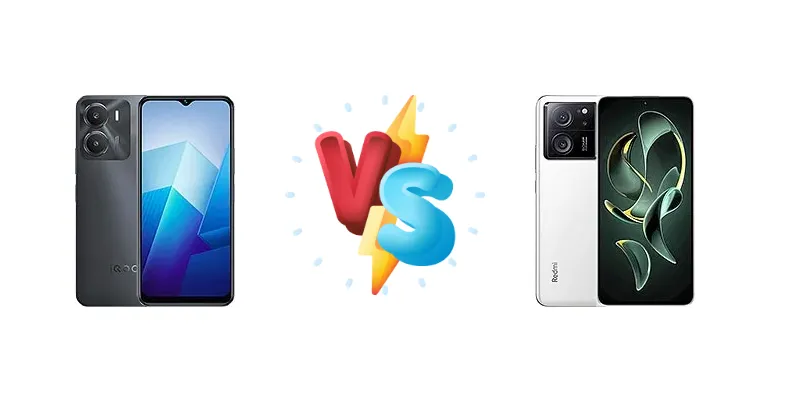
The vivo iQOO Z7i and Xiaomi Redmi K60 Ultra represent distinct approaches to the mid-range smartphone market. The Z7i aims for affordability, while the K60 Ultra pushes the boundaries of what's possible at its price point. This comparison dissects their key differences, focusing on performance, charging, and overall user experience.
🏆 Quick Verdict
For most users, the Xiaomi Redmi K60 Ultra is the clear winner. Its significantly more powerful Dimensity 9200+ chipset and blazing-fast 120W charging justify the price premium. However, the iQOO Z7i remains a viable option for budget-conscious users prioritizing basic functionality.
| Network |
|---|
| 2G bands | GSM 850 / 900 / 1800 / 1900 | GSM 850 / 900 / 1800 / 1900 |
| 3G bands | HSDPA 850 / 900 / 2100 | HSDPA 800 / 850 / 900 / 1700(AWS) / 2100 |
| 4G bands | 1, 3, 5, 8, 28, 34, 38, 39, 40, 41 | 1, 3, 4, 5, 8, 18, 19, 26, 34, 38, 39, 40, 41, 42, 66 |
| 5G bands | 1, 5, 8, 28, 41, 77, 78 SA/NSA | 1, 3, 5, 8, 28, 38, 41, 66, 77, 78 SA/NSA |
| Speed | HSPA, LTE, 5G | HSPA, LTE, 5G |
| Technology | GSM / CDMA / HSPA / CDMA2000 / LTE / 5G | GSM / CDMA / HSPA / CDMA2000 / LTE / 5G |
| | CDMA2000 1x | - |
| Launch |
|---|
| Announced | 2023, March 13 | 2023, August 15 |
| Status | Available. Released 2023, March 20 | Available. Released 2023, August 15 |
| Body |
|---|
| Build | Glass front, plastic frame, plastic back | - |
| Dimensions | 164.1 x 75.6 x 8.2 mm (6.46 x 2.98 x 0.32 in) | 162.2 x 75.7 x 8.5 mm (6.39 x 2.98 x 0.33 in) |
| SIM | Nano-SIM + Nano-SIM | Nano-SIM + Nano-SIM |
| Weight | 186 (6.56 oz) | 204 g (7.20 oz) |
| Display |
|---|
| Protection | - | Unspecified |
| Resolution | 720 x 1600 pixels, 20:9 ratio (~270 ppi density) | 1220 x 2712 pixels, 20:9 ratio (~446 ppi density) |
| Size | 6.51 inches, 102.3 cm2 (~82.5% screen-to-body ratio) | 6.67 inches, 107.4 cm2 (~87.5% screen-to-body ratio) |
| Type | IPS LCD | OLED, 68B colors, 144Hz, Dolby Vision, HDR10+, 2600 nits (peak) |
| Platform |
|---|
| CPU | Octa-core (2x2.2 GHz Cortex-A76 & 6x2.0 GHz Cortex-A55) | Octa-core (1x3.35 GHz Cortex-X3 & 3x3.0 GHz Cortex-A715 & 4x2.0 GHz Cortex-A510) |
| Chipset | Mediatek Dimensity 6020 (7 nm) | Mediatek Dimensity 9200+ (4 nm) |
| GPU | Mali-G57 MC2 | Immortalis-G715 MC11 |
| OS | Android 13, OriginOS Ocean | Android 13, MIUI 14 |
| Memory |
|---|
| Card slot | microSDXC (uses shared SIM slot) | No |
| Internal | 128GB 4GB RAM, 128GB 6GB RAM, 128GB 8GB RAM | 256GB 12GB RAM, 256GB 16GB RAM, 512GB 16GB RAM, 1TB 16GB RAM, 1TB 24GB RAM |
| | UFS 2.2 | - |
| Main Camera |
|---|
| Dual | 13 MP, f/2.2, (wide), PDAF
2 MP (macro) | - |
| Features | LED flash, HDR, panorama | Color spectrum sensor, Dual-LED dual-tone flash, HDR, panorama |
| Single | 5 MP, f/1.8, (wide) | - |
| Triple | - | 50 MP, f/1.7, (wide), 1/1.49", 1.0µm, PDAF, OIS
8 MP, 119˚ (ultrawide), 1/4.0", 1.12µm
2 MP (macro) |
| Video | 1080p@30fps | 8K@24fps, 4K@30/60fps, 1080p@30/60/120/240/960fps, gyro-EIS, HDR10+, 10-bit |
| Selfie camera |
|---|
| Features | - | HDR |
| Single | 5 MP, f/1.8, (wide) | 20 MP, (wide), 1/2.0", 0.8µm |
| Video | Yes | 1080p@30/120fps |
| Sound |
|---|
| 3.5mm jack | Yes | - |
| 35mm jack | Yes | No |
| Loudspeaker | Yes | Yes, with stereo speakers |
| Comms |
|---|
| Bluetooth | 5.1, A2DP, LE, aptX HD | 5.4, A2DP, LE |
| Infrared port | - | Yes |
| NFC | No | Yes |
| Positioning | GPS, GLONASS, GALILEO, BDS, QZSS | GPS (L1+L5), GLONASS (G1), BDS (B1I+B1C+B2a+B2b), GALILEO (E1+E5a), QZSS (L1+L5), NavIC |
| Radio | No | Unspecified |
| USB | USB Type-C, OTG | USB Type-C, OTG |
| WLAN | Wi-Fi 802.11 a/b/g/n/ac, dual-band | Wi-Fi 802.11 a/b/g/n/ac/6e, dual-band, Wi-Fi Direct |
| Features |
|---|
| Sensors | Fingerprint (side-mounted), accelerometer, proximity, compass | Fingerprint (under display, optical), accelerometer, gyro, proximity, compass |
| Battery |
|---|
| Charging | 15W wired | 120W wired, PD3.0, 100% in 19 min |
| Type | 5000 mAh | Li-Po 5000 mAh |
| Misc |
|---|
| Colors | Black, Blue | Black, White, Green |
| Models | V2230EA | 23078RKD5C |
| Price | About 130 EUR | About 330 EUR |
vivo iQOO Z7i
- More affordable price point
- Sufficient for basic smartphone tasks
- Reliable Mediatek Dimensity 6020 chipset
- Slow 15W charging
- Less powerful processor for gaming and multitasking
- Likely inferior camera performance
Xiaomi Redmi K60 Ultra
- Blazing-fast 120W charging
- Powerful Dimensity 9200+ processor
- Superior performance for gaming and demanding apps
- Higher price tag
- Potentially more heat generation under heavy load
- May be overkill for basic users
Display Comparison
While both devices likely feature LCD panels (data not provided), the core difference lies in the processing power driving them. The Redmi K60 Ultra’s Dimensity 9200+ will handle graphically intensive tasks with ease, resulting in smoother animations and a more responsive user interface. The iQOO Z7i’s Dimensity 6020, while capable, will show its limitations in demanding scenarios. Without specific display specs, it's reasonable to assume the K60 Ultra benefits from a higher refresh rate, contributing to a more fluid visual experience.
Camera Comparison
Without detailed camera specifications, a direct comparison is difficult. However, the Redmi K60 Ultra, positioned as a more premium device, likely features a more sophisticated camera system with a larger sensor and improved image processing. The iQOO Z7i will likely offer acceptable image quality for casual photography, but will struggle in low-light conditions and lack the dynamic range of the K60 Ultra. The absence of OIS information for both devices suggests a reliance on software stabilization.
Performance
The performance gap between these two phones is substantial. The Xiaomi Redmi K60 Ultra’s Dimensity 9200+ (4nm) boasts a prime Cortex-X3 core clocked at 3.35 GHz, alongside three Cortex-A715 cores and four Cortex-A510 cores. This architecture is significantly more advanced than the iQOO Z7i’s Dimensity 6020 (7nm), which utilizes older Cortex-A76 and A55 cores. The 4nm process node of the K60 Ultra’s chipset also translates to improved thermal efficiency, reducing throttling during sustained workloads. Gamers and power users will overwhelmingly benefit from the K60 Ultra’s superior processing capabilities.
Battery Life
The Redmi K60 Ultra’s 120W wired charging is a game-changer, capable of fully charging the device in just 19 minutes. This is a massive advantage over the iQOO Z7i’s slow 15W charging. While battery capacity isn’t specified, the K60 Ultra’s faster charging mitigates the impact of a potentially smaller battery. Users who frequently find themselves needing a quick top-up will greatly appreciate the K60 Ultra’s charging speed. The inclusion of PD3.0 further enhances the K60 Ultra’s charging versatility.
Buying Guide
Buy the vivo iQOO Z7i if you need a reliable smartphone for everyday tasks like calling, texting, and social media, and prioritize a lower upfront cost. Buy the Xiaomi Redmi K60 Ultra if you demand smooth multitasking, demanding gaming performance, and incredibly fast charging, and are willing to invest a bit more for a premium experience.
Frequently Asked Questions
❓ Is the Dimensity 9200+ in the Redmi K60 Ultra prone to overheating during extended gaming sessions?
While the Dimensity 9200+ is a powerful chip, the Redmi K60 Ultra incorporates thermal management solutions to mitigate overheating. The 4nm process node also contributes to improved thermal efficiency compared to older chipsets. However, prolonged, high-intensity gaming will inevitably generate heat, potentially leading to some throttling, though likely less than with the iQOO Z7i.
❓ How does the 120W charging of the Redmi K60 Ultra affect battery health over the long term?
Xiaomi employs charging algorithms and battery protection features to minimize the impact of fast charging on battery health. While fast charging *can* contribute to faster battery degradation over several years, the benefits of significantly reduced charging times often outweigh this concern for most users. The K60 Ultra’s charging system is designed to optimize charging speed while preserving battery longevity.
❓ Is the iQOO Z7i a good choice for playing demanding mobile games like Genshin Impact or PUBG?
The iQOO Z7i’s Dimensity 6020 chipset is not ideally suited for demanding games like Genshin Impact or PUBG. While it can run these games, you’ll likely need to lower graphics settings and accept lower frame rates for a smooth experience. The Redmi K60 Ultra is a far better choice for serious mobile gamers.