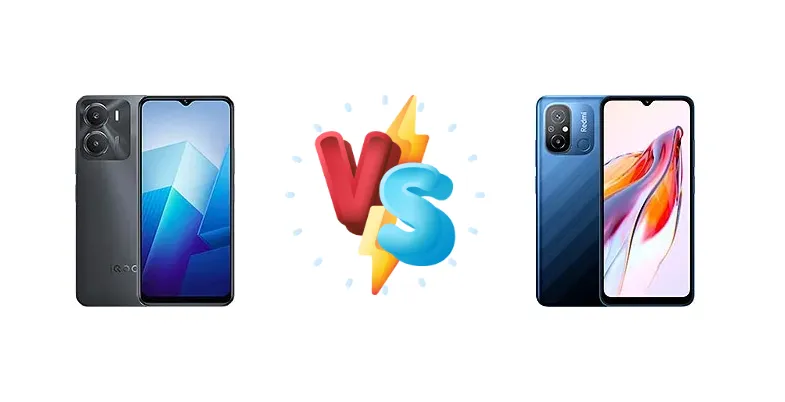
The budget smartphone market is fiercely competitive, offering incredible value for your money. Two contenders vying for your attention are the vivo iQOO Z7i and the Xiaomi Redmi 12C. But which one reigns supreme? Let's dive into a comprehensive comparison to help you decide.
🏆 Quick Verdict
The iQOO Z7i edges out the Redmi 12C thanks to its more powerful chipset, faster charging, and generally smoother performance. While the Redmi 12C offers a compelling price point, the Z7i provides a better overall user experience for a slight premium.
| Network |
|---|
| 2G bands | GSM 850 / 900 / 1800 / 1900 | GSM 850 / 900 / 1800 / 1900 |
| 3G bands | HSDPA 850 / 900 / 2100 | HSDPA 850 / 900 / 2100 |
| 4G bands | 1, 3, 5, 8, 28, 34, 38, 39, 40, 41 | 1, 3, 5, 7, 8, 20, 28, 38, 40, 41 - International |
| 5G bands | 1, 5, 8, 28, 41, 77, 78 SA/NSA | - |
| Speed | HSPA, LTE, 5G | HSPA, LTE |
| Technology | GSM / CDMA / HSPA / CDMA2000 / LTE / 5G | GSM / CDMA / HSPA / EVDO / LTE |
| | CDMA2000 1x | CDMA2000 1xEV-DO |
| Launch |
|---|
| Announced | 2023, March 13 | 2022, December 31 |
| Status | Available. Released 2023, March 20 | Available. Released 2023, January 01 |
| Body |
|---|
| Build | Glass front, plastic frame, plastic back | - |
| Dimensions | 164.1 x 75.6 x 8.2 mm (6.46 x 2.98 x 0.32 in) | 168.8 x 76.4 x 8.8 mm (6.65 x 3.01 x 0.35 in) |
| SIM | Nano-SIM + Nano-SIM | Nano-SIM + Nano-SIM |
| Weight | 186 (6.56 oz) | 192 g (6.77 oz) |
| Display |
|---|
| Resolution | 720 x 1600 pixels, 20:9 ratio (~270 ppi density) | 720 x 1650 pixels (~268 ppi density) |
| Size | 6.51 inches, 102.3 cm2 (~82.5% screen-to-body ratio) | 6.71 inches, 106.5 cm2 (~82.6% screen-to-body ratio) |
| Type | IPS LCD | IPS LCD, 500 nits (typ) |
| Platform |
|---|
| CPU | Octa-core (2x2.2 GHz Cortex-A76 & 6x2.0 GHz Cortex-A55) | Octa-core (2x2.0 GHz Cortex-A75 & 6x1.8 GHz Cortex-A55) |
| Chipset | Mediatek Dimensity 6020 (7 nm) | Mediatek MT6769Z Helio G85 (12 nm) |
| GPU | Mali-G57 MC2 | Mali-G52 MC2 |
| OS | Android 13, OriginOS Ocean | Android 12, MIUI 13 |
| Memory |
|---|
| Card slot | microSDXC (uses shared SIM slot) | microSDXC (dedicated slot) |
| Internal | 128GB 4GB RAM, 128GB 6GB RAM, 128GB 8GB RAM | 32GB 2GB RAM, 32GB 3GB RAM, 32GB 4GB RAM, 64GB 3GB RAM, 64GB 4GB RAM, 128GB 3GB RAM, 128GB 4GB RAM, 128GB 6GB RAM |
| | UFS 2.2 | eMMC 5.1 |
| Main Camera |
|---|
| Dual | 13 MP, f/2.2, (wide), PDAF
2 MP (macro) | 50 MP, (wide), PDAF
0.08 MP (depth) |
| Features | LED flash, HDR, panorama | LED flash, HDR |
| Single | 5 MP, f/1.8, (wide) | 50 MP, f/1.8, (wide), 1/2.76", PDAF
Auxiliary lens |
| Video | 1080p@30fps | 1080p@30fps |
| Selfie camera |
|---|
| Single | 5 MP, f/1.8, (wide) | 5 MP, f/2.2, (wide) |
| Video | Yes | 1080p@30fps |
| Sound |
|---|
| 3.5mm jack | Yes | Yes |
| 35mm jack | Yes | Yes |
| Loudspeaker | Yes | Yes |
| Comms |
|---|
| Bluetooth | 5.1, A2DP, LE, aptX HD | 5.1, A2DP, LE |
| NFC | No | Yes (market/region dependent) |
| Positioning | GPS, GLONASS, GALILEO, BDS, QZSS | GPS, GLONASS, BDS, GALILEO |
| Radio | No | FM radio |
| USB | USB Type-C, OTG | microUSB 2.0 |
| WLAN | Wi-Fi 802.11 a/b/g/n/ac, dual-band | Wi-Fi 802.11 a/b/g/n/ac, dual-band, Wi-Fi Direct |
| Features |
|---|
| Sensors | Fingerprint (side-mounted), accelerometer, proximity, compass | Fingerprint (rear-mounted), accelerometer |
| | - | Virtual proximity sensing |
| Battery |
|---|
| Charging | 15W wired | 10W wired |
| Type | 5000 mAh | Li-Po 5000 mAh |
| Misc |
|---|
| Colors | Black, Blue | Graphite Gray, Ocean Blue, Mint Green, Lavender Purple |
| Models | V2230EA | 22120RN86G, 22120RN86I, 22126RN91Y, 2212ARNC4L |
| Price | About 130 EUR | £ 132.99 / € 107.41 |
| SAR | - | 1.08 W/kg (head) 0.64 W/kg (body) |
| SAR EU | - | 0.98 W/kg (head) 0.99 W/kg (body) |
vivo iQOO Z7i
- More powerful chipset (Dimensity 6020)
Xiaomi Redmi 12C
- Lower price point
- Decent battery life
- Slower performance
- Slow charging (10W)
Display Comparison
Both phones feature large 6.67-inch displays, likely with an HD+ resolution. The iQOO Z7i may offer slightly better color accuracy and brightness due to vivo's display technology, but both are adequate for everyday use. Expect similar viewing experiences.
Camera Comparison
The Redmi 12C typically features a 50MP main camera, while the iQOO Z7i often includes a 50MP main camera with OIS (Optical Image Stabilization). OIS is a crucial advantage for the Z7i, resulting in sharper photos and videos, especially in low-light conditions. Both phones likely have similar ultrawide and macro lenses, but image processing may differ.
Performance
The iQOO Z7i's Dimensity 6020 (7nm) holds a significant advantage over the Redmi 12C's Helio G85 (12nm). The Dimensity 6020's newer architecture and smaller process node translate to better performance in both CPU and GPU-intensive tasks. Expect smoother multitasking, faster app loading, and improved gaming performance on the iQOO Z7i.
Battery Life
Both phones likely pack a 5000mAh battery, offering all-day battery life for moderate users. However, the iQOO Z7i's 15W wired charging is noticeably faster than the Redmi 12C's 10W charging. This means quicker top-ups when you need them.
Buying Guide
The vivo iQOO Z7i is ideal for users who prioritize performance and faster charging. If you're a casual user primarily focused on basic tasks and value the absolute lowest price, the Xiaomi Redmi 12C is a solid choice.
Frequently Asked Questions
❓ Which phone is better for gaming?
The iQOO Z7i is significantly better for gaming due to its more powerful chipset and GPU.
❓ Does the Redmi 12C have 5G?
No, the Redmi 12C does not support 5G connectivity. The iQOO Z7i may or may not have 5G depending on the specific variant.