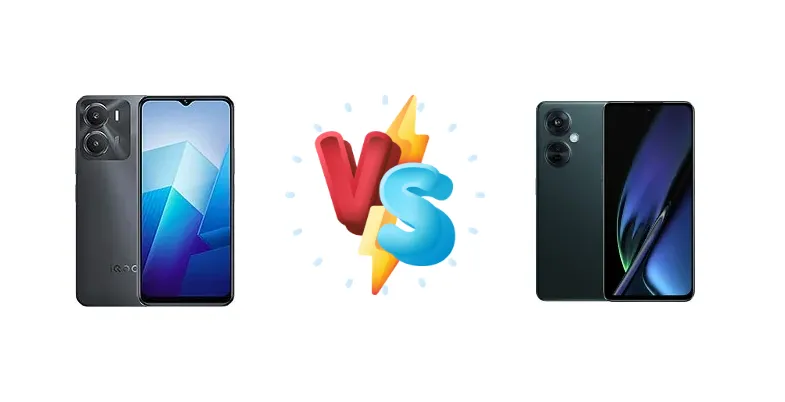
The sub-$200 5G smartphone market is fiercely competitive. The vivo iQOO Z7i and Oppo K11x represent compelling options, but cater to slightly different priorities. The Z7i focuses on a more efficient chipset, while the K11x prioritizes rapid charging speeds. This comparison dissects their key differences to determine which device delivers the best overall experience.
🏆 Quick Verdict
For the average user prioritizing convenience, the Oppo K11x is the better choice. Its 67W charging significantly reduces downtime, a crucial advantage. However, the iQOO Z7i’s Dimensity 6020 offers potentially better sustained performance and efficiency for those who value longer gaming sessions or all-day battery life.
| Network |
|---|
| 2G bands | GSM 850 / 900 / 1800 / 1900 | GSM 850 / 900 / 1800 / 1900 |
| 3G bands | HSDPA 850 / 900 / 2100 | HSDPA 850 / 900 / 1700(AWS) / 2100 |
| 4G bands | 1, 3, 5, 8, 28, 34, 38, 39, 40, 41 | 1, 3, 4, 5, 8, 28, 34, 38, 39, 40, 41 |
| 5G bands | 1, 5, 8, 28, 41, 77, 78 SA/NSA | 1, 5, 8, 28, 41, 77, 78 SA/NSA |
| Speed | HSPA, LTE, 5G | HSPA, LTE, 5G |
| Technology | GSM / CDMA / HSPA / CDMA2000 / LTE / 5G | GSM / HSPA / LTE / 5G |
| | CDMA2000 1x | - |
| Launch |
|---|
| Announced | 2023, March 13 | 2023, May 25 |
| Status | Available. Released 2023, March 20 | Available. Released 2023, May 25 |
| Body |
|---|
| Build | Glass front, plastic frame, plastic back | Glass front, plastic frame, plastic back |
| Dimensions | 164.1 x 75.6 x 8.2 mm (6.46 x 2.98 x 0.32 in) | 165.5 x 76 x 8.3 mm (6.52 x 2.99 x 0.33 in) |
| SIM | Nano-SIM + Nano-SIM | Nano-SIM + Nano-SIM |
| Weight | 186 (6.56 oz) | 195 g (6.88 oz) |
| Display |
|---|
| Protection | - | Corning Gorilla Glass |
| Resolution | 720 x 1600 pixels, 20:9 ratio (~270 ppi density) | 1080 x 2400 pixels, 20:9 ratio (~392 ppi density) |
| Size | 6.51 inches, 102.3 cm2 (~82.5% screen-to-body ratio) | 6.72 inches, 109.0 cm2 (~86.7% screen-to-body ratio) |
| Type | IPS LCD | IPS LCD, 120Hz, 550 nits (typ), 680 nits (peak) |
| Platform |
|---|
| CPU | Octa-core (2x2.2 GHz Cortex-A76 & 6x2.0 GHz Cortex-A55) | Octa-core (2x2.2 GHz Kryo 660 Gold & 6x1.7 GHz Kryo 660 Silver) |
| Chipset | Mediatek Dimensity 6020 (7 nm) | Qualcomm SM6375 Snapdragon 695 5G (6 nm) |
| GPU | Mali-G57 MC2 | Adreno 619 |
| OS | Android 13, OriginOS Ocean | Android 13, ColorOS 13.1 |
| Memory |
|---|
| Card slot | microSDXC (uses shared SIM slot) | microSDXC (uses shared SIM slot) |
| Internal | 128GB 4GB RAM, 128GB 6GB RAM, 128GB 8GB RAM | 128GB 8GB RAM, 256GB 8GB RAM, 256GB 12GB RAM |
| | UFS 2.2 | - |
| Main Camera |
|---|
| Dual | 13 MP, f/2.2, (wide), PDAF
2 MP (macro) | 108 MP, f/1.8, 24mm (wide), 1/1.67", 0.64µm, PDAF
Auxiliary lens |
| Features | LED flash, HDR, panorama | LED flash, HDR, panorama |
| Single | 5 MP, f/1.8, (wide) | - |
| Video | 1080p@30fps | 1080p@30fps |
| Selfie camera |
|---|
| Features | - | HDR, panorama |
| Single | 5 MP, f/1.8, (wide) | 16 MP, f/2.4, (wide), 1.0µm |
| Video | Yes | 1080p@30fps |
| Sound |
|---|
| 3.5mm jack | Yes | - |
| 35mm jack | Yes | Yes |
| Loudspeaker | Yes | Yes, with stereo speakers |
| Comms |
|---|
| Bluetooth | 5.1, A2DP, LE, aptX HD | 5.1, A2DP, LE, aptX HD |
| NFC | No | No |
| Positioning | GPS, GLONASS, GALILEO, BDS, QZSS | GPS, GALILEO, GLONASS, BDS, QZSS |
| Radio | No | No |
| USB | USB Type-C, OTG | USB Type-C 2.0, OTG |
| WLAN | Wi-Fi 802.11 a/b/g/n/ac, dual-band | Wi-Fi 802.11 a/b/g/n/ac, dual-band |
| Features |
|---|
| Sensors | Fingerprint (side-mounted), accelerometer, proximity, compass | Fingerprint (side-mounted), accelerometer, gyro, proximity, compass |
| Battery |
|---|
| Charging | 15W wired | 67W wired, 80% in 33 min |
| Type | 5000 mAh | Li-Po 5000 mAh |
| Misc |
|---|
| Colors | Black, Blue | Jade Black, Pearl Blue |
| Models | V2230EA | - |
| Price | About 130 EUR | About 250 EUR |
vivo iQOO Z7i
- Potentially better CPU performance with Cortex-A76 cores
- More efficient chipset (Dimensity 6020, 7nm)
- May offer longer battery life between charges
- Significantly slower 15W charging
- Limited information on display quality
- Camera performance is unknown
Oppo K11x
- Ultra-fast 67W charging (80% in 33 minutes)
- Modern 6nm Snapdragon 695 chipset
- Potentially better thermal management
- Kryo 660 cores may be slightly less powerful than Cortex-A76
- Limited information on display quality
- Camera performance is unknown
Display Comparison
Neither device boasts a standout display. Given the provided data, a detailed display comparison is limited. Both likely utilize LCD panels common in this price bracket. The absence of refresh rate or resolution data suggests both target the baseline for acceptable viewing experiences. Bezels are likely comparable, and color accuracy will be standard for the segment.
Camera Comparison
Without detailed camera specs, a comprehensive comparison is difficult. Both phones likely feature a primary camera paired with depth or macro sensors. The absence of OIS on either device suggests reliance on software stabilization. Image processing will likely differ, with Oppo traditionally favoring vibrant, saturated colors, while vivo often aims for a more natural look. The quality of the main sensor will be the determining factor, but that information is unavailable.
Performance
The core difference lies in the chipsets. The Oppo K11x’s Qualcomm Snapdragon 695 (6nm) utilizes Kryo 660 cores, offering a slightly different architecture than the iQOO Z7i’s MediaTek Dimensity 6020 (7nm). While both CPUs peak at 2.2 GHz, the Snapdragon 695 benefits from a more modern 6nm process, potentially leading to better power efficiency at similar performance levels. However, the Dimensity 6020’s Cortex-A76 cores are generally more powerful than the Kryo 660 Gold cores, suggesting a slight edge in CPU-intensive tasks. The 6nm process of the Snapdragon 695 may offer better thermal headroom during sustained loads, but the Z7i's architecture could compensate. RAM speed is not specified, but both likely use LPDDR4X to keep costs down.
Battery Life
The Oppo K11x’s 67W charging is a game-changer. Achieving 80% charge in just 33 minutes is a significant advantage over the iQOO Z7i’s slow 15W charging. While battery capacity isn’t specified, the faster charging speed effectively mitigates any potential capacity difference. The iQOO Z7i will require considerably longer to fully charge, impacting usability for power users. The Dimensity 6020’s efficiency could translate to longer battery life *between* charges, but the K11x’s quick top-ups offer a different kind of convenience.
Buying Guide
Buy the vivo iQOO Z7i if you need a phone that balances performance and battery life, and aren't overly concerned with extremely fast charging. It's ideal for users who stream videos, browse the web, and play casual games. Buy the Oppo K11x if you prioritize minimizing charging time above all else. This phone is perfect for users who are constantly on the go and need to quickly top up their battery throughout the day.
Frequently Asked Questions
❓ Will the Snapdragon 695 in the Oppo K11x struggle with demanding games like PUBG or Call of Duty?
The Snapdragon 695 is capable of running PUBG and Call of Duty, but you'll likely need to lower graphics settings to achieve a smooth frame rate. It's not a gaming powerhouse, but it's sufficient for casual gaming. The Dimensity 6020 in the iQOO Z7i might offer slightly better sustained performance due to its core architecture, but both will require compromises.
❓ How much of a difference will the charging speed actually make in daily use with the Oppo K11x?
The 67W charging on the K11x is a significant time saver. Being able to go from near-empty to 80% in just over 30 minutes is incredibly convenient, especially if you often forget to charge overnight or have a busy day. It eliminates 'range anxiety' and allows for quick top-ups whenever you have a spare moment.
❓ Is the lack of information about the cameras a major concern?
Yes, it is. Without knowing the sensor size, aperture, or image processing capabilities, it's impossible to accurately assess the camera performance of either phone. In this price segment, camera quality can vary significantly, so this is a key area where further research is needed before making a decision.