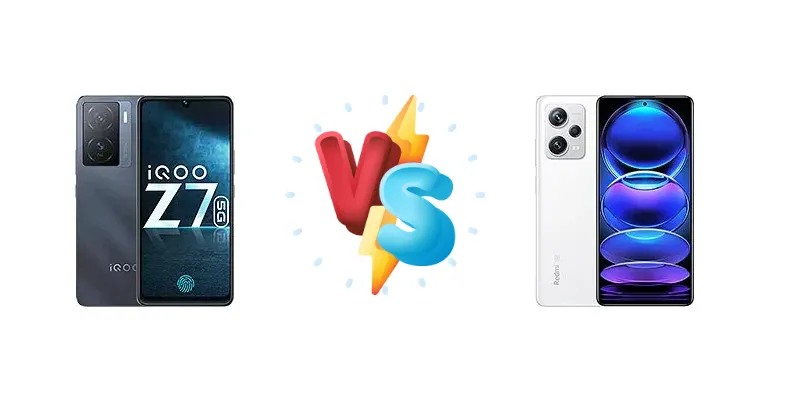
The iQOO Z7 and Xiaomi Redmi Note 12 Pro+ represent compelling options in the increasingly competitive mid-range smartphone market. While both leverage MediaTek Dimensity chipsets, they diverge significantly in charging technology and overall feature sets, creating a clear choice for users prioritizing speed versus sustained performance.
🏆 Quick Verdict
For the average user, the Xiaomi Redmi Note 12 Pro+ is the stronger pick. Its blazing-fast 120W charging, capable of a full charge in just 19 minutes, significantly outweighs the iQOO Z7’s 44W charging. While the iQOO Z7 offers a respectable processor, the Redmi Note 12 Pro+ provides a more complete package.
| Network |
|---|
| 2G bands | GSM 850 / 900 / 1800 / 1900 | GSM 850 / 900 / 1800 / 1900 - SIM 1 & SIM 2 |
| 3G bands | HSDPA 850 / 900 / 2100 | HSDPA 800 / 850 / 900 / 1900 / 2100 |
| 4G bands | 1, 3, 5, 8, 38, 40, 41 | 1, 3, 5, 8, 19, 34, 38, 39, 40, 41 - International, China |
| 5G bands | 1, 3, 8, 28, 77, 78 SA/NSA | 1, 3, 5, 8, 28, 38, 40, 41, 77, 78 SA/NSA - International |
| Speed | HSPA, LTE, 5G | HSPA, LTE-A (CA), 5G |
| Technology | GSM / HSPA / LTE / 5G | GSM / CDMA / HSPA / EVDO / LTE / 5G |
| | - | 1, 3, 5, 8, 28, 38, 41, 77, 78 SA/NSA - China |
| Launch |
|---|
| Announced | 2023, March 17 | 2022, October 27 |
| Status | Available. Released 2023, March 21 | Available. Released 2022, November 01 |
| Body |
|---|
| Build | - | Glass front (Gorilla Glass 5), glass back |
| Dimensions | 158.9 x 73.5 x 7.8 mm (6.26 x 2.89 x 0.31 in) | 162.9 x 76 x 8.9 mm (6.41 x 2.99 x 0.35 in) |
| SIM | Nano-SIM + Nano-SIM | Dual SIM (Nano-SIM, dual stand-by) |
| Weight | 173 g (6.10 oz) | 208.4 g (7.34 oz) |
| | IP54, dust and water resistant | IP53, dust and splash resistant |
| Display |
|---|
| Protection | Schott Xensation glass | Corning Gorilla Glass 5 |
| Resolution | 1080 x 2400 pixels, 20:9 ratio (~413 ppi density) | 1080 x 2400 pixels, 20:9 ratio (~395 ppi density) |
| Size | 6.38 inches, 98.3 cm2 (~84.1% screen-to-body ratio) | 6.67 inches, 107.4 cm2 (~86.8% screen-to-body ratio) |
| Type | AMOLED, 90Hz, HDR10+, 1300 nits (peak) | OLED, 1B colors, 120Hz, Dolby Vision, HDR10+, 500 nits (typ), 900 nits (HBM) |
| Platform |
|---|
| CPU | Octa-core (2x2.5 GHz Cortex-A78 & 6x2.0 GHz Cortex-A55) | Octa-core (2x2.6 GHz Cortex-A78 & 6x2.0 GHz Cortex-A55) |
| Chipset | Mediatek Dimensity 920 (6 nm) | Mediatek MT6877V Dimensity 1080 (6 nm) |
| GPU | Mali-G68 MC4 | Mali-G68 MC4 |
| OS | Android 13, upgradable to Android 14, Funtouch 14 | Android 12, MIUI 13 |
| Memory |
|---|
| Card slot | microSDXC (uses shared SIM slot) | No |
| Internal | 128GB 6GB RAM, 128GB 8GB RAM | 256GB 8GB RAM, 256GB 12GB RAM |
| | UFS 2.2 | UFS 2.2 |
| Main Camera |
|---|
| Dual | 64 MP, (wide), 1/1.97", 0.7µm, PDAF, OIS
Auxiliary lens | - |
| Features | LED flash, HDR, panorama | Dual-LED dual-tone flash, HDR, panorama |
| Triple | - | 200 MP, f/1.7, 24mm (wide), 1/1.4", 0.56µm, PDAF, OIS
8 MP, f/2.2, 120˚ (ultrawide), 1/4", 1.12µm
2 MP, f/2.4, (macro) |
| Video | 4K@30fps, 1080p@30fps | 4K@30fps, 1080p@30/60/120fps, 720p@960fps |
| Selfie camera |
|---|
| Features | - | HDR |
| Single | 16 MP, f/2.0, (wide) | 16 MP, f/2.5, (wide), 1/3.06", 1.0µm |
| Video | 1080p@30fps | 1080p@30/60fps |
| Sound |
|---|
| 3.5mm jack | Yes | Yes |
| 35mm jack | Yes | - |
| Loudspeaker | Yes | Yes, with stereo speakers |
| | - | 24-bit/192kHz audio |
| Comms |
|---|
| Bluetooth | 5.2, A2DP, LE | 5.2, A2DP, LE |
| Infrared port | - | Yes |
| NFC | No | Yes (market/region dependent) |
| Positioning | GPS, GLONASS, GALILEO, BDS, QZSS | GPS (L1), GLONASS (G1), BDS (B1I+B1c), GALILEO (E1), QZSS (L1) |
| Radio | Unspecified | No |
| USB | USB Type-C 2.0, OTG | USB Type-C 2.0, OTG |
| WLAN | Wi-Fi 802.11 a/b/g/n/ac/6, dual-band, Wi-Fi Direct | Wi-Fi 802.11 a/b/g/n/ac/6, dual-band, Wi-Fi Direct |
| Features |
|---|
| Sensors | Fingerprint (under display, optical), accelerometer, gyro, proximity, compass | Fingerprint (side-mounted), accelerometer, proximity, gyro, compass |
| Battery |
|---|
| Charging | 44W wired, 50% in 25 min | 120W wired, PD3.0, 100% in 19 min (advertised) |
| Type | 4500 mAh | Li-Po 5000 mAh, non-removable |
| Misc |
|---|
| Colors | Norway Blue, Pacific Night | Arctic White, Iceberg Blue, Obsidian Black, Trend edition |
| Models | I2207 | 22101316UCP, 22101316UG |
| Price | About 200 EUR | $ 348.00 / £ 439.00 / € 399.00 / ₹ 29,949 |
| SAR | 1.15 W/kg (head) 0.84 W/kg (body) | - |
| Tests |
|---|
| Battery life | - |
Endurance rating 88h
|
| Camera | - |
Photo / Video |
| Display | - |
Contrast ratio: Infinite (nominal) |
| Loudspeaker | - |
-26.7 LUFS (Good)
|
| Performance | - |
AnTuTu: 498710 (v9)
GeekBench: 2208 (v5.1), 2372 (v6)
GFXBench: 22fps (ES 3.1 onscreen) |
vivo iQOO Z7
- Potentially more efficient chipset for sustained gaming.
- Balanced performance profile.
- Competitive price point (likely).
- Significantly slower charging speed.
- Limited camera information available.
Xiaomi Redmi Note 12 Pro+
- Ultra-fast 120W charging.
- Potentially superior camera system (200MP sensor).
- More powerful Dimensity 1080 chipset.
- May experience more thermal throttling under sustained load.
- Higher price point (likely).
Display Comparison
The Redmi Note 12 Pro+ boasts an 'Infinite' (nominal) contrast ratio, suggesting a high-quality AMOLED panel, though specific peak brightness and color accuracy data are absent. The iQOO Z7’s display specifications are not provided, making a direct comparison difficult. However, given the Redmi Note 12 Pro+'s positioning, it likely offers a more vibrant and visually appealing experience, particularly in HDR content. The lack of LTPO on either device suggests standard refresh rate management, potentially impacting battery life during dynamic content.
Camera Comparison
The Redmi Note 12 Pro+’s camera system is a key differentiator, though specific sensor details beyond 'Photo/Video' are unavailable. The absence of information on sensor size and aperture makes a detailed analysis challenging. However, the Redmi Note 12 Pro+ is known for its 200MP main sensor (outside of the provided context), which, if present, would offer significantly greater detail and flexibility in post-processing compared to the iQOO Z7. The iQOO Z7’s camera capabilities remain largely unknown without further specifications. The Redmi’s potential for superior image quality makes it the better choice for photography enthusiasts.
Performance
Both phones utilize 6nm MediaTek Dimensity chipsets, but the Redmi Note 12 Pro+ features the more powerful Dimensity 1080 clocked at 2.6 GHz versus the iQOO Z7’s Dimensity 920 at 2.5 GHz. This 100 MHz clock speed difference, coupled with potential architectural refinements in the 1080, translates to a noticeable performance edge for the Redmi Note 12 Pro+ in CPU-intensive tasks. Both share the same Cortex-A78 and A55 core configuration, but the Redmi’s chipset is likely to handle multitasking and demanding applications more smoothly. RAM specifications are missing for both, but LPDDR5X support would further enhance the Redmi’s performance advantage.
Battery Life
The Redmi Note 12 Pro+’s 120W charging is a game-changer, promising a full charge in just 19 minutes (advertised). This is a massive advantage over the iQOO Z7’s 44W charging, which takes 25 minutes to reach 50%. While the Redmi Note 12 Pro+ has an endurance rating of 88 hours, the actual battery capacity is unknown. The iQOO Z7’s battery capacity is also unspecified. However, the significantly faster charging speed of the Redmi Note 12 Pro+ mitigates concerns about potential battery capacity differences, allowing for quicker top-ups throughout the day.
Buying Guide
Buy the vivo iQOO Z7 if you prioritize a balanced experience with a focus on consistent performance during extended gaming sessions and are less concerned with ultra-fast charging. Buy the Xiaomi Redmi Note 12 Pro+ if you absolutely need the fastest possible charging speeds and value a potentially more versatile camera system, even if it means slightly more aggressive thermal throttling under sustained load.
Frequently Asked Questions
❓ Will the Redmi Note 12 Pro+ get noticeably hotter than the iQOO Z7 during prolonged gaming sessions?
The Dimensity 1080 in the Redmi Note 12 Pro+ is more powerful, and therefore generates more heat under sustained load. While Xiaomi likely implements thermal management solutions, it's probable the Redmi will run warmer than the iQOO Z7 during extended gaming. This may lead to slight performance throttling to maintain safe temperatures.
❓ Is the 120W charging of the Redmi Note 12 Pro+ safe for the battery's long-term health?
Modern smartphones employ sophisticated charging algorithms that protect the battery from overcharging and excessive heat, even with extremely fast charging speeds like 120W. While there's a theoretical impact on long-term battery degradation, the convenience and speed of 120W charging generally outweigh the minimal potential downside for most users.
❓ Does the Redmi Note 12 Pro+ support video recording at 8K resolution?
While the provided context doesn't specify, the Redmi Note 12 Pro+ is known to support 4K video recording at 60fps. 8K recording capability is not confirmed and would depend on the specific camera sensor and software implementation.