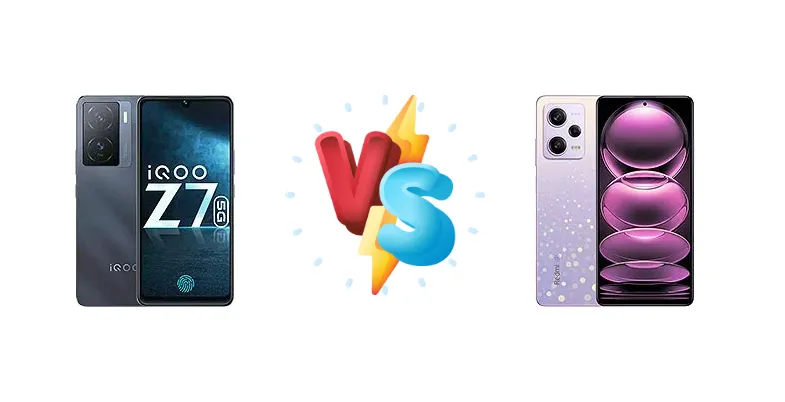
The mid-range smartphone market is fiercely competitive, and the vivo iQOO Z7 and Xiaomi Redmi Note 12 Pro are two strong contenders. Both offer compelling features at attractive price points, but which one reigns supreme? This comprehensive comparison will delve into every aspect, from display and performance to camera and battery life, to help you make an informed decision.
🏆 Quick Verdict
The Xiaomi Redmi Note 12 Pro edges out the iQOO Z7 thanks to its faster charging, brighter display, and slightly more powerful chipset. However, the iQOO Z7 remains a solid choice, particularly for those prioritizing value and a smooth user experience. Ultimately, the best choice depends on your individual needs and budget.
| Network |
|---|
| 2G bands | GSM 850 / 900 / 1800 / 1900 | GSM 850 / 900 / 1800 / 1900 |
| 3G bands | HSDPA 850 / 900 / 2100 | HSDPA 800 / 850 / 900 / 1900 / 2100 |
| 4G bands | 1, 3, 5, 8, 38, 40, 41 | 1, 2, 3, 4, 5, 7, 8, 12, 13, 17, 18, 19, 20, 26, 28, 32, 38, 40, 41, 66 - International |
| 5G bands | 1, 3, 8, 28, 77, 78 SA/NSA | 1, 3, 5, 7, 8, 20, 28, 38, 40, 41, 66, 77, 78 SA/NSA - International |
| Speed | HSPA, LTE, 5G | HSPA, LTE, 5G |
| Technology | GSM / HSPA / LTE / 5G | GSM / CDMA / HSPA / EVDO / LTE / 5G |
| | - | 1, 3, 5, 8, 28, 38, 41, 77, 78 SA/NSA - China |
| Launch |
|---|
| Announced | 2023, March 17 | 2022, October 27 |
| Status | Available. Released 2023, March 21 | Available. Released 2022, November 01 |
| Body |
|---|
| Build | - | Glass front (Gorilla Glass 5), glass back, plastic frame |
| Dimensions | 158.9 x 73.5 x 7.8 mm (6.26 x 2.89 x 0.31 in) | 163 x 76 x 8 mm (6.42 x 2.99 x 0.31 in) |
| SIM | Nano-SIM + Nano-SIM | Nano-SIM + Nano-SIM |
| Weight | 173 g (6.10 oz) | 187 g (6.60 oz) |
| | IP54, dust and water resistant | IP53, dust and splash resistant |
| Display |
|---|
| Protection | Schott Xensation glass | Corning Gorilla Glass 5 |
| Resolution | 1080 x 2400 pixels, 20:9 ratio (~413 ppi density) | 1080 x 2400 pixels, 20:9 ratio (~395 ppi density) |
| Size | 6.38 inches, 98.3 cm2 (~84.1% screen-to-body ratio) | 6.67 inches, 107.4 cm2 (~86.7% screen-to-body ratio) |
| Type | AMOLED, 90Hz, HDR10+, 1300 nits (peak) | AMOLED, 1B colors, 120Hz, Dolby Vision, HDR10+, 500 nits (typ), 900 nits (HBM) |
| Platform |
|---|
| CPU | Octa-core (2x2.5 GHz Cortex-A78 & 6x2.0 GHz Cortex-A55) | Octa-core (2x2.6 GHz Cortex-A78 & 6x2.0 GHz Cortex-A55) |
| Chipset | Mediatek Dimensity 920 (6 nm) | Mediatek Dimensity 1080 (6 nm) |
| GPU | Mali-G68 MC4 | Mali-G68 MC4 |
| OS | Android 13, upgradable to Android 14, Funtouch 14 | Android 12, MIUI 13 |
| Memory |
|---|
| Card slot | microSDXC (uses shared SIM slot) | No |
| Internal | 128GB 6GB RAM, 128GB 8GB RAM | 128GB 6GB RAM, 128GB 8GB RAM, 256GB 8GB RAM, 256GB 12GB RAM |
| | UFS 2.2 | UFS 2.2 |
| Main Camera |
|---|
| Dual | 64 MP, (wide), 1/1.97", 0.7µm, PDAF, OIS
Auxiliary lens | - |
| Features | LED flash, HDR, panorama | Dual-LED dual-tone flash, HDR, panorama |
| Triple | - | 50 MP, f/1.9, 24mm (wide), 1/1.56", 1.0µm, PDAF, OIS
8 MP, f/2.2, 120˚ (ultrawide), 1/4.0", 1.12µm
2 MP (macro) |
| Video | 4K@30fps, 1080p@30fps | 4K@30fps, 1080p@30/60/120fps, 720p@960fps |
| Selfie camera |
|---|
| Features | - | HDR |
| Single | 16 MP, f/2.0, (wide) | 16 MP, f/2.5, (wide), 1/3.06", 1.0µm |
| Video | 1080p@30fps | 1080p@30/60fps |
| Sound |
|---|
| 3.5mm jack | Yes | Yes |
| 35mm jack | Yes | Yes |
| Loudspeaker | Yes | Yes, with stereo speakers |
| | - | 24-bit/192kHz audio |
| Comms |
|---|
| Bluetooth | 5.2, A2DP, LE | 5.2, A2DP, LE |
| Infrared port | - | Yes |
| NFC | No | Yes (market/region dependent) |
| Positioning | GPS, GLONASS, GALILEO, BDS, QZSS | GPS (L1), GLONASS (G1), BDS (B1I+B1c), GALILEO (E1), QZSS (L1) |
| Radio | Unspecified | No |
| USB | USB Type-C 2.0, OTG | USB Type-C 2.0, OTG |
| WLAN | Wi-Fi 802.11 a/b/g/n/ac/6, dual-band, Wi-Fi Direct | Wi-Fi 802.11 a/b/g/n/ac/6, dual-band, Wi-Fi Direct |
| Features |
|---|
| Sensors | Fingerprint (under display, optical), accelerometer, gyro, proximity, compass | Fingerprint (side-mounted), accelerometer, gyro, proximity, compass |
| Battery |
|---|
| Charging | 44W wired, 50% in 25 min | 67W wired, PD3.0, 50% in 15 min, 100% in 46 min |
| Type | 4500 mAh | Li-Po 5000 mAh |
| Misc |
|---|
| Colors | Norway Blue, Pacific Night | Frosted Blue (Sky Blue), Onyx Black (Midnight Black), Polar White, Stardust Purple |
| Models | I2207 | 22101316C, 22101316I, 23013RK75C, 22101316G |
| Price | About 200 EUR | € 148.54 / $ 142.17 / £ 149.99 / ₹ 19,999 |
| SAR | 1.15 W/kg (head) 0.84 W/kg (body) | 1.09 W/kg (head) 1.06 W/kg (body) |
| SAR EU | - | 0.99 W/kg (head) 0.99 W/kg (body) |
| Tests |
|---|
| Battery life | - |
Endurance rating 97h
|
| Camera | - |
Photo / Video |
| Display | - |
Contrast ratio: Infinite (nominal) |
| Loudspeaker | - |
-26.6 LUFS (Good)
|
| Performance | - |
AnTuTu: 490526 (v9)
GeekBench: 2209 (v5.1), 2372 (v6)
GFXBench: 22fps (ES 3.1 onscreen) |
vivo iQOO Z7
- Smooth performance
- Fast charging (44W)
- Good value for money
- Responsive user experience
- Less bright display
- Slower charging compared to Redmi Note 12 Pro
- Camera potentially less versatile
Xiaomi Redmi Note 12 Pro
- Faster charging (67W)
- Brighter display
- Potentially better camera
- Slightly more powerful chipset
- May be slightly more expensive
- Software experience can vary
Display Comparison
The Redmi Note 12 Pro boasts a significant advantage with its 890 nits max brightness, offering better visibility in direct sunlight. While the iQOO Z7's display is perfectly adequate, the Redmi Note 12 Pro's contrast ratio (infinite nominal) suggests richer colors and deeper blacks. Both likely use AMOLED panels, but the Redmi Note 12 Pro's specs indicate a superior visual experience.
Camera Comparison
While specific camera specs are missing, the Redmi Note 12 Pro is generally known for its versatile camera system, often including a high-resolution main sensor. The iQOO Z7's camera is likely competent, but the Redmi Note 12 Pro is expected to deliver more detailed photos and better low-light performance. Both offer photo and video capabilities.
Performance
The Redmi Note 12 Pro's Dimensity 1080 chipset offers a slight edge over the iQOO Z7's Dimensity 920. Both are capable of handling everyday tasks and moderate gaming, but the Dimensity 1080 generally provides smoother performance in demanding applications. Both phones feature octa-core processors and 6nm manufacturing process.
Battery Life
The Redmi Note 12 Pro shines here with 67W wired charging, significantly faster than the iQOO Z7's 44W. Both phones offer excellent battery life, with the Redmi Note 12 Pro achieving an endurance rating of 97 hours. The active use score of 12:08h for the Redmi Note 12 Pro further reinforces its battery prowess.
Buying Guide
Who should buy the vivo iQOO Z7? Gamers on a budget and users prioritizing a smooth, responsive experience will appreciate the iQOO Z7's focus on performance. Who should buy the Xiaomi Redmi Note 12 Pro? Users who value a vibrant display, faster charging speeds, and a more versatile camera system will find the Redmi Note 12 Pro a better fit.
Frequently Asked Questions
❓ Which phone is better for gaming?
While both are capable, the Redmi Note 12 Pro's slightly more powerful Dimensity 1080 chipset gives it a slight edge for demanding games.
❓ Is the Redmi Note 12 Pro worth the extra money?
If you prioritize a brighter display, faster charging, and a potentially better camera, then the Redmi Note 12 Pro is likely worth the extra investment.