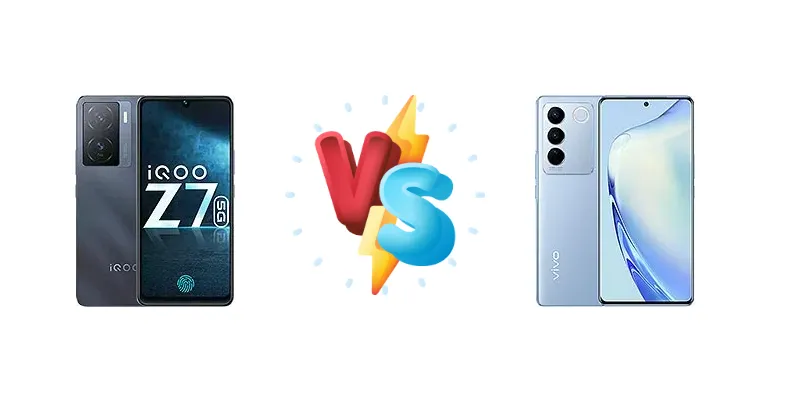
Choosing a new smartphone can be overwhelming, especially with so many options from vivo. The iQOO Z7 and V27 are both compelling choices, but cater to slightly different users. This comprehensive comparison will help you decide which phone best fits your lifestyle and budget.
🏆 Quick Verdict
The vivo V27 emerges as the overall winner thanks to its superior chipset, brighter display, and faster charging. While the iQOO Z7 offers good value, the V27's enhanced performance and features justify its slightly higher price point for most users.
| Network |
|---|
| 2G bands | GSM 850 / 900 / 1800 / 1900 | GSM 850 / 900 / 1800 / 1900 |
| 3G bands | HSDPA 850 / 900 / 2100 | HSDPA 850 / 900 / 1700(AWS) / 1900 / 2100 - International |
| 4G bands | 1, 3, 5, 8, 38, 40, 41 | 1, 2, 3, 4, 5, 7, 8, 18, 19, 20, 26, 28, 38, 39, 40, 41 - International |
| 5G bands | 1, 3, 8, 28, 77, 78 SA/NSA | 1, 3, 5, 7, 8, 20, 28, 38, 40, 41, 77, 78 SA/NSA - International |
| Speed | HSPA, LTE, 5G | HSPA, LTE, 5G |
| Technology | GSM / HSPA / LTE / 5G | GSM / HSPA / LTE / 5G |
| | - | 1, 3, 5, 8, 28, 78 SA/NSA - Asia |
| Launch |
|---|
| Announced | 2023, March 17 | 2023, March 01 |
| Status | Available. Released 2023, March 21 | Available. Released 2023, March 01 |
| Body |
|---|
| Build | - | Glass front, glass back |
| Dimensions | 158.9 x 73.5 x 7.8 mm (6.26 x 2.89 x 0.31 in) | 164.1 x 74.8 x 7.4 mm (6.46 x 2.94 x 0.29 in) |
| SIM | Nano-SIM + Nano-SIM | Nano-SIM + Nano-SIM |
| Weight | 173 g (6.10 oz) | 180 g (6.35 oz) |
| | IP54, dust and water resistant | Color changing back panel color |
| Display |
|---|
| Protection | Schott Xensation glass | - |
| Resolution | 1080 x 2400 pixels, 20:9 ratio (~413 ppi density) | 1080 x 2400 pixels, 20:9 ratio (~388 ppi density) |
| Size | 6.38 inches, 98.3 cm2 (~84.1% screen-to-body ratio) | 6.78 inches, 111.0 cm2 (~90.4% screen-to-body ratio) |
| Type | AMOLED, 90Hz, HDR10+, 1300 nits (peak) | AMOLED, 1B colors, 120Hz, HDR10+ |
| Platform |
|---|
| CPU | Octa-core (2x2.5 GHz Cortex-A78 & 6x2.0 GHz Cortex-A55) | Octa-core (2x2.8 GHz Cortex-A715 & 6x Cortex-A510) |
| Chipset | Mediatek Dimensity 920 (6 nm) | Mediatek Dimensity 7200 (4 nm) |
| GPU | Mali-G68 MC4 | Mali-G610 MC4 |
| OS | Android 13, upgradable to Android 14, Funtouch 14 | Android 13, Funtouch 13 |
| Memory |
|---|
| Card slot | microSDXC (uses shared SIM slot) | No |
| Internal | 128GB 6GB RAM, 128GB 8GB RAM | 128GB 8GB RAM, 256GB 8GB RAM, 256GB 12GB RAM |
| | UFS 2.2 | - |
| Main Camera |
|---|
| Dual | 64 MP, (wide), 1/1.97", 0.7µm, PDAF, OIS
Auxiliary lens | - |
| Features | LED flash, HDR, panorama | Ring-LED flash, panorama, HDR |
| Single | - | 50 MP, f/2.5, (wide), AF |
| Triple | - | 50 MP, f/1.9, (wide), 1/1.56", 1.0µm, PDAF, OIS
8 MP, f/2.2, 16mm, 120˚ (ultrawide), 1/4.0", 1.12µm
2 MP (macro) |
| Video | 4K@30fps, 1080p@30fps | 4K@30/60fps, 1080p@30fps, gyro-EIS |
| Selfie camera |
|---|
| Features | - | Dual-LED flash, HDR |
| Single | 16 MP, f/2.0, (wide) | 50 MP, f/2.5, (wide), AF |
| Video | 1080p@30fps | 4K@30/60fps, 1080p@30fps, gyro-EIS |
| Sound |
|---|
| 3.5mm jack | Yes | No |
| 35mm jack | Yes | No |
| Loudspeaker | Yes | Yes |
| | - | 24-bit/192kHz audio |
| Comms |
|---|
| Bluetooth | 5.2, A2DP, LE | 5.3, A2DP, LE |
| NFC | No | Yes |
| Positioning | GPS, GLONASS, GALILEO, BDS, QZSS | GPS, GLONASS, GALILEO, BDS, QZSS, NavIC |
| Radio | Unspecified | No |
| USB | USB Type-C 2.0, OTG | USB Type-C 2.0, OTG |
| WLAN | Wi-Fi 802.11 a/b/g/n/ac/6, dual-band, Wi-Fi Direct | Wi-Fi 802.11 a/b/g/n/ac, dual-band, Wi-Fi Direct |
| Features |
|---|
| Sensors | Fingerprint (under display, optical), accelerometer, gyro, proximity, compass | Fingerprint (under display, optical), accelerometer, gyro, proximity, compass |
| Battery |
|---|
| Charging | 44W wired, 50% in 25 min | 66W wired, 50% in 19 min |
| Type | 4500 mAh | 4600 mAh |
| Misc |
|---|
| Colors | Norway Blue, Pacific Night | Magic Blue, Noble Black, Emerald Green, Flowing Gold |
| Models | I2207 | V2231, V2246 |
| Price | About 200 EUR | About 380 EUR |
| SAR | 1.15 W/kg (head) 0.84 W/kg (body) | - |
| Tests |
|---|
| Battery life | - |
Endurance rating 134h
|
| Camera | - |
Photo / Video |
| Display | - |
Contrast ratio: Infinite (nominal) |
| Loudspeaker | - |
-28.2 LUFS (Average)
|
| Performance | - |
AnTuTu: 613641 (v9)
GeekBench: 2400 (v5.1), 2689 (v6)
GFXBench: 34fps (ES 3.1 onscreen) |
vivo iQOO Z7
- Excellent value for money
- Smooth everyday performance
- Decent battery life
- Fast charging (44W)
- Less powerful chipset than V27
- Dimmer display
- Potentially less impressive camera
vivo V27
- Superior chipset (Dimensity 7200)
- Brighter and more vibrant display
- Faster charging (66W)
- Likely better camera performance
- Premium design and build quality
- Higher price point
- Battery life is comparable, not significantly better
Display Comparison
The vivo V27 boasts a significantly brighter display, reaching 1055 nits peak brightness, offering excellent visibility even in direct sunlight. Its 'infinite' contrast ratio (though nominal) suggests deep blacks and vibrant colors. The iQOO Z7's display is respectable but lacks the V27's punch and outdoor usability. The V27 likely uses AMOLED technology, while the Z7 probably uses an LCD.
Camera Comparison
While both phones offer 'Photo/Video' capabilities, the V27 is expected to have a more advanced camera system. The Dimensity 7200 often pairs with better image processing capabilities. The iQOO Z7's camera is adequate for everyday shots, but the V27 should deliver superior image quality, especially in low light. Specific camera specs (megapixels, sensor size) are needed for a more precise comparison.
Performance
The vivo V27's Dimensity 7200 chipset (4nm) provides a noticeable performance advantage over the iQOO Z7's Dimensity 920 (6nm). Expect smoother multitasking, faster app loading times, and better gaming performance on the V27. The V27's newer CPU architecture (Cortex-A715) also contributes to improved efficiency.
Battery Life
Both phones offer impressive battery life with an endurance rating of 134 hours. However, the vivo V27's 66W charging is faster than the iQOO Z7's 44W, allowing it to reach 50% charge in just 19 minutes compared to 25 minutes. This faster charging can be a significant convenience.
Buying Guide
The vivo iQOO Z7 is ideal for budget-conscious gamers and users prioritizing a smooth, everyday experience. The vivo V27 is perfect for photography enthusiasts, those who value a vibrant display, and users who want a more premium feel and faster charging.
Frequently Asked Questions
❓ Is the iQOO Z7 good for gaming?
The iQOO Z7 is decent for casual gaming, but the V27's more powerful chipset will provide a smoother experience for demanding games.
❓ Which phone has better camera quality?
Based on the chipset and expected features, the vivo V27 is likely to have better camera quality, especially in low light conditions. However, a detailed camera comparison would require testing both devices.