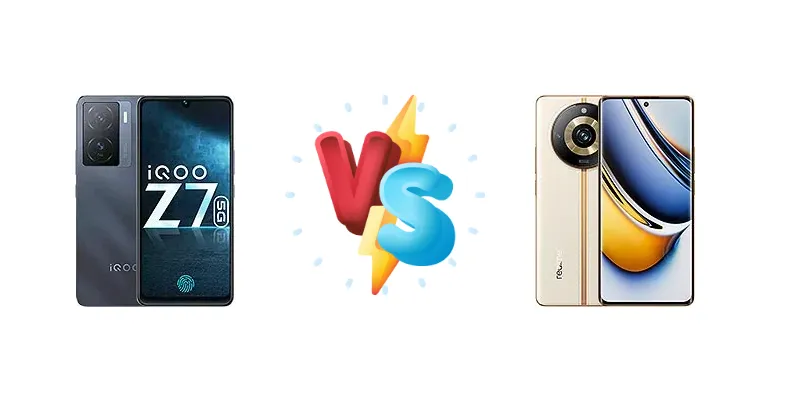
The iQOO Z7 and Realme 11 Pro+ represent compelling options in the increasingly competitive mid-range smartphone market. The iQOO Z7 focuses on delivering solid performance at a competitive price, while the Realme 11 Pro+ aims to elevate the experience with faster charging and a brighter display. This comparison dissects their key differences to determine which device best suits your needs.
🏆 Quick Verdict
For the average user prioritizing rapid replenishment, the Realme 11 Pro+ is the clear winner thanks to its 100W charging. However, the iQOO Z7 offers a strong performance profile and represents excellent value for those less concerned with charging speed.
| Network |
|---|
| 2G bands | GSM 850 / 900 / 1800 / 1900 | GSM 850 / 900 / 1800 / 1900 |
| 3G bands | HSDPA 850 / 900 / 2100 | HSDPA 850 / 900 / 2100 |
| 4G bands | 1, 3, 5, 8, 38, 40, 41 | 1, 3, 5, 8, 28, 38, 40, 41 - India |
| 5G bands | 1, 3, 8, 28, 77, 78 SA/NSA | 1, 3, 5, 8, 28, 40, 41, 77, 78 SA/NSA - International |
| Speed | HSPA, LTE, 5G | HSPA, LTE, 5G |
| Technology | GSM / HSPA / LTE / 5G | GSM / CDMA / HSPA / CDMA2000 / LTE / 5G |
| | - | CDMA2000 1x |
| Launch |
|---|
| Announced | 2023, March 17 | 2023, May 10 |
| Status | Available. Released 2023, March 21 | Available. Released 2023, May 15 |
| Body |
|---|
| Build | - | Glass front, leather or plastic back, plastic frame |
| Dimensions | 158.9 x 73.5 x 7.8 mm (6.26 x 2.89 x 0.31 in) | 161.6 x 73.9 x 8.2 mm or 8.7 mm |
| SIM | Nano-SIM + Nano-SIM | Nano-SIM + Nano-SIM |
| Weight | 173 g (6.10 oz) | 183 g or 189 g (6.46 oz) |
| | IP54, dust and water resistant | - |
| Display |
|---|
| Protection | Schott Xensation glass | - |
| Resolution | 1080 x 2400 pixels, 20:9 ratio (~413 ppi density) | 1080 x 2412 pixels, 20:9 ratio (~394 ppi density) |
| Size | 6.38 inches, 98.3 cm2 (~84.1% screen-to-body ratio) | 6.7 inches, 108.0 cm2 (~90.5% screen-to-body ratio) |
| Type | AMOLED, 90Hz, HDR10+, 1300 nits (peak) | AMOLED, 1B colors, HDR10+, 120Hz, 950 nits (peak) |
| Platform |
|---|
| CPU | Octa-core (2x2.5 GHz Cortex-A78 & 6x2.0 GHz Cortex-A55) | Octa-core (2x2.6 GHz Cortex-A78 & 6x2.0 GHz Cortex-A55) |
| Chipset | Mediatek Dimensity 920 (6 nm) | Mediatek Dimensity 7050 (6 nm) |
| GPU | Mali-G68 MC4 | Mali-G68 MC4 |
| OS | Android 13, upgradable to Android 14, Funtouch 14 | Android 13, up to 2 major Android upgrades, Realme UI 5.0 |
| Memory |
|---|
| Card slot | microSDXC (uses shared SIM slot) | No |
| Internal | 128GB 6GB RAM, 128GB 8GB RAM | 256GB 8GB RAM, 256GB 12GB RAM, 512GB 12GB RAM, 1TB 12GB RAM |
| | UFS 2.2 | - |
| Main Camera |
|---|
| Dual | 64 MP, (wide), 1/1.97", 0.7µm, PDAF, OIS
Auxiliary lens | - |
| Features | LED flash, HDR, panorama | LED flash, HDR, panorama |
| Triple | - | 200 MP, f/1.7, 23mm (wide), 1/1.4", 0.56µm, PDAF, OIS
8 MP, f/2.2, 16mm, 112˚ (ultrawide)
2 MP (macro) |
| Video | 4K@30fps, 1080p@30fps | 4K@30fps, 1080p@30/60/120/480fps, 720p@960fps, gyro-EIS |
| Selfie camera |
|---|
| Features | - | Panorama |
| Single | 16 MP, f/2.0, (wide) | 32 MP, f/2.5, 22mm (wide) |
| Video | 1080p@30fps | 1080p@30fps |
| Sound |
|---|
| 3.5mm jack | Yes | No |
| 35mm jack | Yes | No |
| Loudspeaker | Yes | Yes, with stereo speakers |
| | - | 24-bit/192kHz audio |
| Comms |
|---|
| Bluetooth | 5.2, A2DP, LE | 5.2, A2DP, LE, aptX HD |
| NFC | No | Yes |
| Positioning | GPS, GLONASS, GALILEO, BDS, QZSS | GPS, GLONASS, GALILEO, BDS, QZSS, NavIC |
| Radio | Unspecified | No |
| USB | USB Type-C 2.0, OTG | USB Type-C 2.0 |
| WLAN | Wi-Fi 802.11 a/b/g/n/ac/6, dual-band, Wi-Fi Direct | Wi-Fi 802.11 a/b/g/n/ac/6, dual-band |
| Features |
|---|
| Sensors | Fingerprint (under display, optical), accelerometer, gyro, proximity, compass | Fingerprint (under display, optical), accelerometer, gyro, proximity, compass |
| Battery |
|---|
| Charging | 44W wired, 50% in 25 min | 100W wired |
| Type | 4500 mAh | 5000 mAh |
| Misc |
|---|
| Colors | Norway Blue, Pacific Night | Astral Black, Sunrise Beige, Oasis Green |
| Models | I2207 | RMX3740, RMX3741 |
| Price | About 200 EUR | € 399.90 / ₹ 27,990 |
| SAR | 1.15 W/kg (head) 0.84 W/kg (body) | - |
vivo iQOO Z7
- Competitive price point
- Solid performance from Dimensity 920
- Likely good value for money
- Slower 44W charging
- Display likely less bright than Realme 11 Pro+
- Camera specifications unknown
Realme 11 Pro+
- Ultra-fast 100W charging
- Brighter 793 nit display
- Potentially more advanced camera system
- Higher price than iQOO Z7
- Dimensity 7050 performance gain over 920 is marginal
- Battery endurance rating doesn't guarantee real-world performance
Display Comparison
The Realme 11 Pro+ boasts a significantly brighter display, reaching a measured 793 nits. While the iQOO Z7’s display specifications are not provided, this brightness advantage benefits Realme users in direct sunlight. The lack of LTPO technology in either device suggests both will rely on adaptive refresh rate switching to conserve battery, but the Realme’s higher peak brightness is a tangible advantage for outdoor use. Bezels are likely comparable given the market segment, and color accuracy will depend on software calibration, a detail not specified in the provided data.
Camera Comparison
The provided data lacks detailed camera specifications beyond the mention of 'Photo / Video' capabilities for the Realme 11 Pro+. Therefore, a direct comparison is limited. However, Realme often emphasizes camera features in its Pro+ line, suggesting a potentially more advanced camera system than the iQOO Z7. The absence of sensor size or aperture information makes it impossible to assess low-light performance or depth of field capabilities. It’s safe to assume both phones will include standard features like HDR and portrait modes, but the Realme 11 Pro+ likely offers more sophisticated image processing algorithms.
Performance
Both devices utilize Mediatek Dimensity chips fabricated on a 6nm process, indicating similar efficiency. However, the Realme 11 Pro+’s Dimensity 7050 has a slightly higher clocked Cortex-A78 core (2.6 GHz vs 2.5 GHz on the iQOO Z7’s Dimensity 920). This marginal clock speed increase, combined with potential optimizations in the 7050, *may* translate to a small performance edge in CPU-intensive tasks. Both phones share the same Cortex-A55 efficiency core configuration. The impact of RAM speed (LPDDR5x is likely on both) is minimal in most daily tasks, but thermal management will be crucial. Without thermal testing data, it’s difficult to predict which device will sustain peak performance for longer periods.
Battery Life
The Realme 11 Pro+’s 100W charging is its standout feature, allowing for significantly faster replenishment compared to the iQOO Z7’s 44W charging. The Realme claims a 0-100% charge in a fraction of the time. While the iQOO Z7’s battery capacity isn’t specified, the Realme 11 Pro+ had an endurance rating of 112 hours, suggesting a reasonably sized battery. The faster charging of the Realme 11 Pro+ effectively mitigates any potential disadvantage from a slightly smaller battery capacity, offering more convenience for users who frequently need to top up their devices.
Buying Guide
Buy the vivo iQOO Z7 if you need a balanced smartphone experience with reliable performance for everyday tasks and light gaming, and value affordability. Buy the Realme 11 Pro+ if you prioritize incredibly fast charging, a brighter display for outdoor visibility, and are willing to spend a bit more for these premium features.
Frequently Asked Questions
❓ Does the Dimensity 7050 in the Realme 11 Pro+ get noticeably hotter than the Dimensity 920 during extended gaming sessions?
Without dedicated thermal testing, it's difficult to say definitively. However, the slightly higher clock speed of the 7050 *could* lead to increased heat generation under sustained load. Both chips are 6nm, so the difference is likely to be minimal, but thermal management implementation by Realme will be key.
❓ Is the 100W charging on the Realme 11 Pro+ compatible with all USB-PD chargers, or does it require a specific Realme charger?
While the Realme 11 Pro+ supports USB-PD, achieving the full 100W charging speed requires the included Realme charger or a compatible charger that specifically supports SuperVOOC/Dart charging protocols. Using a standard USB-PD charger will likely result in slower charging speeds.
❓ How does the iQOO Z7's software experience compare to Realme UI on the 11 Pro+?
iQOO's Funtouch OS is generally considered to be lighter and closer to stock Android than Realme UI, which includes more customization options and pre-installed apps. Preference here is subjective; some users prefer the cleaner experience of Funtouch OS, while others appreciate the features of Realme UI.