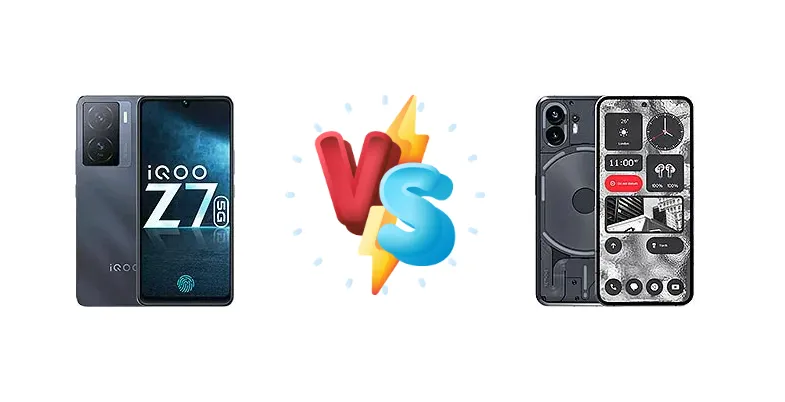
The Nothing Phone (2) arrives as a design-forward contender aiming to disrupt the mid-range, while the vivo iQOO Z7 focuses on delivering strong performance at a competitive price. This comparison dissects their key differences, from chipset architecture to battery endurance, to help you determine which device best suits your needs.
🏆 Quick Verdict
For users prioritizing raw performance and a unique software experience, the Nothing Phone (2) is the clear winner. Its Snapdragon 8+ Gen 1 chipset significantly outperforms the iQOO Z7’s Dimensity 920. However, the iQOO Z7 offers a compelling value proposition for budget-conscious users who prioritize speed and don't need wireless charging.
| Network |
|---|
| 2G bands | GSM 850 / 900 / 1800 / 1900 | GSM 850 / 900 / 1800 / 1900 |
| 3G bands | HSDPA 850 / 900 / 2100 | HSDPA 800 / 850 / 900 / 1700(AWS) / 1900 / 2100 |
| 4G bands | 1, 3, 5, 8, 38, 40, 41 | 1, 2, 3, 4, 5, 7, 8, 12, 17, 18, 19, 20, 25, 26, 28, 30, 32, 34, 38, 39, 40, 41, 42, 48, 66, 71 |
| 5G bands | 1, 3, 8, 28, 77, 78 SA/NSA | 1, 2, 3, 5, 7, 8, 12, 20, 25, 28, 30, 38, 40, 41, 66, 71, 75, 77, 78 SA/NSA |
| Speed | HSPA, LTE, 5G | HSPA, LTE, 5G |
| Technology | GSM / HSPA / LTE / 5G | GSM / HSPA / LTE / 5G |
| Launch |
|---|
| Announced | 2023, March 17 | 2023, July 11 |
| Status | Available. Released 2023, March 21 | Available. Released 2023, July 17 |
| Body |
|---|
| Build | - | Glass front (Gorilla Glass 5), glass back (Gorilla Glass 5), aluminum frame |
| Dimensions | 158.9 x 73.5 x 7.8 mm (6.26 x 2.89 x 0.31 in) | 162.1 x 76.4 x 8.6 mm (6.38 x 3.01 x 0.34 in) |
| SIM | Nano-SIM + Nano-SIM | Nano-SIM + Nano-SIM |
| Weight | 173 g (6.10 oz) | 201.2 g (7.09 oz) |
| | IP54, dust and water resistant | - |
| Display |
|---|
| Protection | Schott Xensation glass | Corning Gorilla Glass 5 |
| Resolution | 1080 x 2400 pixels, 20:9 ratio (~413 ppi density) | 1080 x 2412 pixels, 20:9 ratio (~394 ppi density) |
| Size | 6.38 inches, 98.3 cm2 (~84.1% screen-to-body ratio) | 6.7 inches, 108.0 cm2 (~87.2% screen-to-body ratio) |
| Type | AMOLED, 90Hz, HDR10+, 1300 nits (peak) | LTPO OLED, 1B colors, 120Hz, 1920Hz PWM, HDR10+, 1600 nits (HBM), 1600 nits (peak) |
| Platform |
|---|
| CPU | Octa-core (2x2.5 GHz Cortex-A78 & 6x2.0 GHz Cortex-A55) | Octa-core (1x3.0 GHz Cortex-X2 & 3x2.5 GHz Cortex-A710 & 4x1.80 GHz Cortex-A510) |
| Chipset | Mediatek Dimensity 920 (6 nm) | Qualcomm SM8475 Snapdragon 8+ Gen 1 (4 nm) |
| GPU | Mali-G68 MC4 | Adreno 730 |
| OS | Android 13, upgradable to Android 14, Funtouch 14 | Android 13, upgradable to Android 15, up to 3 major Android upgrades, Nothing OS 3.0 |
| Memory |
|---|
| Card slot | microSDXC (uses shared SIM slot) | No |
| Internal | 128GB 6GB RAM, 128GB 8GB RAM | 128GB 8GB RAM, 256GB 12GB RAM, 512GB 12GB RAM |
| | UFS 2.2 | - |
| Main Camera |
|---|
| Dual | 64 MP, (wide), 1/1.97", 0.7µm, PDAF, OIS
Auxiliary lens | 50 MP, f/1.9, 24mm (wide), 1/1.56", 1.0µm, PDAF, OIS
50 MP, f/2.2, 114˚ (ultrawide), 1/2.76", 0.64µm, AF |
| Features | LED flash, HDR, panorama | LED flash, panorama, HDR |
| Video | 4K@30fps, 1080p@30fps | 4K@30/60fps, 1080p@30/60fps, gyro-EIS, live HDR, OIS |
| Selfie camera |
|---|
| Features | - | HDR |
| Single | 16 MP, f/2.0, (wide) | 32 MP, f/2.5, (wide), 1/2.74", 0.8µm |
| Video | 1080p@30fps | 1080p@30fps |
| Sound |
|---|
| 3.5mm jack | Yes | - |
| 35mm jack | Yes | No |
| Loudspeaker | Yes | Yes, with stereo speakers |
| Comms |
|---|
| Bluetooth | 5.2, A2DP, LE | 5.3, A2DP, LE, aptX HD, aptX Adaptive |
| NFC | No | Yes |
| Positioning | GPS, GLONASS, GALILEO, BDS, QZSS | GPS (L1+L5), GLONASS (L1), BDS (B1I+B1c), GALILEO (E1), QZSS (L1), NavIC |
| Radio | Unspecified | No |
| USB | USB Type-C 2.0, OTG | USB Type-C 2.0, OTG |
| WLAN | Wi-Fi 802.11 a/b/g/n/ac/6, dual-band, Wi-Fi Direct | Wi-Fi 802.11 a/b/g/n/ac/6, dual-band, Wi-Fi Direct |
| Features |
|---|
| Sensors | Fingerprint (under display, optical), accelerometer, gyro, proximity, compass | Fingerprint (under display, optical), accelerometer, proximity, gyro, compass |
| Battery |
|---|
| Charging | 44W wired, 50% in 25 min | 45W wired, PD3.0, PPS, QC4, 100% in 55 min
15W wireless, 100% in 130 min
5W reverse wireless |
| Type | 4500 mAh | Li-Ion 4700 mAh |
| Misc |
|---|
| Colors | Norway Blue, Pacific Night | White, Dark Gray |
| Models | I2207 | A065 |
| Price | About 200 EUR | $ 379.99 / £ 370.00 |
| SAR | 1.15 W/kg (head) 0.84 W/kg (body) | - |
vivo iQOO Z7
- Faster 44W wired charging
- Competitive price point
- Capable Dimensity 920 chipset for everyday tasks
- Less powerful chipset compared to Snapdragon 8+ Gen 1
- No wireless charging support
- Limited camera details
Nothing Phone (2)
- Significantly more powerful Snapdragon 8+ Gen 1 chipset
- Wireless and reverse wireless charging
- Brighter display with potentially better color accuracy
- Slightly slower wired charging (55 minutes to full)
- Higher price point
- Glyph Interface may not appeal to all users
Display Comparison
The Nothing Phone (2) boasts a brighter display, reaching a measured 998 nits, which translates to better visibility outdoors compared to the iQOO Z7 (brightness unspecified). While both likely utilize OLED panels, the Nothing Phone (2)'s superior brightness and potentially higher color accuracy (based on Nothing's brand focus) provide a more immersive viewing experience. The iQOO Z7’s display specs are less detailed, suggesting a more standard offering.
Camera Comparison
Detailed camera specs are limited for both devices. However, the Nothing Phone (2) is marketed with a focus on photo and video quality, suggesting a more sophisticated image processing pipeline and potentially larger sensor sizes. The iQOO Z7’s camera capabilities are less emphasized, implying a more standard mid-range experience. Without specific sensor details, it’s difficult to make a definitive judgment, but the Nothing Phone (2)'s positioning suggests a more versatile and capable camera system.
Performance
The core difference lies in the chipsets. The Nothing Phone (2) is powered by the Qualcomm Snapdragon 8+ Gen 1 (4nm), featuring a Cortex-X2 prime core clocked at 3.0 GHz. This architecture, built on a smaller 4nm process, offers superior performance and efficiency compared to the iQOO Z7’s Mediatek Dimensity 920 (6nm). The Dimensity 920, while capable with its 2x2.5 GHz Cortex-A78 cores, will struggle to match the Snapdragon’s sustained performance, particularly in demanding games. The Snapdragon 8+ Gen 1’s Adreno 730 GPU also provides a substantial graphics advantage. The iQOO Z7 may feel snappier for everyday tasks, but the Nothing Phone (2) will excel in resource-intensive applications.
Battery Life
The Nothing Phone (2) demonstrates impressive battery life, achieving 14:21 hours of active use and an endurance rating of 103 hours. While the iQOO Z7’s battery capacity is not specified, its 44W wired charging (50% in 25 minutes) is competitive with the Nothing Phone (2)’s 45W wired charging (100% in 55 minutes). However, the Nothing Phone (2) adds the convenience of 15W wireless charging and 5W reverse wireless charging, features absent on the iQOO Z7. The Nothing Phone (2)'s superior endurance rating suggests better power efficiency, likely stemming from the more advanced Snapdragon chipset.
Buying Guide
Buy the vivo iQOO Z7 if you need a fast-charging, capable daily driver that won’t break the bank and prioritize quick gaming sessions over sustained performance. Buy the Nothing Phone (2) if you prefer a premium design, a more refined software experience, and demand significantly higher processing power for demanding tasks like video editing or graphically intensive games, and value wireless charging.
Frequently Asked Questions
❓ Does the Snapdragon 8+ Gen 1 in the Nothing Phone (2) suffer from overheating during prolonged gaming sessions?
While the Snapdragon 8+ Gen 1 was known to run warm, Nothing has implemented a sophisticated cooling system in the Phone (2) to mitigate thermal throttling. Reviews indicate that the phone maintains stable performance for extended gaming periods, though some warmth is expected. The 4nm process also contributes to improved thermal efficiency compared to older Snapdragon generations.
❓ How does the Dimensity 920 in the iQOO Z7 handle graphically demanding games like Genshin Impact or Call of Duty Mobile?
The Dimensity 920 can run these games, but you'll likely need to lower graphics settings to achieve a consistently smooth frame rate. It's capable of providing a playable experience, but won't match the sustained performance and higher graphical fidelity offered by the Snapdragon 8+ Gen 1 in the Nothing Phone (2).
❓ Is the 44W charging on the iQOO Z7 significantly slower than the 45W charging on the Nothing Phone (2)?
The difference is relatively minor. The iQOO Z7 reaches 50% charge in 25 minutes, while the Nothing Phone (2) takes 55 minutes for a full charge. For most users, the convenience of wireless charging on the Nothing Phone (2) will be more impactful than the slight difference in wired charging speed.
❓ What are the key software differences between Nothing OS and vivo's Funtouch OS?
Nothing OS is known for its clean, near-stock Android experience with a unique Glyph Interface. It prioritizes simplicity and customization. Funtouch OS, while improved in recent iterations, traditionally includes more pre-installed apps and a more customized user interface. The Nothing Phone (2) offers a more streamlined and minimalist software experience.