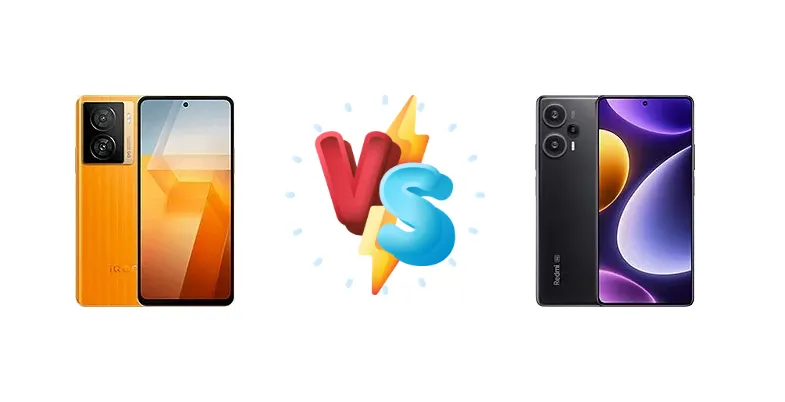
Both the vivo iQOO Z7 (China) and the Xiaomi Redmi Note 12 Turbo aim to deliver impressive performance without breaking the bank. However, they take distinctly different approaches. The iQOO Z7 prioritizes blazing-fast 120W charging, while the Redmi Note 12 Turbo leverages the newer, more efficient Snapdragon 7+ Gen 2 chipset. This comparison dissects these choices, revealing which phone best suits your needs.
🏆 Quick Verdict
For most users, the Xiaomi Redmi Note 12 Turbo is the superior choice. The Snapdragon 7+ Gen 2 provides a substantial performance advantage in both CPU and GPU tasks, translating to smoother gaming and faster app loading. While the iQOO Z7’s 120W charging is tempting, the Turbo’s efficiency and overall power outweigh this benefit.
| Network |
|---|
| 2G bands | GSM 850 / 900 / 1800 / 1900 | GSM 850 / 900 / 1800 / 1900 |
| 3G bands | HSDPA 850 / 900 / 2100 | HSDPA 800 / 850 / 900 / 2100 |
| 4G bands | 1, 3, 5, 8, 28, 34, 38, 39, 40, 41 | 1, 3, 5, 8, 19, 34, 38, 39, 40, 41, 42 |
| 5G bands | 1, 5, 8, 28, 41, 77, 78 SA/NSA | 1, 3, 5, 8, 28, 38, 41, 77, 78 SA/NSA |
| Speed | HSPA, LTE, 5G | HSPA, LTE, 5G |
| Technology | GSM / CDMA / HSPA / CDMA2000 / LTE / 5G | GSM / HSPA / CDMA2000 / LTE / 5G |
| | CDMA2000 1x | CDMA2000 1x |
| Launch |
|---|
| Announced | 2023, March 20 | 2023, March 28 |
| Status | Available. Released 2023, March 24 | Available. Released 2023, March 28 |
| Body |
|---|
| Build | - | Glass front, plastic frame, plastic back |
| Dimensions | 164.6 x 75.8 x 8.8 mm (6.48 x 2.98 x 0.35 in) | 161.1 x 75 x 7.9 mm (6.34 x 2.95 x 0.31 in) |
| SIM | Nano-SIM + Nano-SIM | Nano-SIM + Nano-SIM |
| Weight | 201.5 g (7.13 oz) | 181 g (6.38 oz) |
| Display |
|---|
| Resolution | 1080 x 2388 pixels (~395 ppi density) | 1080 x 2400 pixels, 20:9 ratio (~395 ppi density) |
| Size | 6.64 inches, 106.8 cm2 (~85.6% screen-to-body ratio) | 6.67 inches, 107.4 cm2 (~88.9% screen-to-body ratio) |
| Type | IPS LCD, 120Hz, HDR10 | OLED, 68B colors, 120Hz, Dolby Vision, HDR10+, 1000 nits (HBM) |
| Platform |
|---|
| CPU | Octa-core (1x2.7 GHz Cortex-A78 & 3x2.4 GHz Cortex-A78 & 4x1.8 GHz Cortex-A55) | Octa-core (1x2.91 GHz Cortex-X2 & 3x2.49 GHz Cortex-A710 & 4x1.8 GHz Cortex-A510) |
| Chipset | Qualcomm Snapdragon 782G (6 nm) | Qualcomm SM7475-AB Snapdragon 7+ Gen 2 (4 nm) |
| GPU | Adreno 642L | Adreno 725 |
| OS | Android 13, OriginOS 3 | Android 13, MIUI 14 |
| Memory |
|---|
| Card slot | No | No |
| Internal | 128GB 8GB RAM, 256GB 8GB RAM, 256GB 12GB RAM | 256GB 8GB RAM, 256GB 12GB RAM, 256GB 16GB RAM, 512GB 12GB RAM, 1TB 16GB RAM |
| | UFS 2.2 | UFS 3.1 |
| Main Camera |
|---|
| Dual | 64 MP, f/1.8, (wide), 1/1.97", 0.7µm, PDAF, OIS
Auxiliary lens | - |
| Features | Dual-LED dual-tone flash, HDR, panorama | LED flash, HDR, panorama |
| Single | 16 MP, f/2.5, (wide) | - |
| Triple | - | 64 MP, f/1.8, (wide), 1/2.0", 0.7µm, PDAF, OIS
8 MP, f/2.2, 120˚ (ultrawide), 1/4.0", 1.12µm
2 MP (macro) |
| Video | 4K@30fps, 1080p@30fps | 4K@30fps, 1080p@30/60/120/240fps |
| Selfie camera |
|---|
| Single | 16 MP, f/2.5, (wide) | 16 MP, f/2.5, (wide) |
| Video | 1080p@30fps | 1080p@30/60fps |
| Sound |
|---|
| 3.5mm jack | Yes | Yes |
| 35mm jack | Yes | Yes |
| Loudspeaker | Yes | Yes, with stereo speakers |
| | - | 24-bit/192kHz audio |
| Comms |
|---|
| Bluetooth | 5.2, A2DP, LE, aptX HD | 5.3, A2DP, LE |
| Infrared port | - | Yes |
| NFC | Yes | Yes |
| Positioning | GPS, GLONASS, GALILEO, BDS | GPS (L1), GLONASS (G1), BDS (B1I+B1c), GALILEO (E1), QZSS (L1) |
| Radio | No | No |
| USB | USB Type-C 2.0, OTG | USB Type-C 2.0, OTG |
| WLAN | Wi-Fi 802.11 a/b/g/n/ac/6, dual-band, Wi-Fi Direct | Wi-Fi 802.11 a/b/g/n/ac/6e, dual-band |
| Features |
|---|
| Sensors | Fingerprint (side-mounted), accelerometer, gyro, proximity, compass | Fingerprint (side-mounted), accelerometer, gyro, proximity, compass |
| Battery |
|---|
| Charging | 120W wired | 67W wired, PD3.0, QC4 |
| Type | 5000 mAh | Li-Po 5000 mAh |
| Misc |
|---|
| Colors | Black, Blue, Orange | Black, Blue, White, Harry Potter Edition |
| Models | V2270A | 23049RAD8C |
| Price | About 220 EUR | About 270 EUR |
vivo iQOO Z7 (China)
- Ultra-fast 120W wired charging
- Potentially lower price point
- Solid performance for everyday tasks
- Older Snapdragon 782G chipset
- Less efficient power consumption
- Likely lower gaming performance
Xiaomi Redmi Note 12 Turbo
- Powerful Snapdragon 7+ Gen 2 chipset
- Improved power efficiency
- Superior gaming performance
- PD3.0 and QC4 fast charging support
- Slower 67W charging compared to iQOO Z7
- Potentially higher price
Display Comparison
Neither device's display specifications are provided, so a direct comparison is limited. However, given the Redmi Note 12 Turbo's positioning, it likely features a higher refresh rate panel (120Hz is common) compared to the iQOO Z7. The key differentiator will be panel technology and color accuracy, which require further testing. Bezels are expected to be minimal on both, reflecting current design trends. Without specific data, it's reasonable to assume both offer adequate viewing experiences for their price points.
Camera Comparison
Without detailed camera specifications, a precise comparison is difficult. However, the Redmi Note 12 Turbo, being a newer model, likely benefits from improved image processing algorithms. The chipset's ISP (Image Signal Processor) plays a crucial role, and the 7+ Gen 2 offers advancements over the 782G. We can assume both phones will feature a multi-camera setup, but the sensor sizes and lens apertures will determine image quality. The iQOO Z7 may attempt to compensate with software enhancements, but the Redmi Note 12 Turbo’s superior processing power gives it an edge.
Performance
The core difference lies in the chipsets. The Xiaomi Redmi Note 12 Turbo’s Snapdragon 7+ Gen 2 (4nm) is a significant upgrade over the iQOO Z7’s Snapdragon 782G (6nm). The 7+ Gen 2 utilizes the newer Cortex-X2 prime core clocked at 2.91 GHz, offering a substantial single-core performance boost. Its Adreno GPU also provides a considerable advantage in graphics-intensive tasks like gaming. The 4nm process node of the 7+ Gen 2 also translates to improved power efficiency and reduced thermal throttling compared to the 6nm 782G. The iQOO Z7’s CPU configuration, while octa-core, relies on older Cortex-A78 cores, limiting its peak performance. The Redmi Note 12 Turbo will demonstrably outperform the iQOO Z7 in demanding applications.
Battery Life
The iQOO Z7’s 120W wired charging is its headline battery feature, promising incredibly fast top-ups. While the Redmi Note 12 Turbo’s 67W charging with PD3.0 and QC4 is slower, the Snapdragon 7+ Gen 2’s superior efficiency means it will likely deliver comparable or even better real-world battery life. The 7+ Gen 2 consumes less power during typical usage, offsetting the charging speed difference. The iQOO Z7’s faster charging is ideal for users who need a quick boost, but the Redmi Note 12 Turbo offers a more balanced approach to power management.
Buying Guide
Buy the vivo iQOO Z7 (China) if you absolutely prioritize the fastest possible charging speeds and frequently top up your phone throughout the day. Buy the Xiaomi Redmi Note 12 Turbo if you value sustained performance, gaming capabilities, and a more efficient chipset that will likely offer better long-term battery health and less thermal throttling.
Frequently Asked Questions
❓ Will the Redmi Note 12 Turbo get noticeably hotter than the iQOO Z7 during extended gaming sessions?
Yes, the iQOO Z7's Snapdragon 782G is more prone to thermal throttling under sustained load. The Redmi Note 12 Turbo's Snapdragon 7+ Gen 2, built on a 4nm process, is significantly more efficient and will maintain higher clock speeds for longer periods, resulting in a cooler and smoother gaming experience.
❓ How much faster is the charging on the iQOO Z7 in real-world scenarios?
The iQOO Z7's 120W charging can potentially take a phone from 0% to 100% in around 25-30 minutes. The Redmi Note 12 Turbo's 67W charging will likely take closer to 45-60 minutes for a full charge. However, the Turbo's efficiency means you may not need to fully charge it as often.
❓ Does the Snapdragon 7+ Gen 2 in the Redmi Note 12 Turbo support advanced gaming features like ray tracing?
While the Snapdragon 7+ Gen 2 doesn't offer the full suite of ray tracing capabilities found in flagship Snapdragon 8 Gen 2 chips, it does include support for some advanced gaming features and optimizations, resulting in a noticeably improved gaming experience compared to the iQOO Z7.