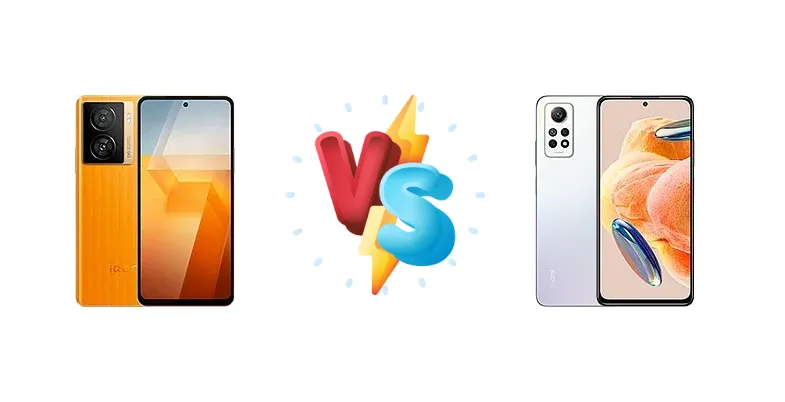
The mid-range smartphone market is fiercely competitive, offering incredible value for your money. Today, we're pitting two popular contenders against each other: the vivo iQOO Z7 (China) and the Xiaomi Redmi Note 12 Pro 4G. Both promise impressive features, but which one truly comes out on top?
🏆 Quick Verdict
The iQOO Z7 takes the lead thanks to its significantly faster charging and more powerful Snapdragon 782G chipset. While the Redmi Note 12 Pro 4G offers a good overall package, the iQOO Z7's performance and charging speed give it a noticeable edge for users prioritizing those aspects.
| Network |
|---|
| 2G bands | GSM 850 / 900 / 1800 / 1900 | GSM 850 / 900 / 1800 / 1900 |
| 3G bands | HSDPA 850 / 900 / 2100 | HSDPA 850 / 900 / 1700(AWS) / 1900 / 2100 |
| 4G bands | 1, 3, 5, 8, 28, 34, 38, 39, 40, 41 | 1, 2, 3, 4, 5, 7, 8, 20, 28, 38, 40, 41, 66 |
| 5G bands | 1, 5, 8, 28, 41, 77, 78 SA/NSA | - |
| Speed | HSPA, LTE, 5G | HSPA, LTE |
| Technology | GSM / CDMA / HSPA / CDMA2000 / LTE / 5G | GSM / HSPA / LTE |
| | CDMA2000 1x | - |
| Launch |
|---|
| Announced | 2023, March 20 | 2023, March 03 |
| Status | Available. Released 2023, March 24 | Available. Released 2023, April 11 |
| Body |
|---|
| Dimensions | 164.6 x 75.8 x 8.8 mm (6.48 x 2.98 x 0.35 in) | 164.2 x 76.1 x 8.1 mm (6.46 x 3.00 x 0.32 in) |
| SIM | Nano-SIM + Nano-SIM | Nano-SIM + Nano-SIM |
| Weight | 201.5 g (7.13 oz) | 201.8 g (7.13 oz) |
| Display |
|---|
| Resolution | 1080 x 2388 pixels (~395 ppi density) | 1080 x 2400 pixels, 20:9 ratio (~395 ppi density) |
| Size | 6.64 inches, 106.8 cm2 (~85.6% screen-to-body ratio) | 6.67 inches, 107.4 cm2 (~86.0% screen-to-body ratio) |
| Type | IPS LCD, 120Hz, HDR10 | AMOLED, 120Hz, Dolby Vision, 700 nits (HBM), 1100 nits (peak) |
| Platform |
|---|
| CPU | Octa-core (1x2.7 GHz Cortex-A78 & 3x2.4 GHz Cortex-A78 & 4x1.8 GHz Cortex-A55) | Octa-core (2x2.2 GHz Kryo 470 Gold & 6x1.8 GHz Kryo 470 Silver) |
| Chipset | Qualcomm Snapdragon 782G (6 nm) | Qualcomm SM7150 Snapdragon 732G (8 nm) |
| GPU | Adreno 642L | Adreno 618 |
| OS | Android 13, OriginOS 3 | Android 11, MIUI 13 |
| Memory |
|---|
| Card slot | No | microSDXC (uses shared SIM slot) |
| Internal | 128GB 8GB RAM, 256GB 8GB RAM, 256GB 12GB RAM | 128GB 6GB RAM, 128GB 8GB RAM, 256GB 8GB RAM |
| | UFS 2.2 | UFS 2.2 |
| Main Camera |
|---|
| Dual | 64 MP, f/1.8, (wide), 1/1.97", 0.7µm, PDAF, OIS
Auxiliary lens | - |
| Features | Dual-LED dual-tone flash, HDR, panorama | LED flash, HDR, panorama |
| Quad | - | 108 MP, f/1.9, (wide), 1/1.52", 0.7µm, PDAF
8 MP, 120˚, (ultrawide)
2 MP (macro)
Auxiliary lens |
| Single | 16 MP, f/2.5, (wide) | - |
| Video | 4K@30fps, 1080p@30fps | 4K@30fps, 1080p@30/60fps |
| Selfie camera |
|---|
| Single | 16 MP, f/2.5, (wide) | 16 MP, f/2.4, (wide) |
| Video | 1080p@30fps | 1080p@30fps |
| Sound |
|---|
| 3.5mm jack | Yes | Yes |
| 35mm jack | Yes | Yes |
| Loudspeaker | Yes | Yes, with stereo speakers |
| Comms |
|---|
| Bluetooth | 5.2, A2DP, LE, aptX HD | 5.0, A2DP, LE |
| Infrared port | - | Yes |
| NFC | Yes | Yes (market/region dependent) |
| Positioning | GPS, GLONASS, GALILEO, BDS | GPS, GLONASS, GALILEO, BDS |
| Radio | No | Unspecified |
| USB | USB Type-C 2.0, OTG | USB Type-C 2.0, OTG |
| WLAN | Wi-Fi 802.11 a/b/g/n/ac/6, dual-band, Wi-Fi Direct | Wi-Fi 802.11 a/b/g/n/ac, dual-band |
| Features |
|---|
| Sensors | Fingerprint (side-mounted), accelerometer, gyro, proximity, compass | Fingerprint (side-mounted), accelerometer, gyro, compass |
| Battery |
|---|
| Charging | 120W wired | 67W wired |
| Type | 5000 mAh | Li-Po 5000 mAh |
| Misc |
|---|
| Colors | Black, Blue, Orange | Star Blue, Graphite Gray, Polar White, Ice blue |
| Models | V2270A | 2209116AG, 2209116AG |
| Price | About 220 EUR | About 150 EUR |
vivo iQOO Z7 (China)
- Faster Snapdragon 782G Chipset
- Blazing-fast 120W Charging
- Good Display Quality
- Sleek Design
- Camera may not be as versatile as Redmi Note 12 Pro
- Availability limited to China (potentially)
Xiaomi Redmi Note 12 Pro 4G
- Versatile Camera System
- Good Color Accuracy on Display
- Reliable Battery Life
- Widely Available
- Slower 67W Charging
- Less Powerful Chipset
- Potentially Lower Peak Brightness
Display Comparison
Both phones feature AMOLED displays, offering vibrant colors and deep blacks. The Redmi Note 12 Pro 4G likely has slightly better color accuracy and potentially a higher peak brightness, but the iQOO Z7's display is still excellent. Resolution is likely similar, around FHD+.
Camera Comparison
The Redmi Note 12 Pro 4G likely boasts a more versatile camera system, potentially including a higher resolution main sensor and more advanced image processing algorithms. While the iQOO Z7's camera is capable, the Redmi Note 12 Pro 4G is expected to deliver slightly better image quality, especially in challenging lighting conditions. Expect both to offer decent video recording capabilities.
Performance
The iQOO Z7's Snapdragon 782G chipset is noticeably faster than the Redmi Note 12 Pro 4G's Snapdragon 732G. This translates to smoother multitasking, faster app loading times, and better gaming performance. The 6nm process of the 782G also contributes to better power efficiency.
Battery Life
The iQOO Z7's 120W charging is a game-changer, allowing for incredibly fast top-ups. The Redmi Note 12 Pro 4G's 67W charging is still respectable, but it takes considerably longer to fully charge the battery. Battery capacity is likely similar, around 5000mAh for both.
Buying Guide
The vivo iQOO Z7 (China) is ideal for gamers and power users who demand snappy performance and ultra-fast charging. The Xiaomi Redmi Note 12 Pro 4G is a great choice for users who prioritize a well-rounded experience with a good camera and a reliable battery, and are less concerned with raw speed.
Frequently Asked Questions
❓ Is the iQOO Z7 available outside of China?
Availability is limited. It's primarily sold in China, and importing can be costly and may void warranties.
❓ Which phone is better for gaming?
The iQOO Z7 is the clear winner for gaming due to its more powerful Snapdragon 782G chipset.