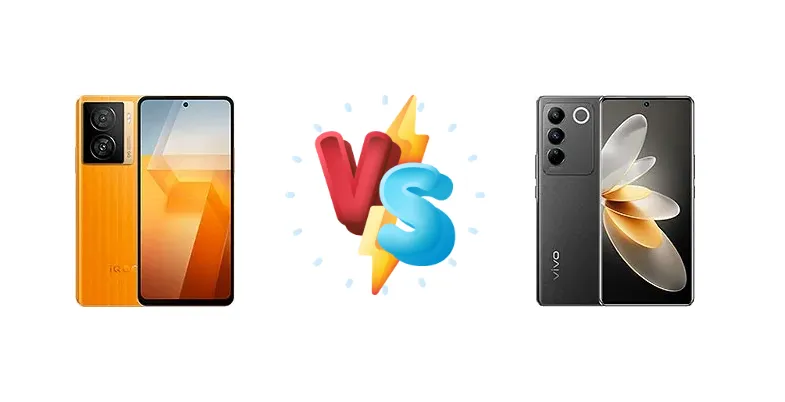
vivo continues to deliver compelling smartphones at various price points. The iQOO Z7 focuses on raw power and incredibly fast charging, while the V27 Pro emphasizes a premium design, vibrant display, and a versatile camera system. Let's dive into a detailed comparison to see which phone emerges as the winner.
🏆 Quick Verdict
The vivo V27 Pro offers a more refined experience with its superior display, more powerful chipset, and better camera capabilities. While the iQOO Z7 boasts blazing-fast 120W charging, the V27 Pro's overall package makes it the more compelling choice for most users.
| Network |
|---|
| 2G bands | GSM 850 / 900 / 1800 / 1900 | GSM 850 / 900 / 1800 / 1900 |
| 3G bands | HSDPA 850 / 900 / 2100 | HSDPA 850 / 900 / 1700(AWS) / 2100 |
| 4G bands | 1, 3, 5, 8, 28, 34, 38, 39, 40, 41 | 1, 3, 4, 5, 8, 28, 38, 40, 41 |
| 5G bands | 1, 5, 8, 28, 41, 77, 78 SA/NSA | 1, 3, 5, 8, 28, 77, 78 SA/NSA |
| Speed | HSPA, LTE, 5G | HSPA, LTE, 5G |
| Technology | GSM / CDMA / HSPA / CDMA2000 / LTE / 5G | GSM / HSPA / LTE / 5G |
| | CDMA2000 1x | - |
| Launch |
|---|
| Announced | 2023, March 20 | 2023, March 01 |
| Status | Available. Released 2023, March 24 | Available. Released 2023, March 01 |
| Body |
|---|
| Build | - | Glass front, plastic frame, glass back |
| Dimensions | 164.6 x 75.8 x 8.8 mm (6.48 x 2.98 x 0.35 in) | 164.1 x 74.8 x 7.4 mm (6.46 x 2.94 x 0.29 in) |
| SIM | Nano-SIM + Nano-SIM | Nano-SIM + Nano-SIM |
| Weight | 201.5 g (7.13 oz) | 182 g (6.42 oz) |
| | - | Color changing back panel color |
| Display |
|---|
| Resolution | 1080 x 2388 pixels (~395 ppi density) | 1080 x 2400 pixels, 20:9 ratio (~388 ppi density) |
| Size | 6.64 inches, 106.8 cm2 (~85.6% screen-to-body ratio) | 6.78 inches, 111.0 cm2 (~90.4% screen-to-body ratio) |
| Type | IPS LCD, 120Hz, HDR10 | AMOLED, 1B colors, 120Hz, HDR10+ |
| Platform |
|---|
| CPU | Octa-core (1x2.7 GHz Cortex-A78 & 3x2.4 GHz Cortex-A78 & 4x1.8 GHz Cortex-A55) | Octa-core (1x3.1 GHz Cortex-A78 & 3x3.0 GHz Cortex-A78 & 4x2.0 GHz Cortex-A55) |
| Chipset | Qualcomm Snapdragon 782G (6 nm) | Mediatek Dimensity 8200 (4 nm) |
| GPU | Adreno 642L | Mali-G610 MC6 |
| OS | Android 13, OriginOS 3 | Android 13, Funtouch 13 |
| Memory |
|---|
| Card slot | No | No |
| Internal | 128GB 8GB RAM, 256GB 8GB RAM, 256GB 12GB RAM | 128GB 8GB RAM, 256GB 8GB RAM, 256GB 12GB RAM |
| | UFS 2.2 | UFS 3.1 |
| Main Camera |
|---|
| Dual | 64 MP, f/1.8, (wide), 1/1.97", 0.7µm, PDAF, OIS
Auxiliary lens | - |
| Features | Dual-LED dual-tone flash, HDR, panorama | Ring-LED flash, panorama, HDR |
| Single | 16 MP, f/2.5, (wide) | 50 MP, f/2.5, (wide), AF |
| Triple | - | 50 MP, f/1.9, (wide), 1/1.56", 1.0µm, PDAF, OIS
8 MP, f/2.2, 16mm, 120˚ (ultrawide), 1/4.0", 1.12µm
2 MP (macro) |
| Video | 4K@30fps, 1080p@30fps | 4K@30/60fps, 1080p@30fps, gyro-EIS |
| Selfie camera |
|---|
| Features | - | Dual-LED flash, HDR |
| Single | 16 MP, f/2.5, (wide) | 50 MP, f/2.5, (wide), AF |
| Video | 1080p@30fps | 4K@30/60fps, 1080p@30fps, gyro-EIS |
| Sound |
|---|
| 3.5mm jack | Yes | No |
| 35mm jack | Yes | No |
| Loudspeaker | Yes | Yes |
| | - | 24-bit/192kHz audio |
| Comms |
|---|
| Bluetooth | 5.2, A2DP, LE, aptX HD | 5.3, A2DP, LE |
| NFC | Yes | Yes |
| Positioning | GPS, GLONASS, GALILEO, BDS | GPS, GLONASS, GALILEO, BDS, NavIC |
| Radio | No | No |
| USB | USB Type-C 2.0, OTG | USB Type-C 2.0, OTG |
| WLAN | Wi-Fi 802.11 a/b/g/n/ac/6, dual-band, Wi-Fi Direct | Wi-Fi 802.11 a/b/g/n/ac/6, dual-band, Wi-Fi Direct |
| Features |
|---|
| Sensors | Fingerprint (side-mounted), accelerometer, gyro, proximity, compass | Fingerprint (under display, optical), accelerometer, gyro, proximity, compass |
| Battery |
|---|
| Charging | 120W wired | 66W wired, 50% in 19 min, 72% in 30 min |
| Type | 5000 mAh | 4600 mAh |
| Misc |
|---|
| Colors | Black, Blue, Orange | Magic Blue, Noble Black |
| Models | V2270A | V2230 |
| Price | About 220 EUR | About 440 EUR |
| SAR | - | 1.22 W/kg (head) 0.89 W/kg (body) |
| Tests |
|---|
| Battery life | - |
Endurance rating 121h
|
| Camera | - |
Photo / Video |
| Display | - |
Contrast ratio: Infinite (nominal) |
| Loudspeaker | - |
-29.1 LUFS (Average)
|
| Performance | - |
AnTuTu: 846767 (v9)
GeekBench: 3933 (v5.1), 3421 (v6)
GFXBench: 57fps (ES 3.1 onscreen) |
vivo iQOO Z7 (China)
- Blazing-fast 120W charging
- Budget-friendly price
- Decent performance for the price
- Good for gaming
- Less powerful chipset than V27 Pro
- Likely inferior display quality
- Camera likely not as advanced
- Design may be less premium
vivo V27 Pro
- Superior display (brightness, contrast)
- More powerful Dimensity 8200 chipset
- Better camera system
- Premium design and build quality
- Excellent battery life
- Slower charging speed (66W)
- Higher price point
- May not be ideal for hardcore gamers seeking absolute peak performance
Display Comparison
The vivo V27 Pro takes a clear lead in the display department. Its 978 nits peak brightness ensures excellent visibility even in direct sunlight, and the infinite contrast ratio (nominal) promises deep blacks and vibrant colors. The iQOO Z7's display is likely good, but lacks the measured brightness and contrast figures of the V27 Pro, suggesting a less premium experience. Expect AMOLED technology on both, but the V27 Pro's implementation is superior.
Camera Comparison
The vivo V27 Pro is expected to have a more advanced camera system. While both phones offer Photo/Video capabilities, the V27 Pro likely features larger sensors, better image processing, and potentially more versatile features like OIS (Optical Image Stabilization). The iQOO Z7's camera is likely decent, but not a standout feature.
Performance
The vivo V27 Pro's Dimensity 8200 chipset (4nm) offers a significant performance advantage over the iQOO Z7's Snapdragon 782G (6nm). The Dimensity 8200's higher clock speeds and more modern architecture translate to smoother multitasking, faster app loading times, and better gaming performance. While the Snapdragon 782G is a capable mid-range chip, it simply can't compete with the V27 Pro's power.
Battery Life
The iQOO Z7's 120W charging is a game-changer, allowing for incredibly fast top-ups. However, the V27 Pro's endurance rating of 121h suggests excellent battery life even without the super-fast charging. While the V27 Pro's 66W charging is slower, its larger battery capacity and efficient chipset likely compensate, resulting in longer overall usage time.
Buying Guide
The vivo iQOO Z7 (China) is ideal for gamers and power users who prioritize charging speed and a budget-friendly price. The vivo V27 Pro is perfect for those seeking a stylish phone with a great camera, a vibrant display, and a more premium feel, even if it means sacrificing some charging speed.
Frequently Asked Questions
❓ Is the iQOO Z7 good for gaming?
The iQOO Z7 is decent for gaming, especially considering its price. However, the vivo V27 Pro's more powerful chipset will provide a smoother and more consistent gaming experience.
❓ Which phone has better battery life?
While the iQOO Z7 charges incredibly fast, the vivo V27 Pro's endurance rating suggests it offers better overall battery life due to its larger battery and more efficient chipset.