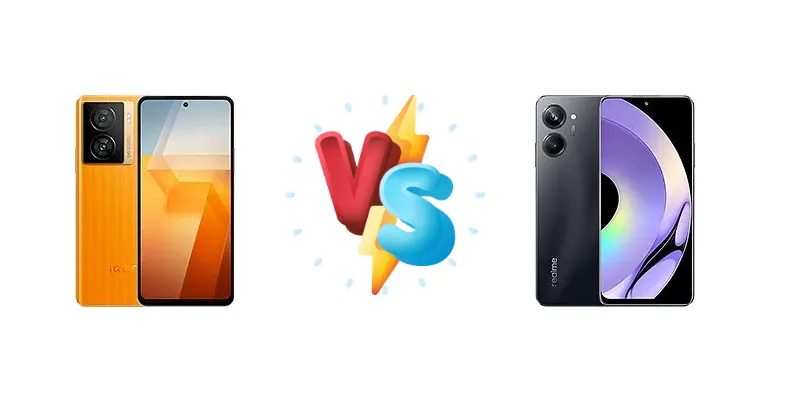
The mid-range smartphone market is fiercely competitive, and the vivo iQOO Z7 and Realme 10 Pro are two strong contenders. Both offer compelling features at attractive price points, but cater to slightly different needs. Let's dive into a detailed comparison to help you decide which one is right for you.
🏆 Quick Verdict
The iQOO Z7 takes the lead with its significantly faster Snapdragon 782G chipset and blazing-fast 120W charging. However, the Realme 10 Pro boasts impressive battery life and a vibrant display. If performance is your priority, the iQOO Z7 wins; for longevity and a great screen, the Realme 10 Pro is a solid choice.
| Network |
|---|
| 2G bands | GSM 850 / 900 / 1800 / 1900 | GSM 850 / 900 / 1800 / 1900 |
| 3G bands | HSDPA 850 / 900 / 2100 | HSDPA 850 / 900 / 1700(AWS) / 1900 / 2100 |
| 4G bands | 1, 3, 5, 8, 28, 34, 38, 39, 40, 41 | 1, 2, 3, 4, 5, 7, 8, 19, 20, 28, 34, 38, 39, 40, 41 |
| 5G bands | 1, 5, 8, 28, 41, 77, 78 SA/NSA | 1, 5, 8, 28, 41, 77, 78 SA/NSA |
| Speed | HSPA, LTE, 5G | HSPA, LTE, 5G |
| Technology | GSM / CDMA / HSPA / CDMA2000 / LTE / 5G | GSM / CDMA / HSPA / CDMA2000 / LTE / 5G |
| | CDMA2000 1x | CDMA2000 1x |
| Launch |
|---|
| Announced | 2023, March 20 | 2022, November 17 |
| Status | Available. Released 2023, March 24 | Available. Released 2022, November 24 |
| Body |
|---|
| Build | - | Glass front, plastic frame, plastic back |
| Dimensions | 164.6 x 75.8 x 8.8 mm (6.48 x 2.98 x 0.35 in) | 163.7 x 74.2 x 8.1 mm or 8.3 mm |
| SIM | Nano-SIM + Nano-SIM | Nano-SIM + Nano-SIM |
| Weight | 201.5 g (7.13 oz) | 190 g / 192 g (6.70 oz) |
| Display |
|---|
| Resolution | 1080 x 2388 pixels (~395 ppi density) | 1080 x 2400 pixels, 20:9 ratio (~392 ppi density) |
| Size | 6.64 inches, 106.8 cm2 (~85.6% screen-to-body ratio) | 6.72 inches, 109.0 cm2 (~89.8% screen-to-body ratio) |
| Type | IPS LCD, 120Hz, HDR10 | IPS LCD, 120Hz, 600 nits (typ), 680 nits (peak) |
| Platform |
|---|
| CPU | Octa-core (1x2.7 GHz Cortex-A78 & 3x2.4 GHz Cortex-A78 & 4x1.8 GHz Cortex-A55) | Octa-core (2x2.2 GHz Kryo 660 Gold & 6x1.8 GHz Kryo 660 Silver) |
| Chipset | Qualcomm Snapdragon 782G (6 nm) | Qualcomm SM6375 Snapdragon 695 5G (6 nm) |
| GPU | Adreno 642L | Adreno 619 |
| OS | Android 13, OriginOS 3 | Android 13, upgradable to Android 14, Realme UI 5.0 |
| Memory |
|---|
| Card slot | No | microSDXC (uses shared SIM slot) |
| Internal | 128GB 8GB RAM, 256GB 8GB RAM, 256GB 12GB RAM | 128GB 6GB RAM, 128GB 8GB RAM, 256GB 8GB RAM, 256GB 12GB RAM |
| | UFS 2.2 | UFS 2.2 |
| Main Camera |
|---|
| Dual | 64 MP, f/1.8, (wide), 1/1.97", 0.7µm, PDAF, OIS
Auxiliary lens | 108 MP, f/1.8, 24mm (wide), 1/1.67", 0.64µm, PDAF
Auxiliary lens |
| Features | Dual-LED dual-tone flash, HDR, panorama | LED flash, HDR, panorama |
| Single | 16 MP, f/2.5, (wide) | 16 MP, f/2.5, 25mm (wide) |
| Video | 4K@30fps, 1080p@30fps | 1080p@30fps |
| Selfie camera |
|---|
| Features | - | Panorama |
| Single | 16 MP, f/2.5, (wide) | 16 MP, f/2.5, 25mm (wide) |
| Video | 1080p@30fps | 1080p@30fps |
| Sound |
|---|
| 3.5mm jack | Yes | Yes |
| 35mm jack | Yes | Yes |
| Loudspeaker | Yes | Yes, with stereo speakers |
| | - | 24-bit/192kHz audio |
| Comms |
|---|
| Bluetooth | 5.2, A2DP, LE, aptX HD | 5.1, A2DP, LE |
| NFC | Yes | Yes (market/region dependent) |
| Positioning | GPS, GLONASS, GALILEO, BDS | GPS, GALILEO, GLONASS, BDS |
| Radio | No | No |
| USB | USB Type-C 2.0, OTG | USB Type-C 2.0 |
| WLAN | Wi-Fi 802.11 a/b/g/n/ac/6, dual-band, Wi-Fi Direct | Wi-Fi 802.11 a/b/g/n/ac, dual-band |
| Features |
|---|
| Sensors | Fingerprint (side-mounted), accelerometer, gyro, proximity, compass | Fingerprint (side-mounted), accelerometer, gyro, proximity, compass |
| Battery |
|---|
| Charging | 120W wired | 33W wired, 50% in 29 min |
| Type | 5000 mAh | 5000 mAh |
| Misc |
|---|
| Colors | Black, Blue, Orange | Dark Matter, Hyperspace Gold, Nebula Blue, Coca-Cola edition |
| Models | V2270A | RMX3663, RMX3660, RMX3661 |
| Price | About 220 EUR | ₹ 18,999 |
| Tests |
|---|
| Battery life | - |
Endurance rating 127h
|
| Camera | - |
Photo / Video |
| Display | - |
Contrast ratio: 1255:1 |
| Loudspeaker | - |
-24.4 LUFS (Very good)
|
| Performance | - |
AnTuTu: 401860 (v9)
GeekBench: 2021 (v5.1)
GFXBench: 16fps (ES 3.1 onscreen) |
vivo iQOO Z7 (China)
- Significantly faster performance
- Blazing-fast 120W charging
- Potentially better gaming experience
- Modern chipset (Snapdragon 782G)
- Display brightness slightly lower than Realme 10 Pro
- Camera performance potentially slightly behind
Realme 10 Pro
- Excellent battery life (127h endurance rating)
- Bright and vibrant display (619 nits)
- Good value for money
- Reliable performance for everyday tasks
- Slower chipset (Snapdragon 695 5G)
- Slower charging speed (33W)
- Less powerful for demanding games
Display Comparison
Both phones feature vibrant displays with a 1255:1 contrast ratio. The Realme 10 Pro edges out the iQOO Z7 with a measured peak brightness of 619 nits, offering slightly better visibility in direct sunlight. While the iQOO Z7's display is good, the Realme 10 Pro's brightness gives it a slight advantage for outdoor use. Screen sizes are likely similar, around 6.4-6.7 inches, but specific resolutions may vary.
Camera Comparison
Camera capabilities are generally comparable, with both phones offering decent photo and video performance. The Realme 10 Pro might have a slight edge in image processing due to Realme's software optimizations. However, the iQOO Z7's hardware is capable of producing high-quality images. Specific camera specs (megapixels, aperture) would need to be compared for a more definitive assessment.
Performance
This is where the iQOO Z7 truly shines. The Snapdragon 782G is a considerably more powerful chipset than the Realme 10 Pro's Snapdragon 695 5G. Expect smoother multitasking, faster app loading times, and significantly better gaming performance on the iQOO Z7. The iQOO Z7's CPU configuration also contributes to its superior performance.
Battery Life
The Realme 10 Pro excels in battery life, boasting an impressive endurance rating of 127 hours. While the iQOO Z7's battery capacity is likely similar, the Realme 10 Pro's power efficiency gives it the edge. However, the iQOO Z7's 120W charging more than compensates for any battery life difference, allowing for incredibly fast charging times.
Buying Guide
The vivo iQOO Z7 is ideal for gamers and power users who prioritize speed and quick charging. The Realme 10 Pro is a great pick for users who value long battery life, a visually appealing display, and a more balanced overall experience.
Frequently Asked Questions
❓ Which phone is better for gaming?
The vivo iQOO Z7 is significantly better for gaming due to its more powerful Snapdragon 782G chipset.
❓ How long does it take to charge each phone?
The iQOO Z7 charges incredibly fast with its 120W charging, while the Realme 10 Pro takes longer with its 33W charging.
❓ Which phone has better battery life?
The Realme 10 Pro has a longer endurance rating and generally better battery life.