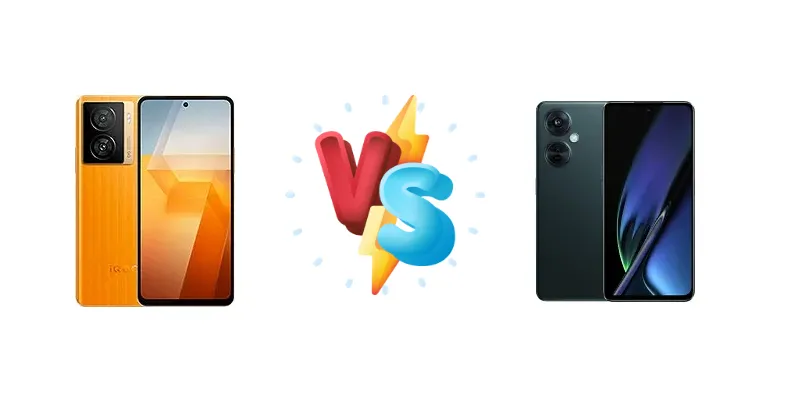
The iQOO Z7 (China) and Oppo K11x represent compelling options in the increasingly competitive mid-range smartphone market. Both leverage Qualcomm's Snapdragon platform, but diverge significantly in chipset choice and charging capabilities. This comparison dissects these differences to determine which device delivers the best experience for various user needs.
🏆 Quick Verdict
For most users, the iQOO Z7 emerges as the stronger contender. Its Snapdragon 782G chipset provides a substantial performance uplift over the K11x’s Snapdragon 695, making it better suited for demanding tasks and gaming. While the K11x offers respectable battery life and 67W charging, the Z7’s blazing-fast 120W charging is a game-changer.
| Network |
|---|
| 2G bands | GSM 850 / 900 / 1800 / 1900 | GSM 850 / 900 / 1800 / 1900 |
| 3G bands | HSDPA 850 / 900 / 2100 | HSDPA 850 / 900 / 1700(AWS) / 2100 |
| 4G bands | 1, 3, 5, 8, 28, 34, 38, 39, 40, 41 | 1, 3, 4, 5, 8, 28, 34, 38, 39, 40, 41 |
| 5G bands | 1, 5, 8, 28, 41, 77, 78 SA/NSA | 1, 5, 8, 28, 41, 77, 78 SA/NSA |
| Speed | HSPA, LTE, 5G | HSPA, LTE, 5G |
| Technology | GSM / CDMA / HSPA / CDMA2000 / LTE / 5G | GSM / HSPA / LTE / 5G |
| | CDMA2000 1x | - |
| Launch |
|---|
| Announced | 2023, March 20 | 2023, May 25 |
| Status | Available. Released 2023, March 24 | Available. Released 2023, May 25 |
| Body |
|---|
| Build | - | Glass front, plastic frame, plastic back |
| Dimensions | 164.6 x 75.8 x 8.8 mm (6.48 x 2.98 x 0.35 in) | 165.5 x 76 x 8.3 mm (6.52 x 2.99 x 0.33 in) |
| SIM | Nano-SIM + Nano-SIM | Nano-SIM + Nano-SIM |
| Weight | 201.5 g (7.13 oz) | 195 g (6.88 oz) |
| Display |
|---|
| Protection | - | Corning Gorilla Glass |
| Resolution | 1080 x 2388 pixels (~395 ppi density) | 1080 x 2400 pixels, 20:9 ratio (~392 ppi density) |
| Size | 6.64 inches, 106.8 cm2 (~85.6% screen-to-body ratio) | 6.72 inches, 109.0 cm2 (~86.7% screen-to-body ratio) |
| Type | IPS LCD, 120Hz, HDR10 | IPS LCD, 120Hz, 550 nits (typ), 680 nits (peak) |
| Platform |
|---|
| CPU | Octa-core (1x2.7 GHz Cortex-A78 & 3x2.4 GHz Cortex-A78 & 4x1.8 GHz Cortex-A55) | Octa-core (2x2.2 GHz Kryo 660 Gold & 6x1.7 GHz Kryo 660 Silver) |
| Chipset | Qualcomm Snapdragon 782G (6 nm) | Qualcomm SM6375 Snapdragon 695 5G (6 nm) |
| GPU | Adreno 642L | Adreno 619 |
| OS | Android 13, OriginOS 3 | Android 13, ColorOS 13.1 |
| Memory |
|---|
| Card slot | No | microSDXC (uses shared SIM slot) |
| Internal | 128GB 8GB RAM, 256GB 8GB RAM, 256GB 12GB RAM | 128GB 8GB RAM, 256GB 8GB RAM, 256GB 12GB RAM |
| | UFS 2.2 | - |
| Main Camera |
|---|
| Dual | 64 MP, f/1.8, (wide), 1/1.97", 0.7µm, PDAF, OIS
Auxiliary lens | 108 MP, f/1.8, 24mm (wide), 1/1.67", 0.64µm, PDAF
Auxiliary lens |
| Features | Dual-LED dual-tone flash, HDR, panorama | LED flash, HDR, panorama |
| Single | 16 MP, f/2.5, (wide) | - |
| Video | 4K@30fps, 1080p@30fps | 1080p@30fps |
| Selfie camera |
|---|
| Features | - | HDR, panorama |
| Single | 16 MP, f/2.5, (wide) | 16 MP, f/2.4, (wide), 1.0µm |
| Video | 1080p@30fps | 1080p@30fps |
| Sound |
|---|
| 3.5mm jack | Yes | - |
| 35mm jack | Yes | Yes |
| Loudspeaker | Yes | Yes, with stereo speakers |
| Comms |
|---|
| Bluetooth | 5.2, A2DP, LE, aptX HD | 5.1, A2DP, LE, aptX HD |
| NFC | Yes | No |
| Positioning | GPS, GLONASS, GALILEO, BDS | GPS, GALILEO, GLONASS, BDS, QZSS |
| Radio | No | No |
| USB | USB Type-C 2.0, OTG | USB Type-C 2.0, OTG |
| WLAN | Wi-Fi 802.11 a/b/g/n/ac/6, dual-band, Wi-Fi Direct | Wi-Fi 802.11 a/b/g/n/ac, dual-band |
| Features |
|---|
| Sensors | Fingerprint (side-mounted), accelerometer, gyro, proximity, compass | Fingerprint (side-mounted), accelerometer, gyro, proximity, compass |
| Battery |
|---|
| Charging | 120W wired | 67W wired, 80% in 33 min |
| Type | 5000 mAh | Li-Po 5000 mAh |
| Misc |
|---|
| Colors | Black, Blue, Orange | Jade Black, Pearl Blue |
| Models | V2270A | - |
| Price | About 220 EUR | About 250 EUR |
vivo iQOO Z7 (China)
- Significantly faster Snapdragon 782G processor
- Blazing-fast 120W wired charging
- Potentially higher refresh rate display
- Battery capacity not specified – could be smaller than K11x
- Limited information on camera capabilities
Oppo K11x
- More affordable price point
- Respectable 67W fast charging
- Potentially better battery life due to less powerful chipset
- Slower Snapdragon 695 processor
- Less capable GPU for gaming
- Longer charging times compared to iQOO Z7
Display Comparison
Neither device's display specifications are provided, so a direct comparison is limited. However, given the iQOO Z7's positioning, it likely features a higher refresh rate panel (potentially 120Hz) compared to the K11x, which is common in this price bracket. The iQOO Z7's display is likely tuned for vibrant colors, catering to a gaming audience. The K11x will likely focus on power efficiency.
Camera Comparison
Without detailed camera specs, analysis is limited. However, the iQOO Z7, being positioned as a gaming-focused device, may prioritize image processing for fast-action shots. The K11x, likely targeting a broader audience, might emphasize balanced image quality across various scenarios. The absence of information regarding sensor sizes and OIS makes a definitive camera comparison impossible, but the iQOO Z7's chipset likely supports more advanced image signal processing capabilities.
Performance
The core difference lies in the chipsets. The iQOO Z7’s Snapdragon 782G (6nm) boasts a more powerful CPU configuration – an octa-core setup with 1x2.7 GHz Cortex-A78, 3x2.4 GHz Cortex-A78, and 4x1.8 GHz Cortex-A55 cores – compared to the Oppo K11x’s Snapdragon 695 (6nm) with 2x2.2 GHz Kryo 660 Gold & 6x1.7 GHz Kryo 660 Silver. This translates to significantly faster application loading times and smoother multitasking on the iQOO Z7. The 782G’s more capable Adreno 642L GPU also provides a substantial advantage in gaming performance, handling higher graphics settings and frame rates. The K11x’s 695 is adequate for casual gaming, but will struggle with more demanding titles.
Battery Life
The iQOO Z7’s 120W wired charging is a standout feature, promising a full charge in under 30 minutes. The Oppo K11x’s 67W charging, while respectable, takes approximately 33 minutes to reach 80%, suggesting a longer full charge time. While battery capacity isn't specified, the iQOO Z7’s faster charging mitigates any potential disadvantage from a slightly smaller battery. The K11x will likely offer longer screen-on time due to the less power-hungry chipset, but the Z7’s charging speed offers a significant convenience factor.
Buying Guide
Buy the vivo iQOO Z7 (China) if you prioritize raw performance for gaming and multitasking, and value the convenience of incredibly fast charging. You'll benefit from a smoother experience with demanding apps and a quicker top-up when battery life runs low. Buy the Oppo K11x if you prioritize a balance of battery life and affordability, and your usage primarily revolves around everyday tasks like social media, browsing, and light gaming. It's a solid choice for budget-conscious users.
Frequently Asked Questions
❓ Will the Snapdragon 695 in the Oppo K11x struggle with graphically intensive games like Genshin Impact?
Yes, the Snapdragon 695 is a mid-range chipset and will likely require significant graphics settings reductions to achieve playable frame rates in demanding games like Genshin Impact. Expect noticeable frame drops and potentially stuttering. The iQOO Z7’s Snapdragon 782G is far better equipped to handle such titles.
❓ How much faster is the 120W charging on the iQOO Z7 compared to the 67W charging on the Oppo K11x in real-world use?
The iQOO Z7’s 120W charging can potentially take a phone from 0% to 100% in around 25-30 minutes, while the Oppo K11x takes approximately 33 minutes to reach 80%, and likely over an hour for a full charge. This means you can get a significant charge boost in a much shorter time with the iQOO Z7, ideal for users who frequently need to top up their battery quickly.
❓ Is the Snapdragon 782G in the iQOO Z7 prone to overheating during extended gaming sessions?
The Snapdragon 782G is a 6nm chip, offering good thermal efficiency. However, sustained gaming will inevitably generate heat. iQOO typically implements effective cooling solutions in their gaming-focused devices, so overheating shouldn't be a major concern, but performance throttling is still possible during prolonged, intense gameplay.