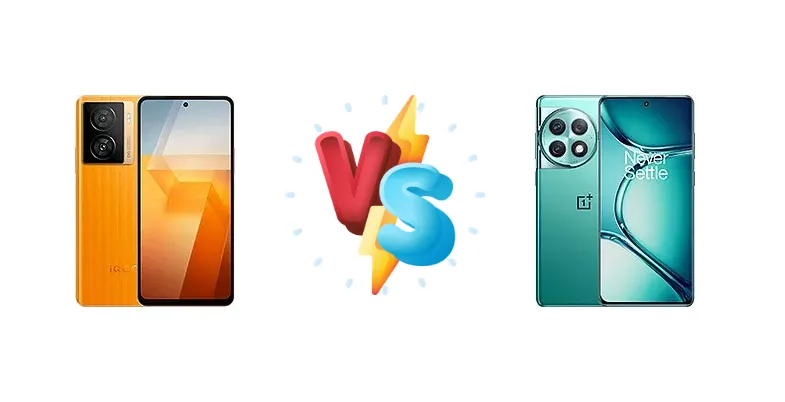
The OnePlus Ace 2 Pro and vivo iQOO Z7 represent distinct approaches to the smartphone market. The Ace 2 Pro aims for near-flagship performance at a competitive price, leveraging the Snapdragon 8 Gen 2. Conversely, the iQOO Z7 focuses on delivering a solid experience with a more mainstream Snapdragon 782G, prioritizing affordability and fast charging. This comparison dissects the key differences to determine which device best suits your needs.
🏆 Quick Verdict
For users prioritizing raw performance and future-proofing, the OnePlus Ace 2 Pro is the clear winner. Its Snapdragon 8 Gen 2 chipset offers a substantial leap in processing and graphics capabilities. However, the iQOO Z7 remains a compelling option for budget-conscious users who value fast charging and a smooth everyday experience.
| Network |
|---|
| 2G bands | GSM 850 / 900 / 1800 / 1900 | GSM 850 / 900 / 1800 / 1900 |
| 3G bands | HSDPA 850 / 900 / 2100 | HSDPA 850 / 900 / 1700(AWS) / 2100 |
| 4G bands | 1, 3, 5, 8, 28, 34, 38, 39, 40, 41 | 1, 3, 4, 5, 7, 8, 18, 19, 26, 28, 34, 38, 39, 40, 41 |
| 5G bands | 1, 5, 8, 28, 41, 77, 78 SA/NSA | 1, 3, 5, 8, 28, 41, 77, 78 SA/NSA |
| Speed | HSPA, LTE, 5G | HSPA, LTE, 5G |
| Technology | GSM / CDMA / HSPA / CDMA2000 / LTE / 5G | GSM / CDMA / HSPA / LTE / 5G |
| | CDMA2000 1x | - |
| Launch |
|---|
| Announced | 2023, March 20 | 2023, August 16 |
| Status | Available. Released 2023, March 24 | Available. Released 2023, August 23 |
| Body |
|---|
| Build | - | Glass front (Asahi Glass), plastic frame, glass back (Gorilla Glass 5) |
| Dimensions | 164.6 x 75.8 x 8.8 mm (6.48 x 2.98 x 0.35 in) | 163.1 x 74.2 x 9 mm (6.42 x 2.92 x 0.35 in) |
| SIM | Nano-SIM + Nano-SIM | Nano-SIM + Nano-SIM |
| Weight | 201.5 g (7.13 oz) | 210 g (7.41 oz) |
| Display |
|---|
| Protection | - | Asahi Glass |
| Resolution | 1080 x 2388 pixels (~395 ppi density) | 1240 x 2772 pixels, 20:9 ratio (~451 ppi density) |
| Size | 6.64 inches, 106.8 cm2 (~85.6% screen-to-body ratio) | 6.74 inches, 109.2 cm2 (~90.3% screen-to-body ratio) |
| Type | IPS LCD, 120Hz, HDR10 | AMOLED, 1B colors, 120Hz, HDR10+, 550 nits (typ), 1200 nits (HBM), 1600 nits (peak) |
| Platform |
|---|
| CPU | Octa-core (1x2.7 GHz Cortex-A78 & 3x2.4 GHz Cortex-A78 & 4x1.8 GHz Cortex-A55) | Octa-core (1x3.2 GHz Cortex-X3 & 2x2.8 GHz Cortex-A715 & 2x2.8 GHz Cortex-A710 & 3x2.0 GHz Cortex-A510) |
| Chipset | Qualcomm Snapdragon 782G (6 nm) | Qualcomm SM8550-AB Snapdragon 8 Gen 2 (4 nm) |
| GPU | Adreno 642L | Adreno 740 |
| OS | Android 13, OriginOS 3 | Android 13, ColorOS 13.1 |
| Memory |
|---|
| Card slot | No | No |
| Internal | 128GB 8GB RAM, 256GB 8GB RAM, 256GB 12GB RAM | 256GB 12GB RAM, 512GB 16GB RAM, 1TB 24GB RAM |
| | UFS 2.2 | - |
| Main Camera |
|---|
| Dual | 64 MP, f/1.8, (wide), 1/1.97", 0.7µm, PDAF, OIS
Auxiliary lens | - |
| Features | Dual-LED dual-tone flash, HDR, panorama | Color spectrum sensor, LED flash, HDR, panorama |
| Single | 16 MP, f/2.5, (wide) | - |
| Triple | - | 50 MP, f/1.8, 24mm (wide), 1/1.56", 1.0µm, PDAF, OIS
8 MP, f/2.2, 16mm, 112˚ (ultrawide), 1/4.0", 1.12µm
2 MP (macro) |
| Video | 4K@30fps, 1080p@30fps | 4K@30/60fps, 1080p@30/60/120/240fps, gyro-EIS, OIS |
| Selfie camera |
|---|
| Features | - | HDR |
| Single | 16 MP, f/2.5, (wide) | 16 MP, f/2.4, 26mm (wide), 1/3.09", 1.0µm |
| Video | 1080p@30fps | 1080p@30fps |
| Sound |
|---|
| 3.5mm jack | Yes | - |
| 35mm jack | Yes | No |
| Loudspeaker | Yes | Yes, with stereo speakers |
| Comms |
|---|
| Bluetooth | 5.2, A2DP, LE, aptX HD | 5.3, A2DP, LE, aptX HD |
| Infrared port | - | Yes |
| NFC | Yes | Yes |
| Positioning | GPS, GLONASS, GALILEO, BDS | GPS (L1+L5), GLONASS (G1), BDS (B1I+B1c+B2a), GALILEO (E1+E5a), QZSS (L1+L5) |
| Radio | No | No |
| USB | USB Type-C 2.0, OTG | USB Type-C 2.0 |
| WLAN | Wi-Fi 802.11 a/b/g/n/ac/6, dual-band, Wi-Fi Direct | Wi-Fi 802.11 a/b/g/n/ac/6/7, dual-band |
| Features |
|---|
| Sensors | Fingerprint (side-mounted), accelerometer, gyro, proximity, compass | Fingerprint (under display, optical), accelerometer, gyro, proximity, compass |
| Battery |
|---|
| Charging | 120W wired | 150W wired |
| Type | 5000 mAh | Li-Po 5000 mAh |
| Misc |
|---|
| Colors | Black, Blue, Orange | Aurora Green, Titanium Gray |
| Models | V2270A | PJA110 |
| Price | About 220 EUR | About 380 EUR |
vivo iQOO Z7 (China)
- Incredibly fast 120W charging
- More affordable price point
- Solid mid-range performance for everyday tasks
- Snapdragon 782G is less powerful than the 8 Gen 2
- Potentially less efficient battery life
OnePlus Ace 2 Pro
- Flagship-level performance with Snapdragon 8 Gen 2
- Faster 150W charging
- Superior image processing capabilities
- Higher price tag
- May run hotter under sustained load (though 4nm helps)
Display Comparison
While both devices likely feature AMOLED panels (based on brand trends), the core difference lies in the processing power driving them. The iQOO Z7’s display is expected to prioritize efficiency, while the Ace 2 Pro, benefiting from the 8 Gen 2’s ISP, could offer more advanced display processing for improved color accuracy and dynamic range. Details like refresh rate and peak brightness are missing, but the Ace 2 Pro’s chipset suggests a higher potential for a smoother, more vibrant visual experience.
Camera Comparison
Without specific camera sensor details, it’s difficult to make a definitive comparison. However, the Snapdragon 8 Gen 2’s advanced ISP in the Ace 2 Pro provides superior image processing capabilities, including better noise reduction, dynamic range, and video stabilization. The iQOO Z7 will likely rely on software optimization to compensate for its less powerful chipset. Expect the Ace 2 Pro to excel in low-light photography and video recording. The presence of OIS (Optical Image Stabilization) on the Ace 2 Pro is highly probable, further enhancing image quality.
Performance
The performance gap is the most significant differentiator. The OnePlus Ace 2 Pro’s Snapdragon 8 Gen 2 (4nm) is built on a more advanced node than the iQOO Z7’s Snapdragon 782G (6nm), resulting in superior power efficiency and thermal management. The 8 Gen 2’s CPU configuration – Cortex-X3, A715, and A710 cores – provides a substantial performance uplift over the 782G’s Cortex-A78 and A55 cores. This translates to faster app loading times, smoother multitasking, and significantly improved gaming performance. The Ace 2 Pro is also likely to feature faster LPDDR5x RAM, further enhancing responsiveness.
Battery Life
Both phones boast impressive charging speeds – 120W for the iQOO Z7 and 150W for the Ace 2 Pro. While battery capacity is unknown, the Ace 2 Pro’s faster charging will likely result in quicker top-ups. The Snapdragon 8 Gen 2’s improved efficiency could also contribute to better battery life despite potentially having a similar capacity to the iQOO Z7. The 6nm vs 4nm process node is a key factor here, reducing power consumption under load.
Buying Guide
Buy the vivo iQOO Z7 (China) if you need a reliable daily driver with incredibly fast 120W charging and are comfortable with a mid-range processor. It’s ideal for social media, streaming, and casual gaming. Buy the OnePlus Ace 2 Pro if you demand top-tier performance for demanding games, multitasking, and content creation, and are willing to spend more for the Snapdragon 8 Gen 2 and its associated benefits.
Frequently Asked Questions
❓ Will the Snapdragon 782G in the iQOO Z7 struggle with graphically demanding games like Genshin Impact?
The Snapdragon 782G can run Genshin Impact, but you'll likely need to lower the graphics settings to achieve a consistently smooth frame rate. The Ace 2 Pro’s Snapdragon 8 Gen 2 will handle these games at maximum settings with ease.
❓ How long does it realistically take to charge both phones from 0% to 100%?
The iQOO Z7’s 120W charging should take around 20-25 minutes for a full charge. The Ace 2 Pro’s 150W charging is expected to be even faster, potentially reaching 100% in 18-22 minutes, depending on battery capacity.
❓ Is the difference in chipset performance noticeable in everyday tasks like browsing and social media?
For basic tasks, the difference will be minimal. Both phones will feel responsive. However, the Ace 2 Pro will exhibit faster app loading times and smoother transitions when multitasking.
❓ Does the OnePlus Ace 2 Pro have any thermal throttling issues under sustained load?
The Snapdragon 8 Gen 2 is known for its improved thermal efficiency compared to previous generations. While some throttling is inevitable under prolonged heavy gaming, the Ace 2 Pro is expected to manage heat better than devices with older chipsets.