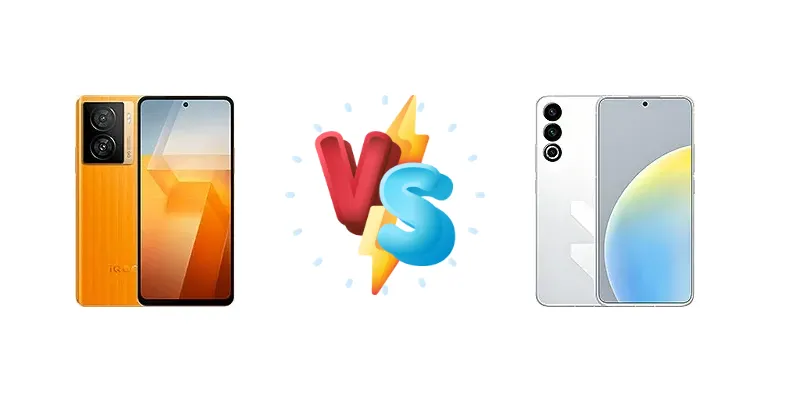
The Meizu 20 Classic and vivo iQOO Z7 (China) represent distinct approaches to the competitive smartphone market. The Meizu aims for a premium experience with a flagship Snapdragon 8 Gen 2, while the iQOO Z7 focuses on delivering strong performance and blazing-fast charging at a more accessible price point. This comparison dissects the core differences to help you determine which device aligns with your needs.
🏆 Quick Verdict
For the average user prioritizing raw performance and future-proofing, the Meizu 20 Classic is the clear winner thanks to its Snapdragon 8 Gen 2. However, the iQOO Z7’s 120W charging and more affordable price make it a compelling option for those prioritizing speed and value.
| Network |
|---|
| 2G bands | GSM 850 / 900 / 1800 / 1900 | GSM 850 / 900 / 1800 / 1900 |
| 3G bands | HSDPA 850 / 900 / 2100 | HSDPA 800 / 850 / 900 / 1900 / 2100 |
| 4G bands | 1, 3, 5, 8, 28, 34, 38, 39, 40, 41 | 1, 2, 3, 4, 5, 7, 8, 12, 28, 34, 38, 39, 40, 41 |
| 5G bands | 1, 5, 8, 28, 41, 77, 78 SA/NSA | 1, 3, 5, 8, 28, 38, 41, 77, 78 SA/NSA |
| Speed | HSPA, LTE, 5G | HSPA, LTE, 5G |
| Technology | GSM / CDMA / HSPA / CDMA2000 / LTE / 5G | GSM / HSPA / LTE / 5G |
| | CDMA2000 1x | - |
| Launch |
|---|
| Announced | 2023, March 20 | 2023, October 19 |
| Status | Available. Released 2023, March 24 | Available. Released 2023, October 31 |
| Body |
|---|
| Dimensions | 164.6 x 75.8 x 8.8 mm (6.48 x 2.98 x 0.35 in) | 157.9 x 73.5 x 8 mm (6.22 x 2.89 x 0.31 in) |
| SIM | Nano-SIM + Nano-SIM | Nano-SIM + Nano-SIM |
| Weight | 201.5 g (7.13 oz) | 190 g (6.70 oz) |
| Display |
|---|
| Resolution | 1080 x 2388 pixels (~395 ppi density) | 1080 x 2400 pixels, 20:9 ratio (~402 ppi density) |
| Size | 6.64 inches, 106.8 cm2 (~85.6% screen-to-body ratio) | 6.55 inches, 103.6 cm2 (~89.2% screen-to-body ratio) |
| Type | IPS LCD, 120Hz, HDR10 | OLED, 1B colors, 144Hz, 500 nits (typ), 800 nits (HBM) |
| Platform |
|---|
| CPU | Octa-core (1x2.7 GHz Cortex-A78 & 3x2.4 GHz Cortex-A78 & 4x1.8 GHz Cortex-A55) | Octa-core (1x3.2 GHz Cortex-X3 & 2x2.8 GHz Cortex-A715 & 2x2.8 GHz Cortex-A710 & 3x2.0 GHz Cortex-A510) |
| Chipset | Qualcomm Snapdragon 782G (6 nm) | Qualcomm SM8550-AB Snapdragon 8 Gen 2 (4 nm) |
| GPU | Adreno 642L | Adreno 740 |
| OS | Android 13, OriginOS 3 | Android 13, Flyme 10 |
| Memory |
|---|
| Card slot | No | No |
| Internal | 128GB 8GB RAM, 256GB 8GB RAM, 256GB 12GB RAM | 256GB 16GB RAM, 512GB 16GB RAM |
| | UFS 2.2 | - |
| Main Camera |
|---|
| Dual | 64 MP, f/1.8, (wide), 1/1.97", 0.7µm, PDAF, OIS
Auxiliary lens | - |
| Features | Dual-LED dual-tone flash, HDR, panorama | Ring-LED flash, panorama, HDR |
| Single | 16 MP, f/2.5, (wide) | - |
| Triple | - | 50 MP, f/1.9, 24mm (wide), 1/1.56", PDAF, OIS
16 MP, f/2.4, 16mm, 122˚ (ultrawide)
5 MP, f/2.4 |
| Video | 4K@30fps, 1080p@30fps | 8K, 4K, 1080p; gyro-EIS |
| Selfie camera |
|---|
| Features | - | HDR |
| Single | 16 MP, f/2.5, (wide) | 32 MP, f/2.5, (wide) |
| Video | 1080p@30fps | Yes |
| Sound |
|---|
| 3.5mm jack | Yes | - |
| 35mm jack | Yes | No |
| Loudspeaker | Yes | Yes, with stereo speakers |
| Comms |
|---|
| Bluetooth | 5.2, A2DP, LE, aptX HD | 5.3, A2DP, LE |
| NFC | Yes | Yes |
| Positioning | GPS, GLONASS, GALILEO, BDS | GPS (L1+L5), GLONASS, BDS (B1I+B1c+B2a), GALILEO, QZSS |
| Radio | No | No |
| USB | USB Type-C 2.0, OTG | USB Type-C, OTG |
| WLAN | Wi-Fi 802.11 a/b/g/n/ac/6, dual-band, Wi-Fi Direct | Wi-Fi 802.11 а/b/g/n/ac/6e/7, dual-band |
| Features |
|---|
| Sensors | Fingerprint (side-mounted), accelerometer, gyro, proximity, compass | Fingerprint (under display, ultrasonic), accelerometer, gyro, proximity, compass |
| Battery |
|---|
| Charging | 120W wired | 67W wired, PD3 PPS, QC4+ |
| Type | 5000 mAh | Li-Po 4700 mAh |
| Misc |
|---|
| Colors | Black, Blue, Orange | Gray, Silver, Green |
| Models | V2270A | - |
| Price | About 220 EUR | About 400 EUR |
vivo iQOO Z7 (China)
- Blazing-fast 120W charging
- More affordable price point
- Solid Snapdragon 782G performance for everyday tasks
- Less powerful chipset compared to the Snapdragon 8 Gen 2
- Potentially lower-quality display and camera system
Meizu 20 Classic
- Flagship Snapdragon 8 Gen 2 performance
- Superior thermal efficiency
- Likely higher-quality display and camera
- Faster charging standard compatibility (PD3 PPS, QC4+)
- Higher price tag
- Slower 67W charging compared to the iQOO Z7
Display Comparison
While display specifications aren't provided, the Meizu 20 Classic, as a flagship, likely features a higher-quality panel with potentially LTPO technology for adaptive refresh rates, contributing to better battery life. The iQOO Z7, positioned in a lower segment, may utilize a standard AMOLED panel. Bezels are expected to be slimmer on the Meizu, enhancing the premium feel. Color accuracy is also likely superior on the Meizu, given its flagship status.
Camera Comparison
Without detailed camera specs, it’s difficult to make precise comparisons. However, the Meizu 20 Classic, being a flagship, is expected to feature a larger main sensor with optical image stabilization (OIS), resulting in better low-light performance and sharper images. The lens aperture is also likely wider, allowing more light to reach the sensor. The iQOO Z7 likely employs a more cost-effective camera system, potentially sacrificing some image quality in challenging conditions. Image processing algorithms will also differ, with the Meizu likely offering more sophisticated features and a more natural look.
Performance
The core difference lies in the chipsets. The Meizu 20 Classic’s Snapdragon 8 Gen 2 (4nm) is a significant leap over the iQOO Z7’s Snapdragon 782G (6nm). The 8 Gen 2 boasts a prime Cortex-X3 core clocked at 3.2GHz, alongside newer Cortex-A715 and A710 cores, offering substantially higher CPU and GPU performance. The 4nm process node also translates to improved thermal efficiency, reducing throttling during sustained workloads. The iQOO Z7’s Cortex-A78 cores, while capable, are a generation behind and operate on a less efficient 6nm process. This means the Meizu will handle demanding games and applications with greater ease and maintain higher frame rates for longer periods. The Meizu will also benefit from faster LPDDR5x RAM, further enhancing performance.
Battery Life
The iQOO Z7’s 120W wired charging is its standout feature, promising incredibly fast top-ups. While the Meizu 20 Classic offers 67W charging with PD3 PPS and QC4+ support, it’s significantly slower. However, the Snapdragon 8 Gen 2’s superior efficiency may offset the battery capacity difference (assuming similar capacities). The iQOO Z7 will likely go from 0-100% in under 30 minutes, while the Meizu will take closer to an hour. The Meizu’s charging standards (PD3 PPS, QC4+) offer broader compatibility with various chargers.
Buying Guide
Buy the vivo iQOO Z7 (China) if you need incredibly fast charging and prioritize value for money, accepting a performance trade-off. It’s ideal for users who frequently top up their phones and enjoy mobile gaming at medium settings. Buy the Meizu 20 Classic if you demand top-tier performance for demanding tasks like video editing, high-end gaming, and want a more refined, flagship-level experience, and are willing to pay a premium.
Frequently Asked Questions
❓ Does the Snapdragon 782G in the iQOO Z7 struggle with graphically intensive games like Genshin Impact?
While the Snapdragon 782G is capable, Genshin Impact and similar titles will likely require reduced graphics settings to maintain a stable frame rate. Expect some frame drops during intense combat scenarios. The Meizu 20 Classic’s Snapdragon 8 Gen 2 will handle these games at maximum settings with ease.
❓ Is the 67W charging on the Meizu 20 Classic slow compared to the iQOO Z7's 120W?
Yes, 67W is considerably slower than 120W. However, the Snapdragon 8 Gen 2’s efficiency means the Meizu 20 Classic may not require as frequent charging, mitigating the slower charging speed. Expect a full charge in around 60-75 minutes with the Meizu, versus under 30 minutes with the iQOO Z7.
❓ Will the iQOO Z7 overheat during prolonged gaming sessions?
The Snapdragon 782G is a relatively efficient chip, but prolonged gaming can lead to some thermal throttling. The iQOO Z7 likely incorporates cooling solutions, but it won't match the thermal management capabilities of the Meizu 20 Classic with its more efficient Snapdragon 8 Gen 2.