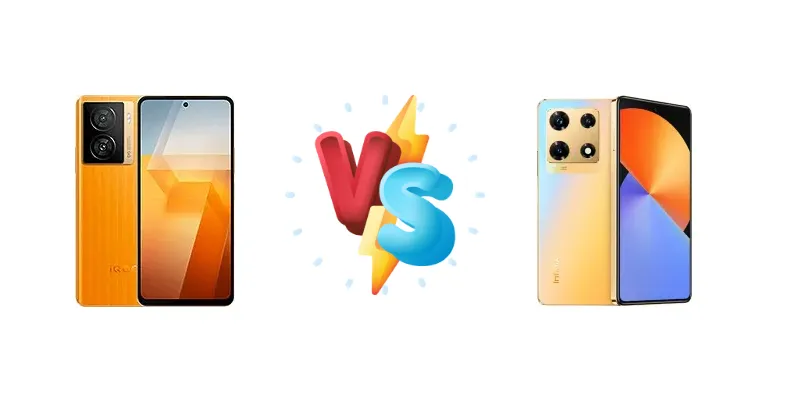
The budget smartphone market is fiercely competitive, and the vivo iQOO Z7 and Infinix Note 30 Pro are two strong contenders. Both offer impressive features at attractive price points, but which one truly delivers the best overall experience? Let's dive into a comprehensive comparison to help you decide.
🏆 Quick Verdict
The iQOO Z7 takes the performance crown thanks to its Snapdragon 782G chipset, offering noticeably faster speeds. However, the Infinix Note 30 Pro boasts faster charging (wired and wireless) and reverse wireless charging, making it a compelling choice for those prioritizing convenience. Ultimately, it depends on your priorities.
| Network |
|---|
| 2G bands | GSM 850 / 900 / 1800 / 1900 | GSM 850 / 900 / 1800 / 1900 |
| 3G bands | HSDPA 850 / 900 / 2100 | HSDPA 850 / 900 / 1700(AWS) / 1900 / 2100 |
| 4G bands | 1, 3, 5, 8, 28, 34, 38, 39, 40, 41 | 1, 2, 3, 4, 5, 7, 8, 12, 17, 20, 28, 38, 40, 41, 66 |
| 5G bands | 1, 5, 8, 28, 41, 77, 78 SA/NSA | - |
| Speed | HSPA, LTE, 5G | HSPA, LTE |
| Technology | GSM / CDMA / HSPA / CDMA2000 / LTE / 5G | GSM / HSPA / LTE |
| | CDMA2000 1x | - |
| Launch |
|---|
| Announced | 2023, March 20 | 2023, May 22 |
| Status | Available. Released 2023, March 24 | Available. Released 2023, May 22 |
| Body |
|---|
| Build | - | Glass front, plastic frame, glass back |
| Dimensions | 164.6 x 75.8 x 8.8 mm (6.48 x 2.98 x 0.35 in) | 162.7 x 76 x 8.2 mm (6.41 x 2.99 x 0.32 in) |
| SIM | Nano-SIM + Nano-SIM | Nano-SIM + Nano-SIM |
| Weight | 201.5 g (7.13 oz) | 203 g (7.16 oz) |
| | - | IP53 |
| Display |
|---|
| Resolution | 1080 x 2388 pixels (~395 ppi density) | 1080 x 2400 pixels, 20:9 ratio (~395 ppi density) |
| Size | 6.64 inches, 106.8 cm2 (~85.6% screen-to-body ratio) | 6.67 inches, 107.4 cm2 (~86.9% screen-to-body ratio) |
| Type | IPS LCD, 120Hz, HDR10 | AMOLED, 1B colors, 120Hz, 900 nits (peak) |
| | - | * the display diagonal size and resolution is unconfirmed |
| Platform |
|---|
| CPU | Octa-core (1x2.7 GHz Cortex-A78 & 3x2.4 GHz Cortex-A78 & 4x1.8 GHz Cortex-A55) | Octa-core (2x2.2 GHz Cortex-A76 & 6x2.0 GHz Cortex-A55) |
| Chipset | Qualcomm Snapdragon 782G (6 nm) | Mediatek Helio G99 (6 nm) |
| GPU | Adreno 642L | Mali-G57 MC2 |
| OS | Android 13, OriginOS 3 | Android 13, XOS 13 |
| Memory |
|---|
| Card slot | No | microSDXC (dedicated slot) |
| Internal | 128GB 8GB RAM, 256GB 8GB RAM, 256GB 12GB RAM | 256GB 8GB RAM |
| | UFS 2.2 | - |
| Main Camera |
|---|
| Dual | 64 MP, f/1.8, (wide), 1/1.97", 0.7µm, PDAF, OIS
Auxiliary lens | - |
| Features | Dual-LED dual-tone flash, HDR, panorama | Quad-LED flash, HDR, panorama |
| Single | 16 MP, f/2.5, (wide) | - |
| Triple | - | 108 MP, (wide), 1/1.67", PDAF
2 MP (macro)
Auxiliary lens |
| Video | 4K@30fps, 1080p@30fps | 1440p@30fps, 1080p@30fps |
| Selfie camera |
|---|
| Features | - | LED flash, HDR |
| Single | 16 MP, f/2.5, (wide) | 32 MP, f/2.0, (wide), 1/2.8" |
| Video | 1080p@30fps | 1080p@30fps |
| Sound |
|---|
| 3.5mm jack | Yes | Yes |
| 35mm jack | Yes | Yes |
| Loudspeaker | Yes | Yes, with dual speakers |
| | - | Sound by JBL
24-bit/192kHz audio |
| Comms |
|---|
| Bluetooth | 5.2, A2DP, LE, aptX HD | Yes |
| NFC | Yes | Yes (market/region dependent) |
| Positioning | GPS, GLONASS, GALILEO, BDS | GPS |
| Radio | No | FM radio |
| USB | USB Type-C 2.0, OTG | USB Type-C 2.0, OTG |
| WLAN | Wi-Fi 802.11 a/b/g/n/ac/6, dual-band, Wi-Fi Direct | Wi-Fi 802.11 a/b/g/n/ac, dual-band, Wi-Fi Direct |
| Features |
|---|
| Sensors | Fingerprint (side-mounted), accelerometer, gyro, proximity, compass | Fingerprint (side-mounted), accelerometer, gyro, proximity, compass |
| Battery |
|---|
| Charging | 120W wired | 68W wired, PD3.0, 80% in 30 min
15W wireless
Reverse wireless |
| Type | 5000 mAh | 5000 mAh |
| Misc |
|---|
| Colors | Black, Blue, Orange | Magic Black, Variable Gold |
| Models | V2270A | X678B |
| Price | About 220 EUR | - |
vivo iQOO Z7 (China)
- Superior Performance (Snapdragon 782G)
- Faster Charging (120W)
- Potentially better image processing
- May lack wireless charging features
- Design might be less premium than Note 30 Pro
Infinix Note 30 Pro
- Faster Wired Charging (68W)
- Wireless Charging (15W)
- Reverse Wireless Charging
- Potentially more stylish design
- Weaker Performance (Helio G99)
- Image processing might not be as refined
Display Comparison
Both phones feature vibrant displays, likely AMOLED panels, though specific resolutions and refresh rates need confirmation. The iQOO Z7 might offer slightly better color accuracy due to vivo's reputation, but the Note 30 Pro's display could have a more saturated look, appealing to some users. Expect both to be adequate for media consumption.
Camera Comparison
Camera specs are crucial here. Assuming both have similar megapixel counts, the iQOO Z7's image processing might be slightly better due to Qualcomm's generally superior ISP. However, Infinix often focuses on vibrant, saturated colors, which some users prefer. Low-light performance will likely be comparable, but testing is needed for a definitive answer.
Performance
Here's where the iQOO Z7 shines. The Snapdragon 782G is a significantly more powerful chipset than the Helio G99. Expect smoother multitasking, faster app loading times, and better gaming performance on the iQOO Z7. The Note 30 Pro will handle everyday tasks well, but may struggle with demanding games at higher settings.
Battery Life
The Infinix Note 30 Pro clearly wins in this category. Its 68W wired charging is faster than the iQOO Z7's 120W, and the addition of 15W wireless charging and reverse wireless charging provides added convenience. Both phones likely have similar battery capacities (around 5000mAh), so charging speed is the key differentiator.
Buying Guide
The vivo iQOO Z7 is ideal for gamers and power users who prioritize raw performance and a smooth user experience. The Infinix Note 30 Pro is a great pick for users who value fast charging, wireless capabilities, and a stylish design, especially if gaming isn't a primary concern.
Frequently Asked Questions
❓ Is the iQOO Z7 good for gaming?
Yes, the iQOO Z7's Snapdragon 782G chipset makes it a solid choice for gaming, offering better performance than the Infinix Note 30 Pro.
❓ Can the Infinix Note 30 Pro wirelessly charge other devices?
Yes, the Infinix Note 30 Pro supports reverse wireless charging, allowing you to charge compatible accessories like earbuds or smartwatches.