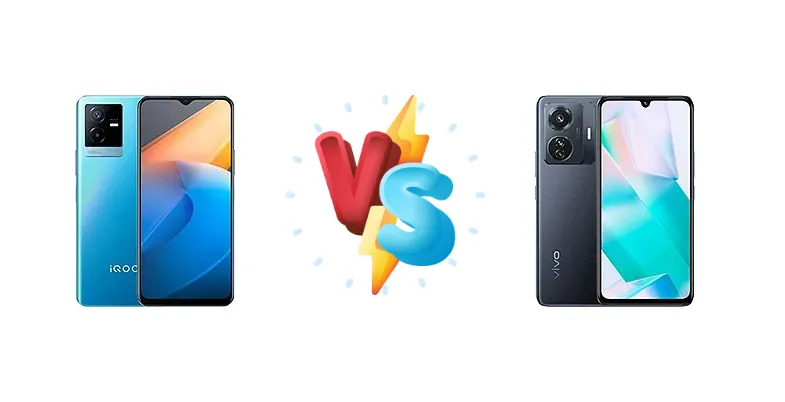
The budget smartphone market is fiercely competitive, and vivo has two strong contenders: the iQOO Z6x and the vivo T1. Both offer compelling features at accessible prices, but cater to slightly different needs. This comprehensive comparison will help you decide which phone is the right fit for you.
🏆 Quick Verdict
The vivo T1 (Snapdragon 778G) emerges as the overall winner thanks to its significantly faster processor, superior charging speed, and generally better camera performance. However, the iQOO Z6x offers excellent value for those prioritizing battery life and a larger display on a tighter budget.
| Network |
|---|
| 2G bands | GSM 850 / 900 / 1800 / 1900 | GSM 850 / 900 / 1800 / 1900 |
| 3G bands | HSDPA 850 / 900 / 1700(AWS) / 2100 | HSDPA 850 / 900 / 2100 |
| 4G bands | 1, 3, 4, 5, 8, 28, 34, 38, 39, 40, 41 | 1, 3, 5, 7, 8, 20, 28, 38, 40, 41 |
| 5G bands | 1, 5, 8, 28, 41, 77, 78 SA/NSA | 1, 3, 28, 40, 41, 77, 78 SA/NSA |
| Speed | HSPA, LTE, 5G | HSPA, LTE, 5G |
| Technology | GSM / CDMA / HSPA / CDMA2000 / LTE / 5G | GSM / HSPA / LTE / 5G |
| | CDMA2000 1x | - |
| Launch |
|---|
| Announced | 2022, August 25 | 2022, April 26 |
| Status | Available. Released 2022, September 01 | Available. Released 2022, April 26 |
| Body |
|---|
| Build | Glass front, plastic frame, plastic back | Glass front, plastic frame, plastic back |
| Dimensions | 163.9 x 75.3 x 9.3 mm (6.45 x 2.96 x 0.37 in) | 159.7 x 73.6 x 8.5 mm (6.29 x 2.90 x 0.33 in) |
| SIM | Nano-SIM + Nano-SIM | Nano-SIM + Nano-SIM |
| Weight | 204 g (7.20 oz) | 180.3 g (6.35 oz) |
| Display |
|---|
| Resolution | 1080 x 2408 pixels, 20:9 ratio (~401 ppi density) | 1080 x 2404 pixels, 20:9 ratio (~409 ppi density) |
| Size | 6.58 inches, 104.3 cm2 (~84.5% screen-to-body ratio) | 6.44 inches, 100.0 cm2 (~85.1% screen-to-body ratio) |
| Type | IPS LCD | AMOLED, 90Hz, HDR10+, 1300 nits (peak) |
| Platform |
|---|
| CPU | Octa-core (2x2.4 GHz Cortex-A76 & 6x2.0 GHz Cortex-A55) | Octa-core (1x2.4 GHz Cortex-A78 & 3x2.2 GHz Cortex-A78 & 4x1.9 GHz Cortex-A55) |
| Chipset | Mediatek Dimensity 810 (6 nm) | Qualcomm SM7325 Snapdragon 778G 5G (6 nm) |
| GPU | Mali-G57 MC2 | Adreno 642L |
| OS | Android 11, OriginOS Ocean | Android 12, Funtouch 12 |
| Memory |
|---|
| Card slot | No | No |
| Internal | 128GB 6GB RAM, 128GB 8GB RAM, 256GB 8GB RAM | 128GB 8GB RAM |
| | UFS 2.2 | - |
| Main Camera |
|---|
| Dual | 50 MP, f/1.8, 26mm (wide), PDAF
2 MP (macro) | - |
| Features | Dual-LED flash, HDR, panorama | Dual-LED dual-tone flash, HDR, panorama |
| Single | 8 MP, f/2.0, (wide) | 16 MP, f/2.0, (wide) |
| Triple | - | 64 MP, f/1.8, 26mm (wide), PDAF
8 MP, f/2.2, 117˚ (ultrawide)
2 MP (macro) |
| Video | 1080p@30fps | 1080p@30fps, gyro-EIS |
| Selfie camera |
|---|
| Single | 8 MP, f/2.0, (wide) | 16 MP, f/2.0, (wide) |
| Video | 1080p@30fps | 1080p@30fps |
| Sound |
|---|
| 3.5mm jack | Yes | No |
| 35mm jack | Yes | No |
| Loudspeaker | Yes | Yes |
| | - | 24-bit/192kHz audio |
| Comms |
|---|
| Bluetooth | 5.1, A2DP, LE, aptX HD | 5.2, A2DP, LE |
| NFC | No | No |
| Positioning | GPS, GLONASS, GALILEO, BDS, QZSS | GPS, GLONASS, GALILEO, BDS, QZSS |
| Radio | - | No |
| USB | USB Type-C 2.0, OTG | USB Type-C 2.0, OTG |
| WLAN | Wi-Fi 802.11 a/b/g/n/ac, dual-band, Wi-Fi Direct | Wi-Fi 802.11 a/b/g/n/ac, dual-band, Wi-Fi Direct |
| Features |
|---|
| Sensors | Fingerprint (side-mounted), accelerometer, proximity, compass | Fingerprint (side-mounted), accelerometer, gyro, proximity, compass |
| Battery |
|---|
| Charging | 44W wired, 50% in 33 min | 66W wired |
| Type | 6000 mAh | 4700 mAh |
| Misc |
|---|
| Colors | Black, Blue, Orange | Turbo Black, Turbo Cyan |
| Models | V2164KA | - |
| Price | About 180 EUR | About 300 EUR |
vivo iQOO Z6x
- Excellent battery life
- Large display for media
- Affordable price
- Fast 44W charging
- Less powerful processor
- Average camera performance
- Larger size may be unwieldy for some
vivo T1 (Snapdragon 778G)
- Powerful Snapdragon 778G processor
- Fast 66W charging
- Better camera performance
- Compact and ergonomic design
- Slightly shorter battery life than Z6x
- Potentially higher price
Display Comparison
Both phones feature vibrant displays, but the iQOO Z6x boasts a larger 6.78-inch screen compared to the vivo T1's 6.44-inch display. While both are LCD panels, the T1 might offer slightly better color accuracy. The iQOO Z6x's larger size is ideal for media consumption, while the T1's more compact form factor offers better one-handed usability.
Camera Comparison
The vivo T1 generally offers better camera performance, thanks to its more capable processor and likely better image processing algorithms. While both phones have multiple rear cameras, the T1's main sensor and overall image quality are expected to be superior. Expect better low-light performance and more detailed photos from the T1.
Performance
This is where the vivo T1 truly shines. The Snapdragon 778G is a significantly more powerful chipset than the Dimensity 810. Expect smoother multitasking, faster app loading times, and a much better gaming experience on the T1. The iQOO Z6x is adequate for everyday tasks, but will struggle with demanding games.
Battery Life
The iQOO Z6x takes the lead in battery capacity, typically offering a larger battery (around 5000mAh) compared to the vivo T1 (around 4400mAh). Coupled with the Dimensity 810's efficiency, the iQOO Z6x provides exceptional battery life. However, the vivo T1's 66W charging significantly reduces charging times, offsetting the battery capacity difference.
Buying Guide
Who should buy the vivo iQOO Z6x? Users prioritizing long battery life, a large display for media consumption, and a more affordable price point. Who should buy the vivo T1 (Snapdragon 778G)? Gamers, photography enthusiasts, and those who value faster performance and quicker charging.
Frequently Asked Questions
❓ Is the Snapdragon 778G better than the Dimensity 810?
Yes, the Snapdragon 778G is significantly more powerful and offers better performance for gaming and demanding tasks.
❓ Which phone has better battery life?
The iQOO Z6x generally offers longer battery life due to its larger battery capacity and more efficient chipset.