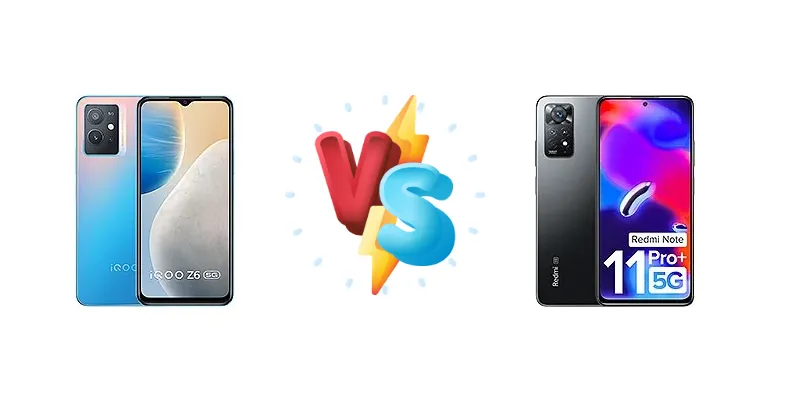
Both the vivo iQOO Z6 and the Xiaomi Redmi Note 11 Pro+ 5G (India) target the competitive mid-range 5G smartphone market. While both leverage the Qualcomm Snapdragon 695 5G chipset, they diverge significantly in charging technology and overall user experience, making the choice less about raw power and more about prioritizing convenience and speed.
🏆 Quick Verdict
For the average user prioritizing convenience and rapid replenishment, the Xiaomi Redmi Note 11 Pro+ 5G (India) is the clear winner. Its 67W charging dramatically reduces downtime compared to the iQOO Z6’s 18W charging, despite both phones sharing the same Snapdragon 695 5G processor.
| Network |
|---|
| 2G bands | GSM 850 / 900 / 1800 / 1900 | GSM 850 / 900 / 1800 / 1900 - SIM 1 & SIM 2 |
| 3G bands | HSDPA 850 / 900 / 2100 | HSDPA 850 / 900 / 1900 / 2100 |
| 4G bands | 1, 3, 5, 8, 38, 40, 41 | 1, 3, 5, 8, 40, 41 |
| 5G bands | 77, 78 SA/NSA | 1, 3, 5, 8, 28, 40, 78 SA/NSA |
| Speed | HSPA, LTE, 5G | HSPA, LTE-A (CA), 5G |
| Technology | GSM / HSPA / LTE / 5G | GSM / HSPA / LTE / 5G |
| Launch |
|---|
| Announced | 2022, March 16 | 2022, March 09 |
| Status | Available. Released 2022, March 22 | Available. Released 2022, March 15 |
| Body |
|---|
| Build | Glass front, plastic frame, plastic back | Glass front (Gorilla Glass 5), glass back |
| Dimensions | 164 x 75.8 x 8.3 mm (6.46 x 2.98 x 0.33 in) | 164.2 x 76.1 x 8.1 mm (6.46 x 3.00 x 0.32 in) |
| SIM | Nano-SIM + Nano-SIM | Hybrid Dual SIM (Nano-SIM, dual stand-by) |
| Weight | 185 g (6.53 oz) | 202 g (7.13 oz) |
| | - | IP53, dust and splash resistant |
| Display |
|---|
| Protection | - | Corning Gorilla Glass 5 |
| Resolution | 1080 x 2408 pixels, 20:9 ratio (~401 ppi density) | 1080 x 2400 pixels, 20:9 ratio (~395 ppi density) |
| Size | 6.58 inches, 104.3 cm2 (~83.9% screen-to-body ratio) | 6.67 inches, 107.4 cm2 (~86.0% screen-to-body ratio) |
| Type | IPS LCD, 120Hz | Super AMOLED, 120Hz, 700 nits, 1200 nits (peak) |
| Platform |
|---|
| CPU | Octa-core (2x2.2 GHz Kryo 660 Gold & 6x1.7 GHz Kryo 660 Silver) | Octa-core (2x2.2 GHz Kryo 660 Gold & 6x1.7 GHz Kryo 660 Silver) |
| Chipset | Qualcomm SM6375 Snapdragon 695 5G (6 nm) | Qualcomm SM6375 Snapdragon 695 5G (6 nm) |
| GPU | Adreno 619 | Adreno 619 |
| OS | Android 12, Funtouch 12 | Android 11, MIUI 13 |
| Memory |
|---|
| Card slot | microSDXC (uses shared SIM slot) | microSDXC (uses shared SIM slot) |
| Internal | 128GB 4GB RAM, 128GB 6GB RAM, 128GB 8GB RAM | 64GB 6GB RAM, 128GB 6GB RAM, 128GB 8GB RAM, 256GB 8GB RAM |
| | - | UFS 2.2 |
| Main Camera |
|---|
| Features | Dual-LED flash, HDR, panorama | LED flash, HDR, panorama |
| Single | 16 MP, f/2.0, (wide) | - |
| Triple | 50 MP, f/1.8, 26mm (wide), PDAF
2 MP (macro)
Auxiliary lens | 108 MP, f/1.9, 26mm (wide), 1/1.52", 0.7µm, PDAF
8 MP, f/2.2, 118˚ (ultrawide)
2 MP, f/2.4, (macro) |
| Video | 1080p@30fps | 1080p@30fps |
| Selfie camera |
|---|
| Single | 16 MP, f/2.0, (wide) | 16 MP, f/2.5, (wide), 1/3.06" 1.0µm |
| Video | 1080p@30fps | 1080p@30fps |
| Sound |
|---|
| 3.5mm jack | Yes | Yes |
| 35mm jack | Yes | - |
| Loudspeaker | Yes | Yes, with stereo speakers |
| | - | 24-bit/192kHz audio |
| Comms |
|---|
| Bluetooth | 5.1, A2DP, LE | 5.1, A2DP, LE |
| Infrared port | - | Yes |
| NFC | No | No |
| Positioning | GPS, GLONASS | GPS, GLONASS, BDS, GALILEO |
| Radio | FM radio | Unspecified |
| USB | USB Type-C 2.0, OTG | USB Type-C 2.0, OTG |
| WLAN | Wi-Fi 802.11 a/b/g/n/ac, dual-band, Wi-Fi Direct | Wi-Fi 802.11 a/b/g/n/ac, dual-band, Wi-Fi Direct |
| Features |
|---|
| Sensors | Fingerprint (side-mounted), accelerometer, gyro, proximity, compass | Fingerprint (side-mounted), accelerometer, gyro, proximity, compass |
| Battery |
|---|
| Charging | 18W wired | 67W wired, PD3.0, QC3, 50% in 15 min, 100% in 42 min (advertised) |
| Type | 5000 mAh | Li-Po 5000 mAh, non-removable |
| Misc |
|---|
| Colors | Dynamo Black, Chromatic Blue | Mirage Blue, Phantom White, Stealth Black |
| Models | I2127 | 2201116SI |
| Price | About 190 EUR | About 250 EUR |
vivo iQOO Z6
- Potentially more affordable price point.
- Understated and minimalist design.
- Efficient Snapdragon 695 5G chipset.
- Significantly slower 18W charging.
- Likely less advanced camera system.
- Potentially less effective thermal management.
Xiaomi Redmi Note 11 Pro+ 5G (India)
- Ultra-fast 67W charging with PD3.0 and QC3 support.
- Likely superior camera system.
- Potentially better thermal management due to larger chassis.
- Higher price compared to the iQOO Z6.
- Potentially bulkier design.
- Software experience may include more pre-installed apps.
Display Comparison
Both devices are expected to feature FHD+ displays, but detailed specifications like peak brightness and panel type (IPS vs AMOLED) are missing. However, given the Redmi Note 11 Pro+’s positioning, it’s likely to offer a more vibrant and color-accurate display. The iQOO Z6, focusing on value, may opt for a more cost-effective panel. Bezels are likely comparable, given the similar market segments.
Camera Comparison
Without detailed camera specifications beyond the presence of sensors, a direct comparison is difficult. However, Xiaomi typically emphasizes camera capabilities in its 'Pro+' models. It’s reasonable to assume the Redmi Note 11 Pro+ 5G (India) will feature a more sophisticated camera system, potentially with a larger main sensor and more advanced image processing algorithms. The iQOO Z6 will likely focus on providing a functional camera experience without prioritizing high-end features. The inclusion of a 2MP macro lens on either device is largely a marketing tactic and offers limited practical benefit.
Performance
Both the vivo iQOO Z6 and the Xiaomi Redmi Note 11 Pro+ 5G (India) are powered by the Qualcomm SM6375 Snapdragon 695 5G (6 nm) chipset, featuring an octa-core CPU configuration with 2x2.2 GHz Kryo 660 Gold and 6x1.7 GHz Kryo 660 Silver cores. This means CPU performance will be virtually identical. The real-world difference will come down to RAM management and thermal throttling. While RAM specifications are not provided, the Redmi Note 11 Pro+’s larger chassis *may* allow for a more effective cooling solution, potentially mitigating throttling during extended gaming sessions. However, the 6nm process node on the Snapdragon 695 is already relatively efficient.
Battery Life
This is where the most significant difference lies. The Redmi Note 11 Pro+ 5G (India) boasts 67W wired charging, supporting a 50% charge in just 15 minutes and a full charge in 42 minutes (advertised). In contrast, the iQOO Z6 is limited to 18W wired charging. While battery capacity isn’t specified, the faster charging of the Redmi Note 11 Pro+ effectively mitigates any potential disadvantage from a slightly smaller battery. Users who frequently find themselves needing to quickly top up their phone will overwhelmingly benefit from the Redmi’s charging speed.
Buying Guide
Buy the vivo iQOO Z6 if you prioritize a more understated design and are comfortable with slower charging speeds, focusing on a balance between affordability and 5G connectivity. Buy the Xiaomi Redmi Note 11 Pro+ 5G (India) if you value incredibly fast charging, minimizing downtime, and are willing to pay a premium for that convenience. This phone is ideal for users who heavily rely on their smartphone throughout the day and need quick top-ups.
Frequently Asked Questions
❓ Will the Snapdragon 695 5G in either phone struggle with demanding games like Genshin Impact?
The Snapdragon 695 5G is a capable chipset for most mobile games, but demanding titles like Genshin Impact will likely require reduced graphics settings to maintain a stable frame rate. Both phones will offer a similar gaming experience, with thermal management potentially being a differentiating factor – the Redmi Note 11 Pro+ *may* handle sustained gaming slightly better due to its larger form factor.
❓ Is the 67W charging on the Redmi Note 11 Pro+ 5G (India) compatible with all USB-C chargers?
The Redmi Note 11 Pro+ 5G (India) supports 67W charging with the included charger. While it's compatible with USB-PD and Quick Charge 3.0 chargers, you may not achieve the full 67W charging speed unless you use a compatible charger that specifically supports these protocols. Using a standard USB-C charger will still charge the phone, but at a slower rate.
❓ Does either phone have a microSD card slot for expandable storage?
Information regarding microSD card support is currently unavailable for either device. However, Xiaomi phones often include microSD card slots, while vivo sometimes omits them in their more budget-focused models. Checking official specifications or reviews is recommended before purchase if expandable storage is a priority.