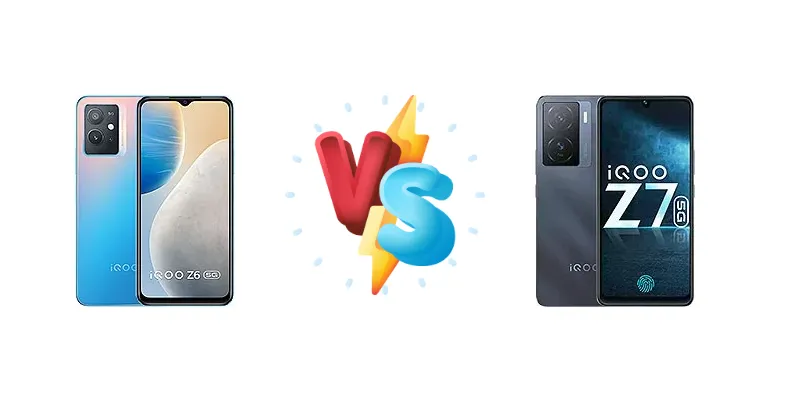
The vivo iQOO series consistently delivers impressive value in the budget smartphone market. The iQOO Z6 and Z7 are two popular contenders, each offering a compelling blend of features and affordability. But which one reigns supreme? Let's dive into a detailed comparison to help you decide.
🏆 Quick Verdict
The iQOO Z7 is the clear winner, boasting a significantly faster Dimensity 920 chipset, faster charging (44W vs 18W), and a generally improved experience. While the Z6 remains a decent budget option, the Z7's upgrades make it a worthwhile investment for most users.
| Network |
|---|
| 2G bands | GSM 850 / 900 / 1800 / 1900 | GSM 850 / 900 / 1800 / 1900 |
| 3G bands | HSDPA 850 / 900 / 2100 | HSDPA 850 / 900 / 2100 |
| 4G bands | 1, 3, 5, 8, 38, 40, 41 | 1, 3, 5, 8, 38, 40, 41 |
| 5G bands | 77, 78 SA/NSA | 1, 3, 8, 28, 77, 78 SA/NSA |
| Speed | HSPA, LTE, 5G | HSPA, LTE, 5G |
| Technology | GSM / HSPA / LTE / 5G | GSM / HSPA / LTE / 5G |
| Launch |
|---|
| Announced | 2022, March 16 | 2023, March 17 |
| Status | Available. Released 2022, March 22 | Available. Released 2023, March 21 |
| Body |
|---|
| Build | Glass front, plastic frame, plastic back | - |
| Dimensions | 164 x 75.8 x 8.3 mm (6.46 x 2.98 x 0.33 in) | 158.9 x 73.5 x 7.8 mm (6.26 x 2.89 x 0.31 in) |
| SIM | Nano-SIM + Nano-SIM | Nano-SIM + Nano-SIM |
| Weight | 185 g (6.53 oz) | 173 g (6.10 oz) |
| | - | IP54, dust and water resistant |
| Display |
|---|
| Protection | - | Schott Xensation glass |
| Resolution | 1080 x 2408 pixels, 20:9 ratio (~401 ppi density) | 1080 x 2400 pixels, 20:9 ratio (~413 ppi density) |
| Size | 6.58 inches, 104.3 cm2 (~83.9% screen-to-body ratio) | 6.38 inches, 98.3 cm2 (~84.1% screen-to-body ratio) |
| Type | IPS LCD, 120Hz | AMOLED, 90Hz, HDR10+, 1300 nits (peak) |
| Platform |
|---|
| CPU | Octa-core (2x2.2 GHz Kryo 660 Gold & 6x1.7 GHz Kryo 660 Silver) | Octa-core (2x2.5 GHz Cortex-A78 & 6x2.0 GHz Cortex-A55) |
| Chipset | Qualcomm SM6375 Snapdragon 695 5G (6 nm) | Mediatek Dimensity 920 (6 nm) |
| GPU | Adreno 619 | Mali-G68 MC4 |
| OS | Android 12, Funtouch 12 | Android 13, upgradable to Android 14, Funtouch 14 |
| Memory |
|---|
| Card slot | microSDXC (uses shared SIM slot) | microSDXC (uses shared SIM slot) |
| Internal | 128GB 4GB RAM, 128GB 6GB RAM, 128GB 8GB RAM | 128GB 6GB RAM, 128GB 8GB RAM |
| | - | UFS 2.2 |
| Main Camera |
|---|
| Dual | - | 64 MP, (wide), 1/1.97", 0.7µm, PDAF, OIS
Auxiliary lens |
| Features | Dual-LED flash, HDR, panorama | LED flash, HDR, panorama |
| Single | 16 MP, f/2.0, (wide) | - |
| Triple | 50 MP, f/1.8, 26mm (wide), PDAF
2 MP (macro)
Auxiliary lens | - |
| Video | 1080p@30fps | 4K@30fps, 1080p@30fps |
| Selfie camera |
|---|
| Single | 16 MP, f/2.0, (wide) | 16 MP, f/2.0, (wide) |
| Video | 1080p@30fps | 1080p@30fps |
| Sound |
|---|
| 3.5mm jack | Yes | Yes |
| 35mm jack | Yes | Yes |
| Loudspeaker | Yes | Yes |
| Comms |
|---|
| Bluetooth | 5.1, A2DP, LE | 5.2, A2DP, LE |
| NFC | No | No |
| Positioning | GPS, GLONASS | GPS, GLONASS, GALILEO, BDS, QZSS |
| Radio | FM radio | Unspecified |
| USB | USB Type-C 2.0, OTG | USB Type-C 2.0, OTG |
| WLAN | Wi-Fi 802.11 a/b/g/n/ac, dual-band, Wi-Fi Direct | Wi-Fi 802.11 a/b/g/n/ac/6, dual-band, Wi-Fi Direct |
| Features |
|---|
| Sensors | Fingerprint (side-mounted), accelerometer, gyro, proximity, compass | Fingerprint (under display, optical), accelerometer, gyro, proximity, compass |
| Battery |
|---|
| Charging | 18W wired | 44W wired, 50% in 25 min |
| Type | 5000 mAh | 4500 mAh |
| Misc |
|---|
| Colors | Dynamo Black, Chromatic Blue | Norway Blue, Pacific Night |
| Models | I2127 | I2207 |
| Price | About 190 EUR | About 200 EUR |
| SAR | - | 1.15 W/kg (head) 0.84 W/kg (body) |
vivo iQOO Z6
- Affordable
- Reliable performance for basic tasks
- Decent battery life
- Slow charging
- Less powerful chipset
- Subpar camera performance
- Older design
vivo iQOO Z7
- Faster performance (Dimensity 920)
- 44W fast charging
- Improved camera
- Modern design
- Likely 120Hz display
- Slightly more expensive than Z6
- May lack some niche features
Display Comparison
Both phones likely feature a 6.67-inch FHD+ display, potentially with a 120Hz refresh rate on the Z7. The Z7 might offer slightly better color accuracy and brightness due to potential panel upgrades. Expect similar viewing angles and overall display quality, but the Z7 has a slight edge.
Camera Comparison
While both likely feature a 50MP main camera, the Z7 likely has improved image processing and potentially additional features like OIS (Optical Image Stabilization). Expect better low-light performance and more detailed photos from the Z7. The Z6's camera is serviceable but lacks the refinement of the Z7.
Performance
The iQOO Z7's Mediatek Dimensity 920 chipset is a substantial upgrade over the Snapdragon 695 in the Z6. Expect significantly faster app loading times, smoother multitasking, and better gaming performance on the Z7. The Z6 is adequate for everyday tasks but will struggle with demanding games or heavy workloads.
Battery Life
The iQOO Z7's 44W fast charging is a game-changer compared to the Z6's 18W. The Z7 can charge to 50% in just 25 minutes, while the Z6 will take considerably longer. Battery capacity is likely similar (around 5000mAh), so the Z7's faster charging provides a much more convenient experience.
Buying Guide
Who should buy the vivo iQOO Z6? Those on a very tight budget who prioritize a reliable, basic smartphone experience. Who should buy the vivo iQOO Z7? Anyone seeking a noticeable performance boost, faster charging, and a more modern feature set without breaking the bank.
Frequently Asked Questions
❓ Is the iQOO Z7 worth the extra money compared to the Z6?
Yes, the iQOO Z7 offers significant improvements in performance and charging speed, making it a worthwhile upgrade for most users.
❓ What kind of games can I play on the iQOO Z6 and Z7?
The Z6 can handle less demanding games at lower settings. The Z7 provides a much smoother gaming experience with higher graphics settings and frame rates.