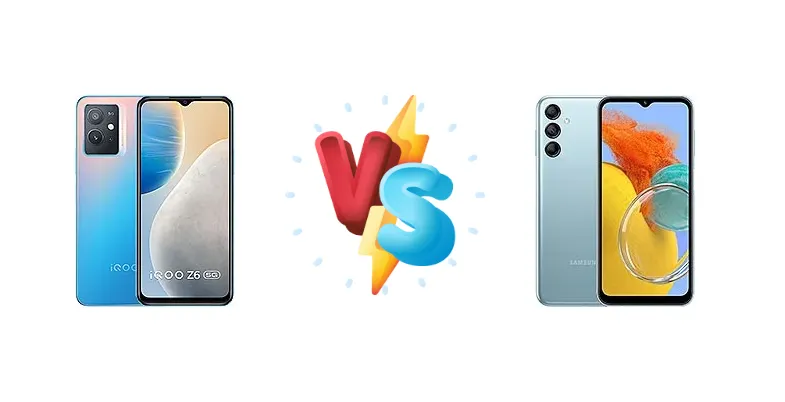
The budget smartphone market is fiercely competitive, and the vivo iQOO Z6 and Samsung Galaxy M14 are two strong contenders. Both offer compelling features at an affordable price, but which one reigns supreme? This comprehensive comparison will delve into their specs, performance, and overall value to help you make an informed decision.
🏆 Quick Verdict
The Samsung Galaxy M14 edges out the iQOO Z6 thanks to its more efficient chipset, larger battery, and potentially better software support. While the iQOO Z6 offers decent performance, the M14's overall package provides a more compelling experience for most users.
| Network |
|---|
| 2G bands | GSM 850 / 900 / 1800 / 1900 | GSM 850 / 900 / 1800 / 1900 |
| 3G bands | HSDPA 850 / 900 / 2100 | HSDPA 850 / 900 / 1700(AWS) / 1900 / 2100 |
| 4G bands | 1, 3, 5, 8, 38, 40, 41 | 1, 2, 3, 4, 5, 7, 8, 12, 17, 20, 26, 28, 38, 40, 41, 66 |
| 5G bands | 77, 78 SA/NSA | 1, 3, 5, 7, 8, 20, 28, 38, 40, 41, 66, 77, 78 SA/NSA |
| Speed | HSPA, LTE, 5G | HSPA, LTE, 5G |
| Technology | GSM / HSPA / LTE / 5G | GSM / HSPA / LTE / 5G |
| Launch |
|---|
| Announced | 2022, March 16 | 2023, March 08 |
| Status | Available. Released 2022, March 22 | Available. Released 2023, March 08 |
| Body |
|---|
| Build | Glass front, plastic frame, plastic back | Glass front (Gorilla Glass 5), plastic back, plastic frame |
| Dimensions | 164 x 75.8 x 8.3 mm (6.46 x 2.98 x 0.33 in) | 166.8 x 77.2 x 9.4 mm (6.57 x 3.04 x 0.37 in) |
| SIM | Nano-SIM + Nano-SIM | · Nano-SIM· Nano-SIM + Nano-SIM |
| Weight | 185 g (6.53 oz) | 206 g (7.27 oz) |
| Display |
|---|
| Protection | - | Corning Gorilla Glass 5 |
| Resolution | 1080 x 2408 pixels, 20:9 ratio (~401 ppi density) | 1080 x 2408 pixels, 20:9 ratio (~400 ppi density) |
| Size | 6.58 inches, 104.3 cm2 (~83.9% screen-to-body ratio) | 6.6 inches, 104.9 cm2 (~81.5% screen-to-body ratio) |
| Type | IPS LCD, 120Hz | PLS LCD, 90Hz |
| Platform |
|---|
| CPU | Octa-core (2x2.2 GHz Kryo 660 Gold & 6x1.7 GHz Kryo 660 Silver) | Octa-core (2x2.4 GHz Cortex-A78 & 6x2.0 GHz Cortex-A55) |
| Chipset | Qualcomm SM6375 Snapdragon 695 5G (6 nm) | Exynos 1330 (5 nm) |
| GPU | Adreno 619 | Mali-G68 MP2 |
| OS | Android 12, Funtouch 12 | Android 13, One UI core 5.1 |
| Memory |
|---|
| Card slot | microSDXC (uses shared SIM slot) | microSDHC (dedicated slot) |
| Internal | 128GB 4GB RAM, 128GB 6GB RAM, 128GB 8GB RAM | 64GB 4GB RAM, 128GB 4GB RAM, 128GB 6GB RAM |
| Main Camera |
|---|
| Features | Dual-LED flash, HDR, panorama | LED flash, panorama, HDR |
| Single | 16 MP, f/2.0, (wide) | 13 MP, f/2.0, (wide) |
| Triple | 50 MP, f/1.8, 26mm (wide), PDAF
2 MP (macro)
Auxiliary lens | 50 MP, f/1.8, (wide), PDAF
2 MP (macro)
Auxiliary lens |
| Video | 1080p@30fps | 1080p@30fps |
| Selfie camera |
|---|
| Single | 16 MP, f/2.0, (wide) | 13 MP, f/2.0, (wide) |
| Video | 1080p@30fps | 1080p@30fps |
| Sound |
|---|
| 3.5mm jack | Yes | Yes |
| 35mm jack | Yes | Yes |
| Loudspeaker | Yes | Yes |
| Comms |
|---|
| Bluetooth | 5.1, A2DP, LE | 5.2, A2DP, LE |
| NFC | No | Yes |
| Positioning | GPS, GLONASS | GPS, GLONASS, GALILEO, BDS, QZSS, NavIC |
| Radio | FM radio | Unspecified |
| USB | USB Type-C 2.0, OTG | USB Type-C 2.0 |
| WLAN | Wi-Fi 802.11 a/b/g/n/ac, dual-band, Wi-Fi Direct | Wi-Fi 802.11 a/b/g/n/ac, dual-band, Wi-Fi Direct |
| Features |
|---|
| Sensors | Fingerprint (side-mounted), accelerometer, gyro, proximity, compass | Fingerprint (side-mounted), accelerometer, gyro, proximity, compass |
| Battery |
|---|
| Charging | 18W wired | 15W wired - international
25W wired - India |
| Type | 5000 mAh | Li-Po 6000 mAh |
| Misc |
|---|
| Colors | Dynamo Black, Chromatic Blue | Navy Blue, Light Blue, Silver |
| Models | I2127 | SM-M146B, SM-M146B/DS, SM-M146B/DSN |
| Price | About 190 EUR | ₹ 10,990 |
| SAR EU | - | 0.48 W/kg (head) 1.53 W/kg (body) |
vivo iQOO Z6
- Potentially higher refresh rate display
- Compact design (compared to M14)
- Decent gaming performance for the price
- Less efficient chipset
- Smaller battery
- Slower charging speed
Samsung Galaxy M14
- More efficient chipset (Exynos 1330)
- Larger battery for longer battery life
- Potentially better camera image processing
- Samsung's software support
- Slower charging speed (international version)
- Larger and potentially less comfortable to hold
Display Comparison
Both phones feature large displays, typically around 6.6 inches. The iQOO Z6 often has a slightly higher refresh rate (120Hz vs. 90Hz on the M14), resulting in smoother scrolling and animations. However, panel quality (AMOLED vs. IPS) can vary depending on the specific region and variant, with the M14 potentially offering better color accuracy and contrast if it uses an AMOLED panel.
Camera Comparison
Camera performance is often subjective. The iQOO Z6 typically features a 50MP main camera, while the Galaxy M14 often has a similar resolution. Image processing and software optimization play a crucial role. Samsung's image processing is generally considered more refined, resulting in more consistent and pleasing photos, especially in challenging lighting conditions. Both phones likely include ultrawide and macro lenses.
Performance
The Samsung Galaxy M14's Exynos 1330 (5nm) generally outperforms the iQOO Z6's Snapdragon 695 (6nm) in sustained performance and efficiency. The Exynos 1330's Cortex-A78 cores provide a noticeable boost in everyday tasks and multitasking. While the iQOO Z6 is capable of handling casual games, the M14 will handle more demanding titles better.
Battery Life
The Samsung Galaxy M14 boasts a significantly larger battery (typically 6000mAh) compared to the iQOO Z6 (typically 5000mAh). This translates to noticeably longer battery life, easily lasting a full day or more with moderate usage. While the M14's charging speed is slower internationally (15W), the Indian variant offers 25W charging, still competitive with the iQOO Z6's 18W.
Buying Guide
The vivo iQOO Z6 is a good choice for users prioritizing gaming performance within a tight budget and who appreciate a slightly more compact design. The Samsung Galaxy M14 is ideal for those seeking long battery life, a smoother user experience, and the reliability of the Samsung brand, even if it means slightly slower gaming.
Frequently Asked Questions
❓ Which phone is better for gaming?
While both can handle casual games, the Samsung Galaxy M14's more powerful chipset generally provides a smoother and more consistent gaming experience, especially for demanding titles.
❓ How long does the battery last on each phone?
The Samsung Galaxy M14's 6000mAh battery typically lasts a full day or more with moderate usage, while the iQOO Z6's 5000mAh battery will likely require charging before the end of the day with similar usage.