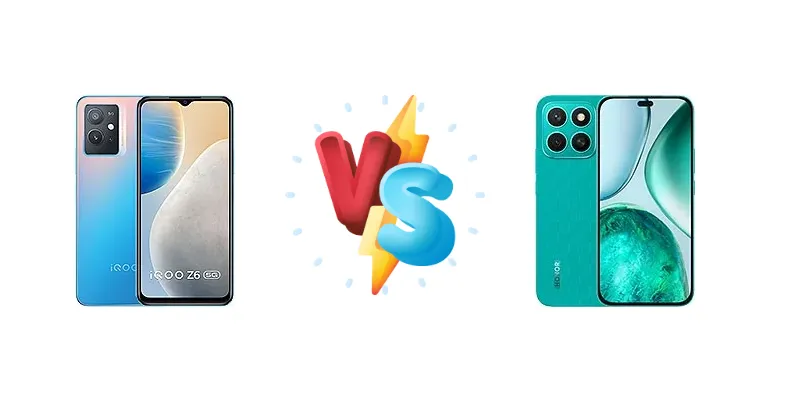
The sub-$250 5G smartphone market is fiercely competitive. The vivo iQOO Z6 and Honor X8c both aim to deliver connectivity and functionality without breaking the bank, but they take different approaches. The iQOO Z6 prioritizes a newer generation Snapdragon chipset, while the Honor X8c focuses on significantly faster charging speeds. This comparison dissects the key differences to determine which phone offers the best value.
🏆 Quick Verdict
For users prioritizing sustained performance and a slightly more modern chipset, the vivo iQOO Z6 is the better choice. However, the Honor X8c’s 35W charging is a game-changer for those who frequently find themselves needing a quick power boost, making it ideal for on-the-go users.
| Network |
|---|
| 2G bands | GSM 850 / 900 / 1800 / 1900 | GSM 850 / 900 / 1800 / 1900 |
| 3G bands | HSDPA 850 / 900 / 2100 | HSDPA 850 / 900 / 1900 / 2100 |
| 4G bands | 1, 3, 5, 8, 38, 40, 41 | LTE |
| 5G bands | 77, 78 SA/NSA | - |
| Speed | HSPA, LTE, 5G | HSPA, LTE |
| Technology | GSM / HSPA / LTE / 5G | GSM / HSPA / LTE |
| Launch |
|---|
| Announced | 2022, March 16 | 2025, January 14 |
| Status | Available. Released 2022, March 22 | Available. Released 2025, January 20 |
| Body |
|---|
| Build | Glass front, plastic frame, plastic back | Glass front, plastic frame, plastic back or silicone polymer back (eco leather) |
| Dimensions | 164 x 75.8 x 8.3 mm (6.46 x 2.98 x 0.33 in) | 161.1 x 74.6 x 7.1 mm (6.34 x 2.94 x 0.28 in) |
| SIM | Nano-SIM + Nano-SIM | Nano-SIM + Nano-SIM |
| Weight | 185 g (6.53 oz) | 174 g (6.14 oz) |
| Display |
|---|
| Resolution | 1080 x 2408 pixels, 20:9 ratio (~401 ppi density) | 1080 x 2412 pixels, 20:9 ratio (~394 ppi density) |
| Size | 6.58 inches, 104.3 cm2 (~83.9% screen-to-body ratio) | 6.7 inches, 108.0 cm2 (~89.9% screen-to-body ratio) |
| Type | IPS LCD, 120Hz | AMOLED, 120Hz, 1200 nits (HBM), 2800 nits (peak) |
| Platform |
|---|
| CPU | Octa-core (2x2.2 GHz Kryo 660 Gold & 6x1.7 GHz Kryo 660 Silver) | Octa-core (4x2.8 GHz Cortex-A73 & 4x1.9 GHz Cortex-A53) |
| Chipset | Qualcomm SM6375 Snapdragon 695 5G (6 nm) | Qualcomm SM6225 Snapdragon 685 (6 nm) |
| GPU | Adreno 619 | Adreno 610 |
| OS | Android 12, Funtouch 12 | Android 15, MagicOS 9 |
| Memory |
|---|
| Card slot | microSDXC (uses shared SIM slot) | No |
| Internal | 128GB 4GB RAM, 128GB 6GB RAM, 128GB 8GB RAM | 128GB 6GB RAM, 128GB 8GB RAM, 256GB 8GB RAM, 512GB 8GB RAM |
| Main Camera |
|---|
| Dual | - | 108 MP, f/1.8, 24mm (wide), 1/1.67", PDAF, OIS
5 MP, f/2.2, (ultrawide) |
| Features | Dual-LED flash, HDR, panorama | LED flash, HDR, panorama |
| Single | 16 MP, f/2.0, (wide) | - |
| Triple | 50 MP, f/1.8, 26mm (wide), PDAF
2 MP (macro)
Auxiliary lens | - |
| Video | 1080p@30fps | 1080p@30fps, gyro-EIS |
| Selfie camera |
|---|
| Single | 16 MP, f/2.0, (wide) | 50 MP, f/2.1, (wide) |
| Video | 1080p@30fps | 1080p@30fps |
| Sound |
|---|
| 3.5mm jack | Yes | - |
| 35mm jack | Yes | No |
| Loudspeaker | Yes | Yes |
| Comms |
|---|
| Bluetooth | 5.1, A2DP, LE | 5.0/5.1, A2DP, LE |
| NFC | No | Yes (market/region dependent) |
| Positioning | GPS, GLONASS | GPS, GLONASS, GALILEO, BDS |
| Radio | FM radio | No |
| USB | USB Type-C 2.0, OTG | USB Type-C 2.0, OTG |
| WLAN | Wi-Fi 802.11 a/b/g/n/ac, dual-band, Wi-Fi Direct | Wi-Fi 802.11 a/b/g/n/ac, dual-band, Wi-Fi Direct |
| Features |
|---|
| Sensors | Fingerprint (side-mounted), accelerometer, gyro, proximity, compass | Fingerprint (under display, optical), accelerometer, gyro, compass, proximity (ultrasonic) |
| Battery |
|---|
| Charging | 18W wired | 35W wired |
| Type | 5000 mAh | Li-Po 5000 mAh |
| Misc |
|---|
| Colors | Dynamo Black, Chromatic Blue | Marrs Green, Midnight Black, Moonlight White, Cloud Purple |
| Models | I2127 | ABR-LX1, ABR-LX2, ABR-LX3 |
| Price | About 190 EUR | € 190.78 / $ 213.42 / £ 159.00 |
vivo iQOO Z6
- More modern Snapdragon 695 chipset
- Potentially better sustained performance
- Slightly better gaming capabilities
- Slower 18W charging
- Display specs are likely basic
- Camera performance is unknown
Honor X8c
- Significantly faster 35W charging
- Higher CPU clock speeds (though older architecture)
- Convenient for heavy smartphone users
- Older Snapdragon 685 chipset
- Potentially lower sustained performance
- Gaming performance may be limited
Display Comparison
Neither device boasts a standout display. Both likely utilize LCD panels, common in this price bracket. The focus here isn't on visual fidelity, but on practicality. Without specific display specs, we can assume similar resolutions and refresh rates. The real differentiator will be color accuracy and peak brightness, which are unknown. Bezels are likely comparable, aiming for maximizing screen real estate within the budget constraints.
Camera Comparison
Without detailed camera specs, a direct comparison is difficult. Both phones likely feature a multi-camera setup with a primary sensor and supporting lenses. However, the quality of image processing and sensor size will be crucial. We can assume both will struggle in low-light conditions. The presence of a 2MP macro lens on either device is largely a marketing tactic, offering minimal practical benefit. The Snapdragon 695’s ISP (Image Signal Processor) in the iQOO Z6 *may* offer slightly better image processing capabilities, but this is speculative without further data.
Performance
The core difference lies in the chipsets. The iQOO Z6’s Snapdragon 695 (6nm) features a Kryo 660 Gold/Silver CPU configuration, offering a balance of performance and efficiency. Its 2x2.2 GHz cores provide a performance edge over the Honor X8c’s Snapdragon 685 (6nm). The X8c utilizes a Cortex-A73/A53 configuration with higher clock speeds (4x2.8 GHz), but the older architecture means it won’t match the 695’s sustained performance. The 695 also benefits from a more modern GPU, translating to better gaming capabilities. While both are 6nm, the architectural improvements in the 695 give it a clear advantage for demanding tasks.
Battery Life
The Honor X8c’s 35W charging is the standout feature here. This significantly reduces charging times compared to the iQOO Z6’s 18W charging. While battery capacity isn’t specified, the faster charging speed allows the X8c to recover quickly from heavy usage. The iQOO Z6 will likely offer comparable battery life with moderate use, but the X8c’s ability to top up rapidly provides a significant convenience factor. The 6nm Snapdragon 695 in the iQOO Z6 *may* offer slightly better power efficiency, but the difference will likely be marginal.
Buying Guide
Buy the vivo iQOO Z6 if you need a phone capable of handling moderate gaming and multitasking with a more recent Snapdragon processor. It’s suited for users who value a smoother overall experience, even if it means slightly slower charging. Buy the Honor X8c if you prioritize rapid charging and are a heavy smartphone user who needs to minimize downtime. It’s the better option for those who value convenience and aren’t demanding gamers.
Frequently Asked Questions
❓ Will the Snapdragon 685 in the Honor X8c struggle with graphically intensive games like PUBG Mobile?
The Snapdragon 685 can run PUBG Mobile, but you’ll likely need to lower the graphics settings to achieve a smooth frame rate. The older architecture and GPU aren’t optimized for demanding games like the Snapdragon 695 in the iQOO Z6, which will offer a more consistent gaming experience.
❓ How long does it *actually* take to fully charge the Honor X8c with the 35W charger?
While Honor doesn't specify exact charging times, 35W charging typically takes a phone from 0-100% in around 60-75 minutes, depending on battery capacity. This is significantly faster than the iQOO Z6’s 18W charging, which could take over 2 hours.
❓ Is the difference in chipset performance between the Snapdragon 695 and 685 noticeable in everyday tasks like browsing and social media?
For basic tasks like browsing, social media, and messaging, the difference will be minimal. Both phones will handle these tasks smoothly. The performance gap becomes more apparent during multitasking, app switching, and demanding applications.
❓ Does either phone support VoLTE or VoWiFi for improved call quality?
Support for VoLTE and VoWiFi depends on the carrier and region. Both phones are likely to support these features, but it’s crucial to check with your mobile carrier to confirm compatibility.