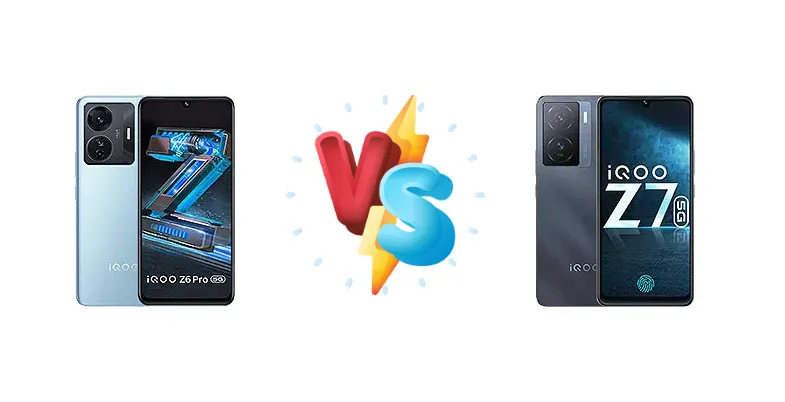
The vivo iQOO Z series consistently delivers impressive value in the budget smartphone market. The iQOO Z6 Pro and Z7 are the latest contenders, each boasting unique features and improvements. But which one is the right choice for you? Let's dive into a comprehensive comparison.
🏆 Quick Verdict
The iQOO Z6 Pro takes the lead thanks to its significantly faster charging and the Snapdragon 778G chipset, offering a smoother overall experience. However, the iQOO Z7 might appeal to those prioritizing a larger display and potentially better camera performance, depending on specific usage.
| Network |
|---|
| 2G bands | GSM 850 / 900 / 1800 / 1900 | GSM 850 / 900 / 1800 / 1900 |
| 3G bands | HSDPA 850 / 900 / 2100 | HSDPA 850 / 900 / 2100 |
| 4G bands | 1, 3, 5, 8, 38, 40, 41 | 1, 3, 5, 8, 38, 40, 41 |
| 5G bands | 1, 3, 5, 8, 41, 77, 78 SA/NSA | 1, 3, 8, 28, 77, 78 SA/NSA |
| Speed | HSPA, LTE, 5G | HSPA, LTE, 5G |
| Technology | GSM / HSPA / LTE / 5G | GSM / HSPA / LTE / 5G |
| Launch |
|---|
| Announced | 2022, April 27 | 2023, March 17 |
| Status | Available. Released 2022, May 03 | Available. Released 2023, March 21 |
| Body |
|---|
| Build | Glass front, plastic frame, plastic back | - |
| Dimensions | 159.7 x 73.6 x 8.5 mm (6.29 x 2.90 x 0.33 in) | 158.9 x 73.5 x 7.8 mm (6.26 x 2.89 x 0.31 in) |
| SIM | Nano-SIM + Nano-SIM | Nano-SIM + Nano-SIM |
| Weight | 180 g (6.35 oz) | 173 g (6.10 oz) |
| | - | IP54, dust and water resistant |
| Display |
|---|
| Protection | Panda Glass | Schott Xensation glass |
| Resolution | 1080 x 2404 pixels, 20:9 ratio (~409 ppi density) | 1080 x 2400 pixels, 20:9 ratio (~413 ppi density) |
| Size | 6.44 inches, 100.0 cm2 (~85.1% screen-to-body ratio) | 6.38 inches, 98.3 cm2 (~84.1% screen-to-body ratio) |
| Type | AMOLED, 90Hz, HDR10+, 1300 nits (peak) | AMOLED, 90Hz, HDR10+, 1300 nits (peak) |
| Platform |
|---|
| CPU | Octa-core (1x2.4 GHz Cortex-A78 & 3x2.2 GHz Cortex-A78 & 4x1.9 GHz Cortex-A55) | Octa-core (2x2.5 GHz Cortex-A78 & 6x2.0 GHz Cortex-A55) |
| Chipset | Qualcomm SM7325 Snapdragon 778G 5G (6 nm) | Mediatek Dimensity 920 (6 nm) |
| GPU | Adreno 642L | Mali-G68 MC4 |
| OS | Android 12, Funtouch 12 | Android 13, upgradable to Android 14, Funtouch 14 |
| Memory |
|---|
| Card slot | No | microSDXC (uses shared SIM slot) |
| Internal | 128GB 6GB RAM, 128GB 8GB RAM, 256GB 12GB RAM | 128GB 6GB RAM, 128GB 8GB RAM |
| | - | UFS 2.2 |
| Main Camera |
|---|
| Dual | - | 64 MP, (wide), 1/1.97", 0.7µm, PDAF, OIS
Auxiliary lens |
| Features | Dual-LED dual-tone flash, HDR, panorama | LED flash, HDR, panorama |
| Single | 16 MP, f/2.0, (wide) | - |
| Triple | 64 MP, f/1.8, 26mm (wide), PDAF
8 MP, f/2.2, 117˚ (ultrawide)
2 MP (macro) | - |
| Video | 4K@30fps, 1080p@30/60fps, gyro-EIS | 4K@30fps, 1080p@30fps |
| Selfie camera |
|---|
| Single | 16 MP, f/2.0, (wide) | 16 MP, f/2.0, (wide) |
| Video | 1080p@30fps | 1080p@30fps |
| Sound |
|---|
| 3.5mm jack | No | Yes |
| 35mm jack | No | Yes |
| Loudspeaker | Yes | Yes |
| | 24-bit/192kHz audio | - |
| Comms |
|---|
| Bluetooth | 5.2, A2DP, LE | 5.2, A2DP, LE |
| NFC | No | No |
| Positioning | GPS, GLONASS, GALILEO, BDS | GPS, GLONASS, GALILEO, BDS, QZSS |
| Radio | No | Unspecified |
| USB | USB Type-C 2.0, OTG | USB Type-C 2.0, OTG |
| WLAN | Wi-Fi 802.11 a/b/g/n/ac/6, dual-band, Wi-Fi Direct | Wi-Fi 802.11 a/b/g/n/ac/6, dual-band, Wi-Fi Direct |
| Features |
|---|
| Sensors | Fingerprint (under display, optical), accelerometer, gyro, proximity, compass | Fingerprint (under display, optical), accelerometer, gyro, proximity, compass |
| Battery |
|---|
| Charging | 66W wired, 50% in 18 min | 44W wired, 50% in 25 min |
| Type | 4700 mAh | 4500 mAh |
| Misc |
|---|
| Colors | Phantom Dusk, Legion Sky | Norway Blue, Pacific Night |
| Models | - | I2207 |
| Price | About 300 EUR | About 200 EUR |
| SAR | - | 1.15 W/kg (head) 0.84 W/kg (body) |
vivo iQOO Z6 Pro
- Faster Charging (66W)
- More Powerful Chipset (Snapdragon 778G)
- Compact Design
- Good Value
- Potentially slightly less impressive camera (depending on software)
vivo iQOO Z7
- Larger Display
- Potentially Improved Camera Sensor
- Good Value
- Slower Charging (44W)
- Less Powerful Chipset (Dimensity 920)
Display Comparison
The iQOO Z7 features a larger 6.64-inch display compared to the Z6 Pro's 6.44-inch screen. Both utilize AMOLED panels with a 120Hz refresh rate, offering vibrant colors and smooth scrolling. The Z7's larger size makes it better for media consumption, while the Z6 Pro's more compact form factor might be preferred for one-handed use.
Camera Comparison
While both phones offer capable camera systems, the iQOO Z7 is rumored to have a slightly improved main sensor. The Z6 Pro typically features a 64MP main camera, while the Z7 is expected to have a 64MP main camera with an OIS. Both have similar ultrawide and macro lenses. Real-world camera performance will depend on software processing and specific shooting conditions.
Performance
The iQOO Z6 Pro's Qualcomm Snapdragon 778G 5G chipset is the clear performance winner. It generally outperforms the iQOO Z7's MediaTek Dimensity 920 in both CPU and GPU benchmarks, resulting in smoother multitasking and better gaming performance. The Snapdragon 778G also benefits from better software optimization in many cases.
Battery Life
The iQOO Z6 Pro shines in this category with its 66W fast charging, capable of reaching 50% charge in just 18 minutes. The iQOO Z7's 44W charging takes considerably longer, reaching 50% in 25 minutes. Both phones likely have similar battery capacities (around 5000mAh), but the Z6 Pro's faster charging provides a significant advantage.
Buying Guide
Who should buy the vivo iQOO Z6 Pro? Gamers and power users who value fast charging and a robust chipset. Who should buy the vivo iQOO Z7? Users prioritizing a larger screen for media consumption and potentially a slightly improved camera experience, willing to trade off charging speed.
Frequently Asked Questions
❓ Is the iQOO Z7 worth the upgrade from the Z6 Pro?
It depends on your priorities. If you value a larger screen and potentially a slightly better camera, the Z7 is worth considering. However, the Z6 Pro's superior performance and faster charging make it a stronger overall choice for most users.
❓ Which chipset is better, Snapdragon 778G or Dimensity 920?
The Snapdragon 778G generally offers better performance and efficiency compared to the Dimensity 920, especially in gaming and demanding applications.