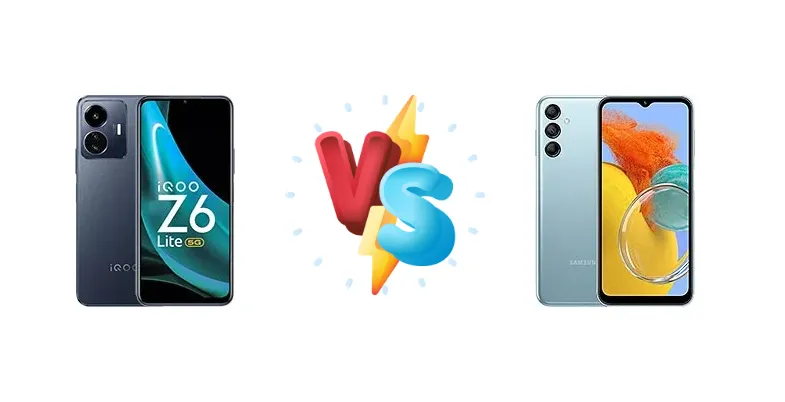
The budget smartphone market is fiercely competitive, and the vivo iQOO Z6 Lite and Samsung Galaxy M14 are two strong contenders. Both offer compelling features at an affordable price, but which one reigns supreme? This comprehensive comparison will delve into their specs, performance, and overall value to help you make an informed decision.
🏆 Quick Verdict
The Samsung Galaxy M14 edges out the iQOO Z6 Lite thanks to its superior chipset, slightly better camera capabilities, and faster charging (especially in India). While the iQOO Z6 Lite offers a competitive price, the M14 provides a more well-rounded experience.
| Network |
|---|
| 2G bands | GSM 850 / 900 / 1800 / 1900 | GSM 850 / 900 / 1800 / 1900 |
| 3G bands | HSDPA 850 / 900 / 2100 | HSDPA 850 / 900 / 1700(AWS) / 1900 / 2100 |
| 4G bands | 1, 3, 5, 8, 38, 40, 41 | 1, 2, 3, 4, 5, 7, 8, 12, 17, 20, 26, 28, 38, 40, 41, 66 |
| 5G bands | 77, 78 SA/NSA | 1, 3, 5, 7, 8, 20, 28, 38, 40, 41, 66, 77, 78 SA/NSA |
| Speed | HSPA, LTE, 5G | HSPA, LTE, 5G |
| Technology | GSM / HSPA / LTE / 5G | GSM / HSPA / LTE / 5G |
| Launch |
|---|
| Announced | 2022, September 14 | 2023, March 08 |
| Status | Available. Released 2022, September 14 | Available. Released 2023, March 08 |
| Body |
|---|
| Build | Glass front, plastic frame, plastic back | Glass front (Gorilla Glass 5), plastic back, plastic frame |
| Dimensions | 164 x 75.8 x 8.3 mm (6.46 x 2.98 x 0.33 in) | 166.8 x 77.2 x 9.4 mm (6.57 x 3.04 x 0.37 in) |
| SIM | Nano-SIM + Nano-SIM | · Nano-SIM· Nano-SIM + Nano-SIM |
| Weight | 194 g (6.84 oz) | 206 g (7.27 oz) |
| Display |
|---|
| Protection | - | Corning Gorilla Glass 5 |
| Resolution | 1080 x 2408 pixels, 20:9 ratio (~401 ppi density) | 1080 x 2408 pixels, 20:9 ratio (~400 ppi density) |
| Size | 6.58 inches, 104.3 cm2 (~83.9% screen-to-body ratio) | 6.6 inches, 104.9 cm2 (~81.5% screen-to-body ratio) |
| Type | IPS LCD, 120Hz | PLS LCD, 90Hz |
| Platform |
|---|
| CPU | Octa-core (2x2.0 GHz Cortex-A78 & 6x1.8 GHz Cortex-A55) | Octa-core (2x2.4 GHz Cortex-A78 & 6x2.0 GHz Cortex-A55) |
| Chipset | Qualcomm SM4375 Snapdragon 4 Gen 1 (6 nm) | Exynos 1330 (5 nm) |
| GPU | Adreno 619 | Mali-G68 MP2 |
| OS | Android 12, Funtouch 12 | Android 13, One UI core 5.1 |
| Memory |
|---|
| Card slot | microSDXC (uses shared SIM slot) | microSDHC (dedicated slot) |
| Internal | 64GB 4GB RAM, 128GB 6GB RAM | 64GB 4GB RAM, 128GB 4GB RAM, 128GB 6GB RAM |
| Main Camera |
|---|
| Dual | 50 MP, f/1.8, (wide), PDAF
2 MP (macro) | - |
| Features | Dual-LED dual-tone flash, HDR, panorama | LED flash, panorama, HDR |
| Single | 8 MP, f/2.0, (wide) | 13 MP, f/2.0, (wide) |
| Triple | - | 50 MP, f/1.8, (wide), PDAF
2 MP (macro)
Auxiliary lens |
| Video | 1080p@30fps | 1080p@30fps |
| Selfie camera |
|---|
| Single | 8 MP, f/2.0, (wide) | 13 MP, f/2.0, (wide) |
| Video | 1080p@30fps | 1080p@30fps |
| Sound |
|---|
| 3.5mm jack | Yes | Yes |
| 35mm jack | Yes | Yes |
| Loudspeaker | Yes | Yes |
| Comms |
|---|
| Bluetooth | 5.1, A2DP, LE | 5.2, A2DP, LE |
| NFC | No | Yes |
| Positioning | GPS, GLONASS, GALILEO, BDS, QZSS | GPS, GLONASS, GALILEO, BDS, QZSS, NavIC |
| Radio | FM radio | Unspecified |
| USB | USB Type-C 2.0, OTG | USB Type-C 2.0 |
| WLAN | Wi-Fi 802.11 a/b/g/n/ac, dual-band, Wi-Fi Direct | Wi-Fi 802.11 a/b/g/n/ac, dual-band, Wi-Fi Direct |
| Features |
|---|
| Sensors | Fingerprint (side-mounted), accelerometer, proximity, compass | Fingerprint (side-mounted), accelerometer, gyro, proximity, compass |
| Battery |
|---|
| Charging | 18W wired | 15W wired - international
25W wired - India |
| Type | 5000 mAh | Li-Po 6000 mAh |
| Misc |
|---|
| Colors | Mystic Night, Stellar Green | Navy Blue, Light Blue, Silver |
| Models | I2208 | SM-M146B, SM-M146B/DS, SM-M146B/DSN |
| Price | About 180 EUR | ₹ 10,990 |
| SAR EU | - | 0.48 W/kg (head) 1.53 W/kg (body) |
vivo iQOO Z6 Lite
- Very affordable
- Decent performance for basic tasks
- Lightweight design
- Less powerful chipset
- Slower charging
- Basic camera system
Samsung Galaxy M14
- More powerful chipset (Exynos 1330)
- Excellent battery life
- Better camera system
- Faster charging (India)
- Slightly more expensive
- Design may be less appealing to some
Display Comparison
Both phones feature large 6.67-inch displays, likely with an LCD panel and a resolution of 1080 x 2408 pixels (FHD+). The Galaxy M14 might offer slightly better color accuracy and brightness due to Samsung's display technology, but the difference will be minimal for most users. Refresh rate is likely 90Hz on both.
Camera Comparison
The Galaxy M14 typically features a triple camera setup with a 50MP main sensor, an 8MP ultrawide, and a 2MP macro lens. The iQOO Z6 Lite usually has a 50MP main camera, a 2MP macro, and a depth sensor. While megapixel counts aren't everything, the M14's likely better image processing and wider ultrawide lens give it an advantage in overall camera quality, especially in low light.
Performance
Here's where the Galaxy M14 takes a significant lead. The Exynos 1330 (5nm) is considerably more powerful than the Snapdragon 4 Gen 1 (6nm). Expect smoother multitasking, faster app loading times, and better gaming performance on the M14. The iQOO Z6 Lite will handle everyday tasks adequately, but may struggle with demanding games or heavy applications.
Battery Life
The Galaxy M14 boasts a larger 6000mAh battery, providing excellent battery life. The iQOO Z6 Lite typically has a 5000mAh battery, which is still respectable but won't last as long. The M14's 25W charging (in India) is also faster than the iQOO Z6 Lite's 18W charging.
Buying Guide
The vivo iQOO Z6 Lite is ideal for users prioritizing a very budget-friendly option and are less concerned with raw performance or advanced camera features. The Samsung Galaxy M14 is a better choice for those seeking a smoother experience, a more capable camera, and faster charging, even if it means spending a bit more.
Frequently Asked Questions
❓ Which phone is better for gaming?
The Samsung Galaxy M14 is significantly better for gaming due to its more powerful Exynos 1330 chipset.
❓ Does the Galaxy M14 support 5G?
Yes, the Samsung Galaxy M14 supports 5G connectivity.
❓ What is the difference in battery life between the two phones?
The Galaxy M14's 6000mAh battery provides noticeably longer battery life than the iQOO Z6 Lite's 5000mAh battery.