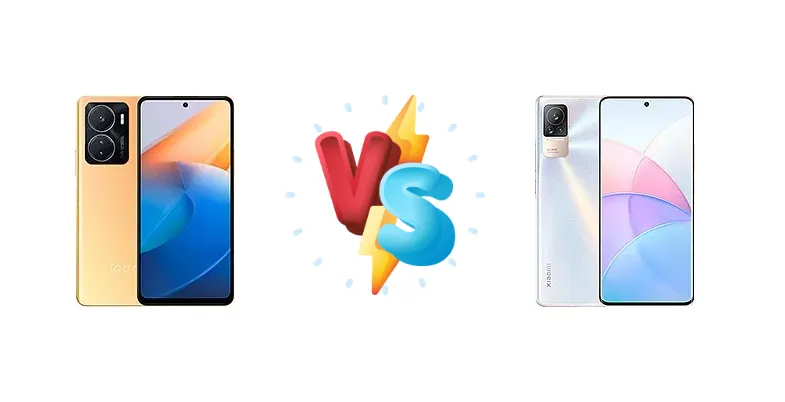
The vivo iQOO Z6 (China) and Xiaomi Civi 1S represent compelling options in the increasingly competitive mid-range smartphone market. Both devices center around the Qualcomm Snapdragon 778G+ 5G chipset, promising strong performance. However, key differences in charging speed and potentially other areas dictate which phone is the better fit for different users. This comparison dissects those differences to help you make an informed decision.
🏆 Quick Verdict
For users prioritizing the fastest possible charging and potentially more sustained performance under load, the iQOO Z6 emerges as the winner. Its 80W charging significantly reduces downtime compared to the Civi 1S’s 55W solution. While both phones offer similar core performance, the iQOO Z6’s charging advantage is a decisive factor for many.
| Network |
|---|
| 2G bands | GSM 850 / 900 / 1800 / 1900 | GSM 850 / 900 / 1800 / 1900 |
| 3G bands | HSDPA 850 / 900 / 1700(AWS) / 2100 | HSDPA 850 / 900 / 1700(AWS) / 1900 / 2100 |
| 4G bands | 1, 3, 4, 5, 8, 28, 34, 38, 39, 40, 41 | 1, 2, 3, 4, 5, 7, 8, 18, 19, 26, 34, 38, 39, 40, 41, 42 |
| 5G bands | 1, 5, 8, 28, 41, 77, 78 SA/NSA | 1, 3, 5, 8, 28, 38, 41, 77, 78 SA/NSA |
| Speed | HSPA, LTE, 5G | HSPA, LTE, 5G |
| Technology | GSM / CDMA / HSPA / CDMA2000 / LTE / 5G | GSM / CDMA / HSPA / CDMA2000 / LTE / 5G |
| | CDMA2000 1x | CDMA2000 1x |
| Launch |
|---|
| Announced | 2022, August 25 | 2022, April 21 |
| Status | Available. Released 2022, September 01 | Available. Released 2022, April 21 |
| Body |
|---|
| Build | - | Glass front (Gorilla Glass 5), glass back, aluminum frame |
| Dimensions | 164 x 75.8 x 8.6 mm (6.46 x 2.98 x 0.34 in) | 158.3 x 71.5 x 7 mm (6.23 x 2.81 x 0.28 in) |
| SIM | Nano-SIM + Nano-SIM | Nano-SIM + Nano-SIM |
| Weight | 194.6 g (6.88 oz) | 166 g (5.86 oz) |
| Display |
|---|
| Protection | - | Corning Gorilla Glass 5 |
| Resolution | 1080 x 2388 pixels (~396 ppi density) | 1080 x 2400 pixels, 20:9 ratio (~402 ppi density) |
| Size | 6.64 inches, 106.3 cm2 (~85.5% screen-to-body ratio) | 6.55 inches, 103.6 cm2 (~91.5% screen-to-body ratio) |
| Type | IPS LCD, 120Hz, HDR10, 650 nits (HBM) | OLED, 1B colors, Dolby Vision, HDR10+, 120Hz, 950 nits (peak) |
| Platform |
|---|
| CPU | Octa-core (1x2.5 GHz Cortex-A78 & 3x2.4 GHz Cortex-A78 & 4x1.9 GHz Cortex-A55) | Octa-core (1x2.5 GHz Cortex-A78 & 3x2.4 GHz Cortex-A78 & 4x1.9 GHz Cortex-A55) |
| Chipset | Qualcomm SM7325-AE Snapdragon 778G+ 5G (6 nm) | Qualcomm SM7325-AE Snapdragon 778G+ 5G (6 nm) |
| GPU | Adreno 642L | Adreno 642L |
| OS | Android 12, OriginOS Ocean | Android 12, MIUI 13 |
| Memory |
|---|
| Card slot | No | No |
| Internal | 128GB 8GB RAM, 256GB 8GB RAM, 256GB 12GB RAM | 128GB 8GB RAM, 256GB 8GB RAM, 256GB 12GB RAM |
| | UFS 3.1 | UFS 2.2 |
| Main Camera |
|---|
| Features | Dual-LED dual-tone flash, HDR, panorama | Color spectrum sensor, LED flash, HDR, panorama |
| Single | 8 MP, f/2.0, (wide) | 32 MP, 24mm (wide), 0.8µm, AF |
| Triple | 64 MP, f/1.8, (wide), PDAF, OIS
2 MP (macro)
Auxiliary lens | 64 MP, f/1.8, 26mm (wide), 1/1.97", 0.7µm, PDAF
8 MP, f/2.2, 120˚ (ultrawide), 1/4.0", 1.12µm
2 MP (macro) |
| Video | 4K@30fps, 1080p@30/60fps, gyro-EIS | 4K@30fps, 1080p@30/60/120fps, 720p@960fps; gyro-EIS |
| Selfie camera |
|---|
| Features | - | HDR, panorama |
| Single | 8 MP, f/2.0, (wide) | 32 MP, 24mm (wide), 0.8µm, AF |
| Video | 1080p@30fps | 1080p@30/60fps |
| Sound |
|---|
| 3.5mm jack | Yes | No |
| 35mm jack | Yes | No |
| Loudspeaker | Yes | Yes, with stereo speakers |
| | 24-bit/192kHz audio | 24-bit/192kHz audio |
| Comms |
|---|
| Bluetooth | 5.2, A2DP, LE, aptX HD, aptX Adaptive | 5.2, A2DP, LE |
| Infrared port | - | Yes |
| NFC | Yes | Yes |
| Positioning | GPS, GLONASS, BDS, GALILEO, QZSS | GPS (L1+L5), GLONASS (L1), BDS (B1I+B1c+B2a), GALILEO (E1+E5a), QZSS (L1+L5), NavIC (L5) |
| Radio | No | No |
| USB | USB Type-C 2.0, OTG | USB Type-C 2.0, OTG |
| WLAN | Wi-Fi 802.11 a/b/g/n/ac/6, dual-band, Wi-Fi Direct | Wi-Fi 802.11 a/b/g/n/ac/6, dual-band, Wi-Fi Direct |
| Features |
|---|
| Sensors | Fingerprint (side-mounted), accelerometer, gyro, proximity, compass | Fingerprint (under display, optical), accelerometer, gyro, proximity, compass |
| Battery |
|---|
| Charging | 80W wired, 50% in 10 min, 100% in 30 min | 55W wired, QC4, 100% in 45 min |
| Type | 4500 mAh | Li-Po 4500 mAh |
| Misc |
|---|
| Colors | Black, Orange, Blue | Black, Blue, Pink, Silver |
| Models | V2220A | - |
| Price | About 250 EUR | About 330 EUR |
vivo iQOO Z6 (China)
- Significantly faster 80W charging
- Potential for better sustained performance due to iQOO’s gaming focus
- Likely optimized for gaming with potential cooling enhancements
- Software experience may be less refined than Xiaomi’s MIUI
- Camera performance is unknown and could be a weakness
Xiaomi Civi 1S
- Potentially more polished software experience with MIUI
- Aesthetically focused design (typical of Xiaomi’s Civi series)
- QC4 support for wider charger compatibility
- Slower 55W charging compared to the iQOO Z6
- May throttle more under sustained load due to potentially less aggressive cooling
Display Comparison
Both the iQOO Z6 and Xiaomi Civi 1S are expected to feature FHD+ displays, typical for this price segment. However, specific details like panel type (AMOLED vs. LCD), peak brightness, and refresh rate are not provided. Given Xiaomi’s focus on aesthetics, the Civi 1S might prioritize display quality with potentially better color accuracy. The absence of LTPO technology on either device suggests standard refresh rate implementations, impacting battery life during dynamic content viewing.
Camera Comparison
Camera specifications are not detailed in the provided data. However, given the market positioning, both phones likely feature multi-camera systems. The quality will hinge on sensor size, lens aperture, and image processing algorithms. Without specific sensor details, it’s difficult to assess which phone has the edge. The inclusion of Optical Image Stabilization (OIS) on the main sensor would be a significant advantage for low-light photography and video recording, but this is unknown for either device. Ignoring the likely presence of low-resolution depth or macro sensors, the primary camera’s performance will be the key differentiator.
Performance
At the heart of both devices lies the Qualcomm SM7325-AE Snapdragon 778G+ 5G (6 nm) chipset. The CPU configuration is identical – an octa-core setup with 1x2.5 GHz Cortex-A78, 3x2.4 GHz Cortex-A78, and 4x1.9 GHz Cortex-A55 cores. This means raw processing power will be nearly indistinguishable between the two. However, thermal management could be a differentiator. iQOO, known for its gaming focus, may implement a more aggressive cooling solution in the Z6, potentially allowing for sustained peak performance during prolonged gaming sessions. RAM configurations are not specified, but LPDDR5 is likely, and faster LPDDR5x would be a bonus.
Battery Life
The iQOO Z6 boasts 80W wired charging, capable of reaching 50% charge in just 10 minutes and 100% in 30 minutes. The Xiaomi Civi 1S, with its 55W wired charging (supporting QC4), takes 45 minutes to reach a full charge. This 15-minute difference is substantial for users who frequently need to top up their phones quickly. While battery capacity isn’t specified, the faster charging of the iQOO Z6 effectively mitigates the impact of a potentially smaller battery, offering more usable uptime throughout the day.
Buying Guide
Buy the vivo iQOO Z6 (China) if you need blazing-fast charging, frequently game for extended periods, or value minimizing downtime. Buy the Xiaomi Civi 1S if you prioritize a potentially more refined software experience (based on Xiaomi’s UI history) and a slightly more balanced approach to charging speed versus other features, and are less concerned with absolute charging speed.
Frequently Asked Questions
❓ Does the Snapdragon 778G+ in either phone struggle with demanding games like Genshin Impact?
The Snapdragon 778G+ is a capable chipset, but demanding titles like Genshin Impact will require reduced graphics settings for a smooth experience on both the iQOO Z6 and Xiaomi Civi 1S. The iQOO Z6 *may* maintain higher frame rates for longer due to potential thermal advantages, but both phones will likely experience some throttling after extended gameplay.
❓ Is the difference in charging speed between 80W and 55W truly noticeable in everyday use?
Absolutely. While both are considered fast charging, the 25% difference in wattage translates to a significant time saving. The iQOO Z6’s 80W charging can add a substantial amount of battery life in just a few minutes, making it ideal for users who are always on the go. The Xiaomi Civi 1S’s 55W is still fast, but requires a longer commitment to reach a full charge.
❓ Which phone is likely to receive more software updates and for how long?
Xiaomi generally provides a more consistent and longer-term software update commitment for its devices, particularly within the Civi series. While iQOO has improved its software support, Xiaomi’s track record suggests the Civi 1S will likely receive more Android version updates and security patches over its lifespan.