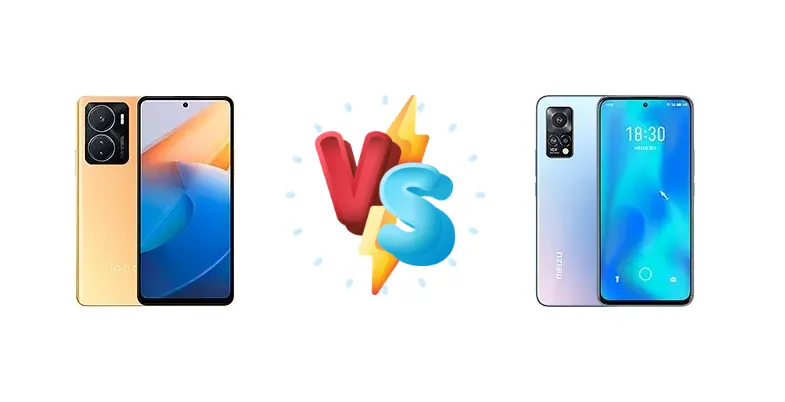
The iQOO Z6 (China) and Meizu 18x represent compelling options in the increasingly competitive mid-range smartphone market. While both aim to deliver a smooth user experience, they take different approaches – the iQOO Z6 prioritizes rapid charging and a newer chipset, while the Meizu 18x leverages the proven Snapdragon 870 for sustained performance. This comparison dissects their key differences to determine which device best suits your needs.
🏆 Quick Verdict
For the average user prioritizing sustained performance and a more refined experience, the Meizu 18x emerges as the winner. Its Snapdragon 870 offers a noticeable edge in demanding tasks, despite the iQOO Z6’s faster charging. However, the iQOO Z6 is a strong contender for those who value incredibly quick top-ups.
| Network |
|---|
| 2G bands | GSM 850 / 900 / 1800 / 1900 | GSM 850 / 900 / 1800 / 1900 |
| 3G bands | HSDPA 850 / 900 / 1700(AWS) / 2100 | HSDPA 850 / 900 / 1700(AWS) / 1900 / 2100 |
| 4G bands | 1, 3, 4, 5, 8, 28, 34, 38, 39, 40, 41 | 1, 2, 3, 4, 5, 7, 8, 12, 34, 38, 39, 40, 41 |
| 5G bands | 1, 5, 8, 28, 41, 77, 78 SA/NSA | 1, 3, 41, 77, 78, 79 SA/NSA |
| Speed | HSPA, LTE, 5G | HSPA, LTE, 5G |
| Technology | GSM / CDMA / HSPA / CDMA2000 / LTE / 5G | GSM / HSPA / LTE / 5G |
| | CDMA2000 1x | - |
| Launch |
|---|
| Announced | 2022, August 25 | 2021, September 22. Released 2021, September 22 |
| Status | Available. Released 2022, September 01 | Discontinued |
| Body |
|---|
| Dimensions | 164 x 75.8 x 8.6 mm (6.46 x 2.98 x 0.34 in) | 165.1 x 76.4 x 8 mm (6.5 x 3.01 x 0.31 in) |
| SIM | Nano-SIM + Nano-SIM | Nano-SIM + Nano-SIM |
| Weight | 194.6 g (6.88 oz) | 189 g (6.67 oz) |
| Display |
|---|
| Resolution | 1080 x 2388 pixels (~396 ppi density) | 1080 x 2400 pixels, 20:9 ratio (~395 ppi density) |
| Size | 6.64 inches, 106.3 cm2 (~85.5% screen-to-body ratio) | 6.67 inches, 107.4 cm2 (~85.2% screen-to-body ratio) |
| Type | IPS LCD, 120Hz, HDR10, 650 nits (HBM) | OLED, 1B colors, 120Hz, 500 nits (typ), 700 nits (peak) |
| Platform |
|---|
| CPU | Octa-core (1x2.5 GHz Cortex-A78 & 3x2.4 GHz Cortex-A78 & 4x1.9 GHz Cortex-A55) | Octa-core (1x3.2 GHz Kryo 585 & 3x2.42 GHz Kryo 585 & 4x1.80 GHz Kryo 585) |
| Chipset | Qualcomm SM7325-AE Snapdragon 778G+ 5G (6 nm) | Qualcomm SM8250-AC Snapdragon 870 5G (7 nm) |
| GPU | Adreno 642L | Adreno 650 |
| OS | Android 12, OriginOS Ocean | Android 11, Flyme 9.2 |
| Memory |
|---|
| Card slot | No | No |
| Internal | 128GB 8GB RAM, 256GB 8GB RAM, 256GB 12GB RAM | 128GB 8GB RAM, 256GB 8GB RAM, 256GB 12GB RAM |
| | UFS 3.1 | UFS 3.1 |
| Main Camera |
|---|
| Features | Dual-LED dual-tone flash, HDR, panorama | LED flash, HDR, panorama |
| Single | 8 MP, f/2.0, (wide) | - |
| Triple | 64 MP, f/1.8, (wide), PDAF, OIS
2 MP (macro)
Auxiliary lens | 64 MP, f/1.8, 26mm (wide), 1/1.97", 0.7µm, PDAF
8 MP, f/2.2, 15mm, 120˚ (ultrawide), 1/4.0", 1.12µm
Auxiliary lens |
| Video | 4K@30fps, 1080p@30/60fps, gyro-EIS | 1080p@30fps |
| Selfie camera |
|---|
| Features | - | HDR |
| Single | 8 MP, f/2.0, (wide) | 13 MP, f/2.0, (wide) |
| Video | 1080p@30fps | 1080p@30fps |
| Sound |
|---|
| 3.5mm jack | Yes | No |
| 35mm jack | Yes | No |
| Loudspeaker | Yes | Yes |
| | 24-bit/192kHz audio | - |
| Comms |
|---|
| Bluetooth | 5.2, A2DP, LE, aptX HD, aptX Adaptive | 5.2, A2DP, LE |
| NFC | Yes | No |
| Positioning | GPS, GLONASS, BDS, GALILEO, QZSS | GPS, GLONASS, GALILEO, BDS |
| Radio | No | No |
| USB | USB Type-C 2.0, OTG | USB Type-C |
| WLAN | Wi-Fi 802.11 a/b/g/n/ac/6, dual-band, Wi-Fi Direct | Wi-Fi 802.11 а/b/g/n/ac/6e, dual-band, Wi-Fi Direct |
| Features |
|---|
| Sensors | Fingerprint (side-mounted), accelerometer, gyro, proximity, compass | Fingerprint (under display, optical), accelerometer, gyro, proximity, compass |
| Battery |
|---|
| Charging | 80W wired, 50% in 10 min, 100% in 30 min | 30W wired, PD3.0, QC4, 70% in 30 min, 100% in 60 min |
| Type | 4500 mAh | Li-Po 4300 mAh |
| Misc |
|---|
| Colors | Black, Orange, Blue | Light Blue, White, Gray |
| Models | V2220A | - |
| Price | About 250 EUR | About 340 EUR |
vivo iQOO Z6 (China)
- Incredibly fast 80W charging
- Modern Snapdragon 778G+ chipset
- Potentially more affordable price point
- Unusual CPU core configuration may impact sustained performance
- Limited camera information available
Meizu 18x
- Powerful Snapdragon 870 processor
- Superior multi-core and gaming performance
- Advanced ISP for better image processing
- Slower 30W charging
- May be slightly more expensive
Display Comparison
Neither device boasts a cutting-edge display, but differences exist. While specific display specs for the iQOO Z6 are unavailable, Meizu typically focuses on color accuracy. The Meizu 18x’s display benefits from the Snapdragon 870’s image signal processor (ISP) for potentially better color reproduction. The absence of high refresh rates on either device suggests a focus on efficiency rather than visual fluidity. Bezels are likely comparable given the market segment, but the Meizu 18x’s compact form factor may result in a slightly higher pixel density.
Camera Comparison
Without detailed camera specs for the iQOO Z6, a direct comparison is limited. However, the Meizu 18x benefits from the Snapdragon 870’s advanced ISP, enabling better image processing and noise reduction. The 870’s ISP also supports faster image capture and more sophisticated computational photography features. While both phones likely feature a primary camera, the Meizu 18x’s image processing pipeline will likely deliver more detailed and dynamic photos, especially in challenging lighting conditions. We can assume both phones will include standard features like HDR and portrait modes, but the 870’s processing power gives it an edge.
Performance
The core difference lies in the chipsets. The Meizu 18x’s Snapdragon 870 (7nm) boasts a higher peak clock speed (3.2 GHz vs 2.5 GHz) and a more powerful GPU compared to the iQOO Z6’s Snapdragon 778G+ (6nm). While the 6nm process of the 778G+ offers efficiency gains, the 870’s architectural advantages – specifically the Kryo 585 cores – translate to superior multi-core and single-core performance. This means faster app loading, smoother multitasking, and a more enjoyable gaming experience on the Meizu 18x. The iQOO Z6’s CPU configuration (1x Cortex-A78, 3x Cortex-A78, 4x Cortex-A55) is unusual, with a triple-core A78 setup, potentially impacting sustained performance compared to the 870’s more balanced core arrangement. Both devices likely utilize LPDDR5 RAM, but the 870’s superior processing power will better leverage its bandwidth.
Battery Life
The iQOO Z6’s 80W wired charging is its standout feature, achieving 50% charge in just 10 minutes and 100% in 30 minutes. The Meizu 18x’s 30W charging, while supporting PD3.0 and QC4, takes 30 minutes to reach 70% and a full hour for a complete charge. This difference is substantial. However, the Snapdragon 870’s efficiency may partially offset the iQOO Z6’s charging advantage. While battery capacity isn’t specified for either device, the iQOO Z6’s faster charging allows for quicker top-ups, mitigating concerns about battery life. The Meizu 18x’s slower charging necessitates longer periods plugged in.
Buying Guide
Buy the vivo iQOO Z6 (China) if you need blazing-fast 80W charging and frequently find yourself needing to quickly replenish your battery. Buy the Meizu 18x if you prefer a more powerful processor for gaming and multitasking, and value a more consistent performance profile over the absolute fastest charging speeds.
Frequently Asked Questions
❓ Does the Snapdragon 778G+ in the iQOO Z6 struggle with graphically intensive games like Genshin Impact?
While the Snapdragon 778G+ is a capable chipset, Genshin Impact and similar demanding titles will likely require reduced graphics settings for a consistently smooth experience. The Snapdragon 870 in the Meizu 18x offers a more comfortable margin for high-fidelity gaming.
❓ Is the 30W charging on the Meizu 18x slow enough to be a dealbreaker in 2024?
30W charging is still respectable, but it’s significantly slower than the iQOO Z6’s 80W. If you frequently need to quickly recharge your phone, the Meizu 18x’s charging speed might be inconvenient. However, the Snapdragon 870’s efficiency can help mitigate battery drain.
❓ What kind of software experience can I expect from Meizu, and is it well-supported with updates?
Meizu’s Flyme OS is known for its customization options and unique aesthetic. However, Meizu’s software update track record has been inconsistent in the past. Users should research the current update status for the 18x before purchasing to ensure continued support.