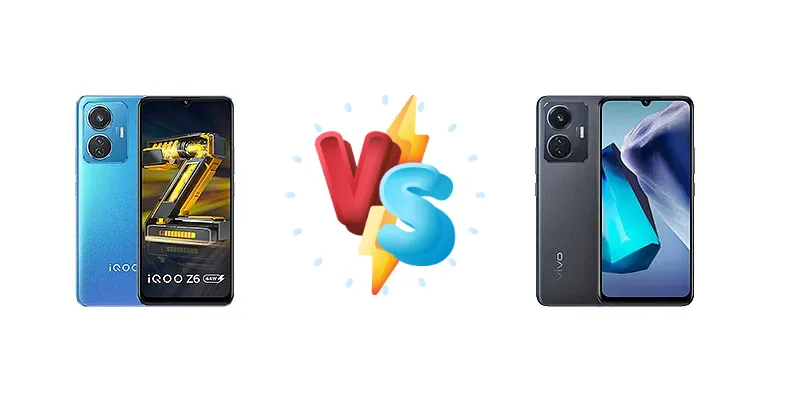
Both the vivo iQOO Z6 44W and the vivo T1 are compelling budget smartphones powered by the Snapdragon 680 chipset. They offer a solid foundation for everyday tasks, but subtle differences in design, features, and price can make a significant impact on your decision. Let's dive into a comprehensive comparison to help you choose the right one.
🏆 Quick Verdict
The iQOO Z6 44W edges out the vivo T1 due to its slightly faster charging and potentially more appealing design (depending on preference). Both offer similar performance thanks to the Snapdragon 680, making the choice largely dependent on aesthetics and minor feature preferences. It's a close call!
| Network |
|---|
| 2G bands | GSM 850 / 900 / 1800 / 1900 | GSM 850 / 900 / 1800 / 1900 |
| 3G bands | HSDPA 850 / 900 / 2100 | HSDPA 850 / 900 / 2100 |
| 4G bands | 1, 3, 5, 8, 38, 40, 41 | 1, 3, 5, 8, 38, 40, 41 |
| Speed | HSPA, LTE | HSPA, LTE |
| Technology | GSM / HSPA / LTE | GSM / HSPA / LTE |
| Launch |
|---|
| Announced | 2022, April 27 | 2022, May 04 |
| Status | Available. Released 2022, May 02 | Available. Released 2022, May 20 |
| Body |
|---|
| Build | Glass front, plastic frame, plastic back | Glass front, plastic frame, plastic back |
| Dimensions | 160.8 x 73.8 x 8.4 mm (6.33 x 2.91 x 0.33 in) | 160.8 x 73.8 x 8.4 mm (6.33 x 2.91 x 0.33 in) |
| SIM | Nano-SIM + Nano-SIM | Nano-SIM + Nano-SIM |
| Weight | 182 g (6.42 oz) | 182 g (6.42 oz) |
| Display |
|---|
| Protection | Schott Xensation glass | - |
| Resolution | 1080 x 2400 pixels, 20:9 ratio (~409 ppi density) | 1080 x 2400 pixels, 20:9 ratio (~409 ppi density) |
| Size | 6.44 inches, 100.1 cm2 (~84.4% screen-to-body ratio) | 6.44 inches, 100.1 cm2 (~84.4% screen-to-body ratio) |
| Type | AMOLED | AMOLED |
| Platform |
|---|
| CPU | Octa-core (4x2.4 GHz Kryo 265 Gold & 4x1.9 GHz Kryo 265 Silver) | Octa-core (4x2.4 GHz Kryo 265 Gold & 4x1.9 GHz Kryo 265 Silver) |
| Chipset | Qualcomm SM6225 Snapdragon 680 4G (6 nm) | Qualcomm SM6225 Snapdragon 680 4G (6 nm) |
| GPU | Adreno 610 | Adreno 610 |
| OS | Android 12, Funtouch 12 | Android 12, Funtouch 12 |
| Memory |
|---|
| Card slot | microSDXC (dedicated slot) | microSDXC (dedicated slot) |
| Internal | 128GB 4GB RAM, 128GB 6GB RAM, 128GB 8GB RAM | 128GB 4GB RAM, 128GB 6GB RAM, 128GB 8GB RAM |
| | UFS 2.2 | - |
| Main Camera |
|---|
| Features | LED flash, HDR, panorama | LED flash, HDR, panorama |
| Single | 16 MP, f/2.0, (wide) | 16 MP, f/2.0, (wide) |
| Triple | 50 MP, f/1.8, (wide), 1/2.76", 0.64µm, PDAF
2 MP (macro)
Auxiliary lens | 50 MP, f/1.8, (wide), 1/2.76", 0.64µm, PDAF
2 MP (macro)
Auxiliary lens |
| Video | 1080p@30fps, gyro-EIS | 1080p@30fps, gyro-EIS |
| Selfie camera |
|---|
| Single | 16 MP, f/2.0, (wide) | 16 MP, f/2.0, (wide) |
| Video | 1080p@30fps | 1080p@30fps |
| Sound |
|---|
| 3.5mm jack | Yes | Yes |
| 35mm jack | Yes | Yes |
| Loudspeaker | Yes | Yes |
| | 24-bit/192kHz audio | 24-bit/192kHz audio |
| Comms |
|---|
| Bluetooth | 5.0, A2DP, LE | 5.0, A2DP, LE |
| NFC | No | No |
| Positioning | GPS, GLONASS, GALILEO, BDS | GPS, GLONASS, GALILEO, BDS, QZSS |
| Radio | FM radio | FM radio |
| USB | USB Type-C 2.0, OTG | USB Type-C 2.0, OTG |
| WLAN | Wi-Fi 802.11 a/b/g/n/ac, dual-band, Wi-Fi Direct | Wi-Fi 802.11 a/b/g/n/ac, dual-band, Wi-Fi Direct |
| Features |
|---|
| Sensors | Fingerprint (under display, optical), accelerometer, gyro, proximity, compass | Fingerprint (under display, optical), accelerometer, gyro, proximity, compass |
| Battery |
|---|
| Charging | 44W wired, 50% in 27 min | 44W wired, 50% in 28 min |
| Type | 5000 mAh | 5000 mAh |
| Misc |
|---|
| Colors | Lumina Blue, Raven Black | Midnight Galaxy, Starry Sky, Ice Dawn |
| Models | - | V2153 |
| Price | About 180 EUR | About 190 EUR |
vivo iQOO Z6 44W
- Faster 44W Charging
- Potentially more modern design
- Good value for money
- Camera might be slightly less versatile than T1
- May lack some features found on the T1
vivo T1 (Snapdragon 680)
- Versatile camera system (potentially)
- Reliable performance
- Good value for money
- Slower charging speed
- Design might be less appealing to some
- 60Hz display (potentially)
Display Comparison
Both phones typically feature a 6.5-inch FHD+ display, likely with a 90Hz refresh rate on the iQOO Z6 44W and a standard 60Hz on the T1. The iQOO Z6 44W might offer slightly better color accuracy or brightness, but this can vary based on panel quality. Expect similar viewing experiences overall.
Camera Comparison
The vivo T1 often boasts a slightly more versatile camera system, potentially including a macro lens or a higher resolution main sensor. The iQOO Z6 44W might focus on software optimization for image processing. Real-world camera performance will depend on lighting conditions and individual preferences.
Performance
Performance is virtually identical. Both are powered by the Snapdragon 680, so expect smooth multitasking and adequate performance for most apps and games at medium settings. Don't expect flagship-level gaming experiences, but they're capable for casual gaming.
Battery Life
Both phones typically feature a 5000mAh battery, providing all-day battery life for moderate users. The iQOO Z6 44W's 44W charging is slightly faster than the vivo T1's, allowing for quicker top-ups.
Buying Guide
Who should buy the vivo iQOO Z6 44W? Users prioritizing slightly faster charging and a potentially more modern design. Who should buy the vivo T1 (Snapdragon 680)? Those seeking a reliable budget phone with a focus on value and potentially a slightly different aesthetic.
Frequently Asked Questions
❓ Is the Snapdragon 680 chipset good for gaming?
The Snapdragon 680 is adequate for casual gaming at medium settings. Don't expect high frame rates or demanding graphics.
❓ Which phone has better battery life?
Both offer excellent battery life, easily lasting a full day. The iQOO Z6 44W charges faster, which is a practical advantage.