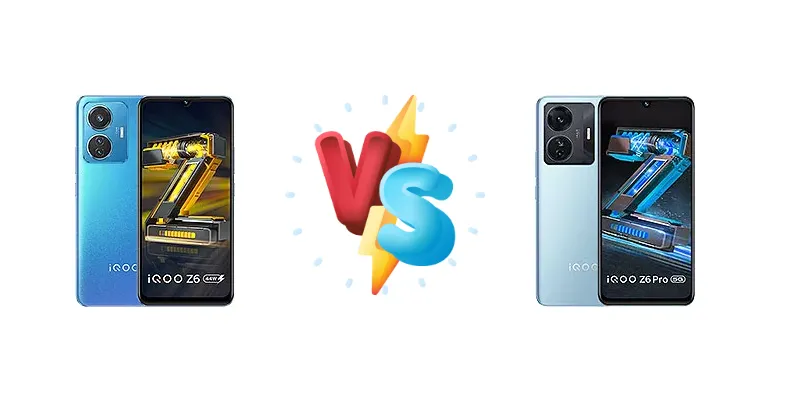
The vivo iQOO Z series consistently delivers impressive value in the mid-range smartphone market. Choosing between the iQOO Z6 44W and the iQOO Z6 Pro can be tricky, as they share a similar design but differ significantly under the hood. This comprehensive comparison will help you decide which phone is right for you.
🏆 Quick Verdict
The iQOO Z6 Pro is the clear winner, offering a significantly faster Snapdragon 778G chipset, faster charging, and 5G connectivity. While the iQOO Z6 44W is a more affordable option, the Pro's performance and features justify the price difference for most users.
| Network |
|---|
| 2G bands | GSM 850 / 900 / 1800 / 1900 | GSM 850 / 900 / 1800 / 1900 |
| 3G bands | HSDPA 850 / 900 / 2100 | HSDPA 850 / 900 / 2100 |
| 4G bands | 1, 3, 5, 8, 38, 40, 41 | 1, 3, 5, 8, 38, 40, 41 |
| 5G bands | - | 1, 3, 5, 8, 41, 77, 78 SA/NSA |
| Speed | HSPA, LTE | HSPA, LTE, 5G |
| Technology | GSM / HSPA / LTE | GSM / HSPA / LTE / 5G |
| Launch |
|---|
| Announced | 2022, April 27 | 2022, April 27 |
| Status | Available. Released 2022, May 02 | Available. Released 2022, May 03 |
| Body |
|---|
| Build | Glass front, plastic frame, plastic back | Glass front, plastic frame, plastic back |
| Dimensions | 160.8 x 73.8 x 8.4 mm (6.33 x 2.91 x 0.33 in) | 159.7 x 73.6 x 8.5 mm (6.29 x 2.90 x 0.33 in) |
| SIM | Nano-SIM + Nano-SIM | Nano-SIM + Nano-SIM |
| Weight | 182 g (6.42 oz) | 180 g (6.35 oz) |
| Display |
|---|
| Protection | Schott Xensation glass | Panda Glass |
| Resolution | 1080 x 2400 pixels, 20:9 ratio (~409 ppi density) | 1080 x 2404 pixels, 20:9 ratio (~409 ppi density) |
| Size | 6.44 inches, 100.1 cm2 (~84.4% screen-to-body ratio) | 6.44 inches, 100.0 cm2 (~85.1% screen-to-body ratio) |
| Type | AMOLED | AMOLED, 90Hz, HDR10+, 1300 nits (peak) |
| Platform |
|---|
| CPU | Octa-core (4x2.4 GHz Kryo 265 Gold & 4x1.9 GHz Kryo 265 Silver) | Octa-core (1x2.4 GHz Cortex-A78 & 3x2.2 GHz Cortex-A78 & 4x1.9 GHz Cortex-A55) |
| Chipset | Qualcomm SM6225 Snapdragon 680 4G (6 nm) | Qualcomm SM7325 Snapdragon 778G 5G (6 nm) |
| GPU | Adreno 610 | Adreno 642L |
| OS | Android 12, Funtouch 12 | Android 12, Funtouch 12 |
| Memory |
|---|
| Card slot | microSDXC (dedicated slot) | No |
| Internal | 128GB 4GB RAM, 128GB 6GB RAM, 128GB 8GB RAM | 128GB 6GB RAM, 128GB 8GB RAM, 256GB 12GB RAM |
| | UFS 2.2 | - |
| Main Camera |
|---|
| Features | LED flash, HDR, panorama | Dual-LED dual-tone flash, HDR, panorama |
| Single | 16 MP, f/2.0, (wide) | 16 MP, f/2.0, (wide) |
| Triple | 50 MP, f/1.8, (wide), 1/2.76", 0.64µm, PDAF
2 MP (macro)
Auxiliary lens | 64 MP, f/1.8, 26mm (wide), PDAF
8 MP, f/2.2, 117˚ (ultrawide)
2 MP (macro) |
| Video | 1080p@30fps, gyro-EIS | 4K@30fps, 1080p@30/60fps, gyro-EIS |
| Selfie camera |
|---|
| Single | 16 MP, f/2.0, (wide) | 16 MP, f/2.0, (wide) |
| Video | 1080p@30fps | 1080p@30fps |
| Sound |
|---|
| 3.5mm jack | Yes | No |
| 35mm jack | Yes | No |
| Loudspeaker | Yes | Yes |
| | 24-bit/192kHz audio | 24-bit/192kHz audio |
| Comms |
|---|
| Bluetooth | 5.0, A2DP, LE | 5.2, A2DP, LE |
| NFC | No | No |
| Positioning | GPS, GLONASS, GALILEO, BDS | GPS, GLONASS, GALILEO, BDS |
| Radio | FM radio | No |
| USB | USB Type-C 2.0, OTG | USB Type-C 2.0, OTG |
| WLAN | Wi-Fi 802.11 a/b/g/n/ac, dual-band, Wi-Fi Direct | Wi-Fi 802.11 a/b/g/n/ac/6, dual-band, Wi-Fi Direct |
| Features |
|---|
| Sensors | Fingerprint (under display, optical), accelerometer, gyro, proximity, compass | Fingerprint (under display, optical), accelerometer, gyro, proximity, compass |
| Battery |
|---|
| Charging | 44W wired, 50% in 27 min | 66W wired, 50% in 18 min |
| Type | 5000 mAh | 4700 mAh |
| Misc |
|---|
| Colors | Lumina Blue, Raven Black | Phantom Dusk, Legion Sky |
| Price | About 180 EUR | About 300 EUR |
vivo iQOO Z6 44W
- More affordable
- Decent battery life
- Good display
- Slower performance
- No 5G
- Slower charging
vivo iQOO Z6 Pro
- Faster performance (Snapdragon 778G)
- 5G connectivity
- Faster 66W charging
- Likely better camera
- More expensive
- Potentially slightly less battery life due to faster charging (though capacity is the same)
Display Comparison
Both phones likely feature a 6.44-inch AMOLED display with a 120Hz refresh rate, offering vibrant colors and smooth scrolling. Expect similar resolution (FHD+) and brightness levels. The Z6 Pro *might* have slightly better color accuracy due to its higher-tier chipset, but it's unlikely to be a major difference.
Camera Comparison
Both phones likely feature a triple-camera setup, potentially with a 50MP main sensor. The Z6 Pro's more powerful chipset likely allows for better image processing, resulting in improved dynamic range, low-light performance, and overall image quality. Expect slightly better video recording capabilities on the Pro as well.
Performance
This is where the biggest difference lies. The iQOO Z6 Pro's Snapdragon 778G is a substantial upgrade over the Z6 44W's Snapdragon 680. Expect significantly faster app loading times, smoother multitasking, and better gaming performance on the Pro. The Z6 44W is adequate for everyday tasks but will struggle with more demanding games.
Battery Life
Both phones likely have a 5000mAh battery. However, the iQOO Z6 Pro's 66W fast charging is a game-changer, allowing it to charge much faster than the Z6 44W's 44W charging. Expect significantly shorter charging times on the Pro.
Buying Guide
The vivo iQOO Z6 44W is ideal for budget-conscious users who prioritize affordability and don't heavily rely on demanding apps or 5G. The vivo iQOO Z6 Pro is the better choice for gamers, power users, and anyone wanting a smoother experience and future-proof 5G capabilities.
Frequently Asked Questions
❓ Is the iQOO Z6 Pro worth the extra money?
Yes, if you value performance, 5G connectivity, and faster charging. The Snapdragon 778G is a significant upgrade over the Snapdragon 680.
❓ Which phone has better battery life?
Both have a 5000mAh battery, but the iQOO Z6 Pro's faster charging means it will likely be charged more often, potentially impacting overall battery longevity over time. Real-world usage will be similar.