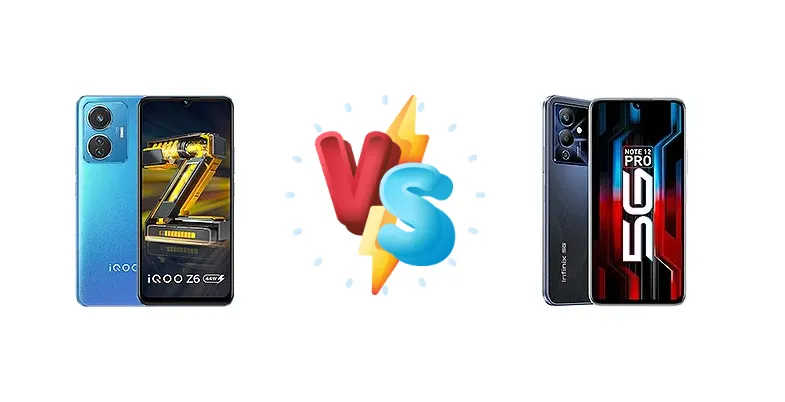
The sub-$200 smartphone market is fiercely competitive, and the vivo iQOO Z6 44W and Infinix Note 12 Pro 5G represent compelling options. The iQOO Z6 prioritizes rapid charging and a streamlined experience, while the Infinix Note 12 Pro 5G aims to deliver 5G connectivity and a more powerful processor. This comparison dissects their key differences to help you choose the right device.
🏆 Quick Verdict
For the average user prioritizing consistent performance and future-proofing with 5G, the Infinix Note 12 Pro 5G is the better choice. Its Mediatek Dimensity 810 chipset offers a noticeable performance edge over the Snapdragon 680, despite the iQOO Z6’s faster 44W charging. However, users heavily focused on minimizing charging times may still prefer the iQOO Z6.
| Network |
|---|
| 2G bands | GSM 850 / 900 / 1800 / 1900 | GSM 850 / 900 / 1800 / 1900 |
| 3G bands | HSDPA 850 / 900 / 2100 | HSDPA 850 / 900 / 2100 |
| 4G bands | 1, 3, 5, 8, 38, 40, 41 | 1, 3, 5, 7, 8, 20, 28, 38, 40, 41 |
| 5G bands | - | 1, 3, 5, 7, 8, 20, 28, 38, 40, 41, 77, 78 |
| Speed | HSPA, LTE | HSPA, LTE, 5G |
| Technology | GSM / HSPA / LTE | GSM / HSPA / LTE / 5G |
| Launch |
|---|
| Announced | 2022, April 27 | 2022, July 08 |
| Status | Available. Released 2022, May 02 | Available. Released 2022, July 15 |
| Body |
|---|
| Build | Glass front, plastic frame, plastic back | Glass front, plastic frame, plastic back |
| Dimensions | 160.8 x 73.8 x 8.4 mm (6.33 x 2.91 x 0.33 in) | 164.7 x 76.9 x 8 mm (6.48 x 3.03 x 0.31 in) |
| SIM | Nano-SIM + Nano-SIM | Nano-SIM + Nano-SIM |
| Weight | 182 g (6.42 oz) | 188 g (6.63 oz) |
| Display |
|---|
| Protection | Schott Xensation glass | Corning Gorilla Glass 3 |
| Resolution | 1080 x 2400 pixels, 20:9 ratio (~409 ppi density) | 1080 x 2400 pixels, 20:9 ratio (~393 ppi density) |
| Size | 6.44 inches, 100.1 cm2 (~84.4% screen-to-body ratio) | 6.7 inches, 108.4 cm2 (~85.6% screen-to-body ratio) |
| Type | AMOLED | AMOLED |
| Platform |
|---|
| CPU | Octa-core (4x2.4 GHz Kryo 265 Gold & 4x1.9 GHz Kryo 265 Silver) | Octa-core (2x2.4 GHz Cortex-A76 & 6x2.0 GHz Cortex-A55) |
| Chipset | Qualcomm SM6225 Snapdragon 680 4G (6 nm) | Mediatek Dimensity 810 (6 nm) |
| GPU | Adreno 610 | Mali-G57 MC2 |
| OS | Android 12, Funtouch 12 | Android 12, XOS 10.6 |
| Memory |
|---|
| Card slot | microSDXC (dedicated slot) | microSDXC (dedicated slot) |
| Internal | 128GB 4GB RAM, 128GB 6GB RAM, 128GB 8GB RAM | 128GB 8GB RAM, 256GB 8GB RAM |
| | UFS 2.2 | - |
| Main Camera |
|---|
| Features | LED flash, HDR, panorama | Quad-LED flash, HDR, panorama |
| Single | 16 MP, f/2.0, (wide) | 16 MP, f/2.0, (wide) |
| Triple | 50 MP, f/1.8, (wide), 1/2.76", 0.64µm, PDAF
2 MP (macro)
Auxiliary lens | 108 MP, f/1.8, 24mm (wide), PDAF
2 MP (macro)
Auxiliary lens |
| Video | 1080p@30fps, gyro-EIS | 1440p@30fps |
| Selfie camera |
|---|
| Features | - | Dual-LED flash |
| Single | 16 MP, f/2.0, (wide) | 16 MP, f/2.0, (wide) |
| Video | 1080p@30fps | 1440p@30fps |
| Sound |
|---|
| 3.5mm jack | Yes | Yes |
| 35mm jack | Yes | Yes |
| Loudspeaker | Yes | Yes, with dual speakers |
| | 24-bit/192kHz audio | - |
| Comms |
|---|
| Bluetooth | 5.0, A2DP, LE | 5.0, A2DP, LE |
| NFC | No | No |
| Positioning | GPS, GLONASS, GALILEO, BDS | GPS |
| Radio | FM radio | Unspecified |
| USB | USB Type-C 2.0, OTG | USB Type-C 2.0, OTG |
| WLAN | Wi-Fi 802.11 a/b/g/n/ac, dual-band, Wi-Fi Direct | Wi-Fi 802.11 a/b/g/n |
| Features |
|---|
| Sensors | Fingerprint (under display, optical), accelerometer, gyro, proximity, compass | Fingerprint (side-mounted), accelerometer, gyro, proximity, compass |
| Battery |
|---|
| Charging | 44W wired, 50% in 27 min | 33W wired |
| Type | 5000 mAh | 5000 mAh |
| Misc |
|---|
| Colors | Lumina Blue, Raven Black | Black, White |
| Models | - | X671B |
| Price | About 180 EUR | About 140 EUR |
vivo iQOO Z6 44W
- Significantly faster 44W charging
- Potentially more refined software experience (vivo's Funtouch OS)
- Streamlined design and build quality
- Lacks 5G connectivity
- Less powerful Snapdragon 680 chipset
- Limited gaming performance compared to the Note 12 Pro 5G
Infinix Note 12 Pro 5G
- 5G connectivity for future-proofing
- More powerful Mediatek Dimensity 810 chipset
- Better performance for multitasking and gaming
- Slower 33W charging
- Potentially more aggressive software customization (Infinix UI)
- May experience more thermal throttling under heavy load
Display Comparison
Neither device boasts a standout display. Both utilize 6nm chipsets, suggesting similar power efficiency demands on the display panel. While specific display specs (resolution, panel type) are missing, the focus here is on performance. The absence of high refresh rates on either device suggests a cost-saving measure, impacting smoothness during scrolling and gaming. The choice will likely come down to subjective preferences regarding color calibration and viewing angles, which require hands-on testing.
Camera Comparison
Without detailed camera specs, a direct comparison is difficult. However, the market positioning suggests both phones will feature similar primary camera capabilities. The iQOO Z6 likely focuses on optimized image processing for social media sharing, while the Infinix Note 12 Pro 5G might offer more manual control options. The presence of a 2MP macro camera on both devices is largely a marketing tactic, offering limited real-world benefit due to the small sensor size and lack of optical image stabilization (OIS).
Performance
The core difference lies in the chipsets. The Infinix Note 12 Pro 5G’s Mediatek Dimensity 810, with its 2x Cortex-A76 cores clocked at 2.4 GHz, offers a significant advantage in CPU-intensive tasks compared to the iQOO Z6’s Snapdragon 680. The Snapdragon 680’s Kryo 265 Gold cores, while efficient, are clocked lower. The Dimensity 810 also includes a more powerful Mali-G57 MC2 GPU, translating to better gaming performance. Crucially, the Note 12 Pro 5G supports 5G connectivity, a feature absent in the iQOO Z6, making it more future-proof. The 6nm fabrication process is shared, suggesting comparable thermal efficiency, but the Dimensity 810’s higher performance will likely generate more heat under sustained load.
Battery Life
The iQOO Z6 44W’s 44W wired charging is a clear advantage, promising a 50% charge in just 27 minutes. The Infinix Note 12 Pro 5G’s 33W charging is slower, requiring more time to reach a full charge. While battery capacity isn’t specified, the Dimensity 810’s higher performance will likely consume more power, potentially offsetting the charging speed difference. Users prioritizing minimal downtime will strongly favor the iQOO Z6, while those who don’t mind a longer charging cycle can benefit from the Note 12 Pro 5G’s more powerful processor.
Buying Guide
Buy the vivo iQOO Z6 44W if you need the absolute fastest charging speeds in this price bracket and prefer a simpler, more refined software experience. Buy the Infinix Note 12 Pro 5G if you prioritize 5G connectivity, a more capable processor for multitasking and gaming, and don't mind slightly slower charging speeds. The Note 12 Pro 5G is the better long-term investment for users wanting to access next-generation networks.
Frequently Asked Questions
❓ Does the Mediatek Dimensity 810 in the Infinix Note 12 Pro 5G overheat during prolonged gaming sessions?
While the Dimensity 810 is more powerful than the Snapdragon 680, it's also more prone to thermal throttling. The 6nm process helps, but extended gaming at high settings may lead to reduced performance to manage heat. The iQOO Z6, with its less demanding chipset, will likely maintain more consistent performance over longer periods, but at a lower frame rate.
❓ Is the 44W charging on the iQOO Z6 44W compatible with Power Delivery (PD) chargers?
While vivo doesn't explicitly advertise PD support for the iQOO Z6 44W, it's likely compatible with some PD chargers, but may not achieve the full 44W charging speed. Using the included charger is recommended for optimal charging performance. The Infinix Note 12 Pro 5G's 33W charging is also likely to benefit from PD chargers, but again, full speed isn't guaranteed.
❓ How does the 5G performance of the Infinix Note 12 Pro 5G compare to other 5G phones in this price range?
The Dimensity 810 supports sub-6GHz 5G, which is the most common type of 5G currently deployed. Performance will vary significantly based on network conditions and carrier support. However, the Note 12 Pro 5G should provide a noticeable speed improvement over 4G LTE, especially in areas with good 5G coverage. It's important to note that 5G availability is still limited in many regions.