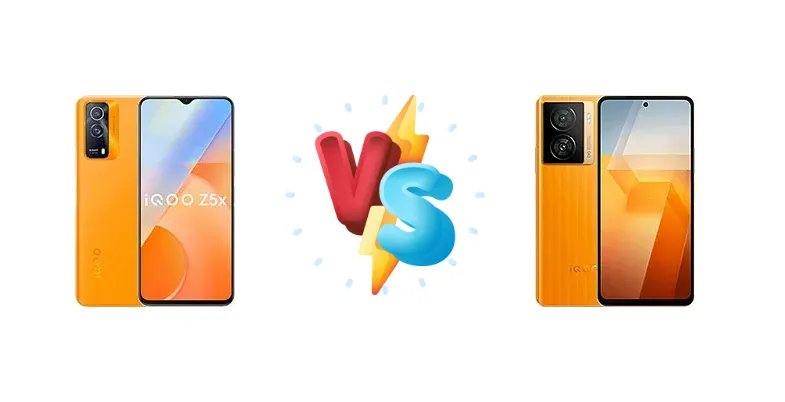
The vivo iQOO series consistently delivers impressive value in the budget smartphone market. Today, we're pitting two contenders against each other: the iQOO Z5x and the newer iQOO Z7 (China). Which one offers the best blend of features and performance for your money?
🏆 Quick Verdict
The iQOO Z7 (China) is the clear winner thanks to its significantly faster charging (120W vs 44W) and a more powerful Snapdragon 782G chipset. While the Z5x is a solid option, the Z7's advancements make it the superior choice for most users seeking a speedy and efficient experience.
| Network |
|---|
| 2G bands | GSM 850 / 900 / 1800 / 1900 | GSM 850 / 900 / 1800 / 1900 |
| 3G bands | HSDPA 850 / 900 / 1700(AWS) / 2100 | HSDPA 850 / 900 / 2100 |
| 4G bands | 1, 3, 4, 5, 8, 28, 34, 38, 39, 40, 41 | 1, 3, 5, 8, 28, 34, 38, 39, 40, 41 |
| 5G bands | 1, 3, 28, 41, 77, 78 SA/NSA | 1, 5, 8, 28, 41, 77, 78 SA/NSA |
| Speed | HSPA, LTE, 5G | HSPA, LTE, 5G |
| Technology | GSM / CDMA / HSPA / CDMA2000 / LTE / 5G | GSM / CDMA / HSPA / CDMA2000 / LTE / 5G |
| | CDMA2000 1x | CDMA2000 1x |
| Launch |
|---|
| Announced | 2021, October 20 | 2023, March 20 |
| Status | Available. Released 2021, November 01 | Available. Released 2023, March 24 |
| Body |
|---|
| Build | Glass front, plastic frame, plastic back | - |
| Dimensions | 164 x 75.3 x 8.5 mm (6.46 x 2.96 x 0.33 in) | 164.6 x 75.8 x 8.8 mm (6.48 x 2.98 x 0.35 in) |
| SIM | Nano-SIM + Nano-SIM | Nano-SIM + Nano-SIM |
| Weight | 189 g (6.67 oz) | 201.5 g (7.13 oz) |
| Display |
|---|
| Resolution | 1080 x 2408 pixels, 20:9 ratio (~401 ppi density) | 1080 x 2388 pixels (~395 ppi density) |
| Size | 6.58 inches, 104.3 cm2 (~84.5% screen-to-body ratio) | 6.64 inches, 106.8 cm2 (~85.6% screen-to-body ratio) |
| Type | IPS LCD, 120Hz | IPS LCD, 120Hz, HDR10 |
| Platform |
|---|
| CPU | Octa-core (2x2.4 GHz Cortex-A78 & 6x2.0 GHz Cortex-A55) | Octa-core (1x2.7 GHz Cortex-A78 & 3x2.4 GHz Cortex-A78 & 4x1.8 GHz Cortex-A55) |
| Chipset | Mediatek Dimensity 900 (6 nm) | Qualcomm Snapdragon 782G (6 nm) |
| GPU | Mali-G68 MC4 | Adreno 642L |
| OS | Android 11, OriginOS 1.0 for iQOO | Android 13, OriginOS 3 |
| Memory |
|---|
| Card slot | No | No |
| Internal | 128GB 6GB RAM, 128GB 8GB RAM, 256GB 8GB RAM | 128GB 8GB RAM, 256GB 8GB RAM, 256GB 12GB RAM |
| | - | UFS 2.2 |
| Main Camera |
|---|
| Dual | 50 MP, f/1.8, 26mm (wide), PDAF
2 MP (macro) | 64 MP, f/1.8, (wide), 1/1.97", 0.7µm, PDAF, OIS
Auxiliary lens |
| Features | LED flash, HDR, panorama | Dual-LED dual-tone flash, HDR, panorama |
| Single | 8 MP, f/2.0, (wide) | 16 MP, f/2.5, (wide) |
| Video | 4K@30fps, 1080p@30/60fps, gyro-EIS | 4K@30fps, 1080p@30fps |
| Selfie camera |
|---|
| Single | 8 MP, f/2.0, (wide) | 16 MP, f/2.5, (wide) |
| Video | 1080p@30fps | 1080p@30fps |
| Sound |
|---|
| 3.5mm jack | Yes | Yes |
| 35mm jack | Yes | Yes |
| Loudspeaker | Yes | Yes |
| Comms |
|---|
| Bluetooth | 5.2, A2DP, LE, aptX HD | 5.2, A2DP, LE, aptX HD |
| NFC | No | Yes |
| Positioning | GPS, GLONASS, GALILEO, BDS, QZSS | GPS, GLONASS, GALILEO, BDS |
| Radio | No | No |
| USB | USB Type-C, OTG | USB Type-C 2.0, OTG |
| WLAN | Wi-Fi 802.11 a/b/g/n/ac/6, dual-band, Wi-Fi Direct | Wi-Fi 802.11 a/b/g/n/ac/6, dual-band, Wi-Fi Direct |
| Features |
|---|
| Sensors | Fingerprint (side-mounted), accelerometer, gyro, proximity, compass | Fingerprint (side-mounted), accelerometer, gyro, proximity, compass |
| Battery |
|---|
| Charging | 44W wired, 70% in 38 min | 120W wired |
| Type | 5000 mAh | 5000 mAh |
| Misc |
|---|
| Colors | Black, Orange, Silver | Black, Blue, Orange |
| Models | - | V2270A |
| Price | About 220 EUR | About 220 EUR |
vivo iQOO Z5x
- Larger Display (potentially)
- Slightly Longer Battery Life (potentially)
- More Affordable
- Slower Charging
- Less Powerful Chipset
- Older Design
vivo iQOO Z7 (China)
- Blazing-Fast 120W Charging
- More Powerful Snapdragon 782G Chipset
- Improved Camera Performance
- Modern Design
- Potentially Smaller Battery (compared to Z5x)
- May be slightly more expensive
Display Comparison
Both phones likely feature a similar display technology (likely LCD) with a high refresh rate (likely 120Hz). The Z5x may have a slightly larger screen size (potentially 6.67 inches) compared to the Z7 (likely around 6.64 inches). We'll need to confirm exact specifications for a definitive comparison.
Camera Comparison
While both phones likely feature a triple-camera setup, the Z7 (China) is expected to have a more advanced camera system. Expect improvements in image processing, low-light performance, and video recording capabilities. The Z5x likely has a 64MP main sensor, while the Z7 may have a similar or slightly improved sensor with better software optimization.
Performance
The iQOO Z7 (China) boasts a significant performance advantage with the Snapdragon 782G chipset. This chip offers better CPU and GPU performance compared to the Mediatek Dimensity 900 in the Z5x, resulting in smoother gaming, faster app loading times, and improved overall responsiveness. The Z7's CPU configuration also looks more efficient.
Battery Life
The iQOO Z5x might have a slightly larger battery capacity (potentially 5000mAh), but the iQOO Z7 (China)'s 120W charging is a game-changer. It can charge the phone from 0% to 100% in around 30 minutes, while the Z5x's 44W charging takes considerably longer.
Buying Guide
Who should buy the vivo iQOO Z5x? Users prioritizing a larger display and slightly longer battery life on a tighter budget might find the Z5x appealing. Who should buy the vivo iQOO Z7 (China)? Those seeking blazing-fast charging, improved performance for gaming and multitasking, and a more modern design should opt for the Z7.
Frequently Asked Questions
❓ Is the iQOO Z7 (China) worth the extra money compared to the Z5x?
Yes, the Z7's significantly faster charging and more powerful chipset make it a worthwhile upgrade for most users. The improved camera is also a bonus.
❓ What is the battery life like on both phones?
Both phones offer decent battery life for everyday use. The Z5x might last slightly longer on a single charge, but the Z7's 120W charging more than compensates for any potential difference.