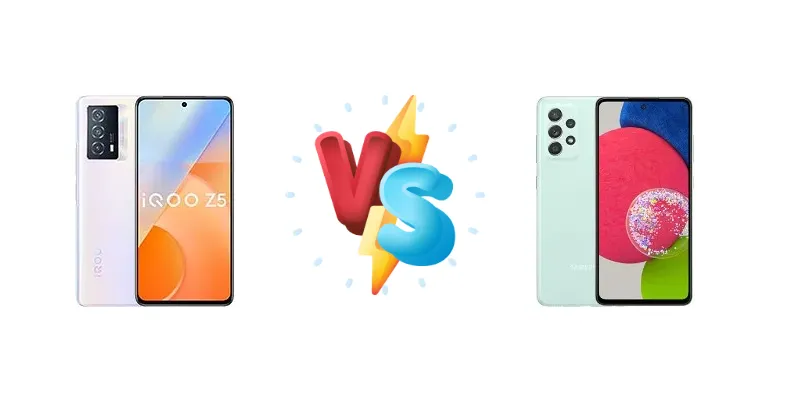
The iQOO Z5 and Samsung Galaxy A52s 5G represent compelling options in the increasingly competitive mid-range 5G smartphone market. Both devices are powered by the Qualcomm Snapdragon 778G 5G chipset, promising similar performance, but diverge significantly in areas like charging speed, display characteristics, and overall user experience. This comparison dissects these differences to help you choose the right phone.
🏆 Quick Verdict
For the average user prioritizing rapid charging and potentially slightly better sustained performance under load, the iQOO Z5 emerges as the winner. However, the Samsung Galaxy A52s 5G counters with a brighter, more visually appealing display and a proven track record for battery endurance, making it a strong contender for media consumers.
| Network |
|---|
| 2G bands | GSM 850 / 900 / 1800 / 1900 | GSM 850 / 900 / 1800 / 1900 |
| 3G bands | HSDPA 850 / 900 / 2100 | HSDPA 850 / 900 / 1700(AWS) / 1900 / 2100 |
| 4G bands | 1, 3, 5, 8, 28, 34, 38, 39, 40, 41 - China | 1, 2, 3, 4, 5, 7, 8, 12, 17, 20, 26, 28, 32, 38, 40, 41, 66 |
| 5G bands | 1, 5, 8, 28, 41, 77, 78 SA/NSA - China | 1, 3, 5, 7, 8, 20, 28, 38, 40, 41, 66, 78 SA/NSA/Sub6 |
| Speed | HSPA, LTE, 5G | HSPA 42.2/5.76 Mbps, LTE Cat18 1200/150 Mbps, 5G |
| Technology | GSM / CDMA / HSPA / CDMA2000 / LTE / 5G | GSM / HSPA / LTE / 5G |
| | 77, 78 SA/NSA - India | - |
| Launch |
|---|
| Announced | 2021, September 23 | 2021, August 17 |
| Status | Available. Released 2021, September 28 | Available. Released 2021, September 01 |
| Body |
|---|
| Build | Glass front (Panda Glass), plastic frame, plastic back | Glass front (Gorilla Glass 5), plastic back |
| Dimensions | 164.7 x 76.7 x 8.5 mm (6.48 x 3.02 x 0.33 in) | 159.9 x 75.1 x 8.4 mm (6.30 x 2.96 x 0.33 in) |
| SIM | Nano-SIM + Nano-SIM | · Nano-SIM· Nano-SIM + Nano-SIM |
| Weight | 193 g (6.81 oz) | 189 g (6.67 oz) |
| | - | IP67 dust/water resistant (up to 1m for 30 min) |
| Display |
|---|
| Protection | Panda Glass | Corning Gorilla Glass 5 |
| Resolution | 1080 x 2400 pixels, 20:9 ratio (~395 ppi density) | 1080 x 2400 pixels, 20:9 ratio (~405 ppi density) |
| Size | 6.67 inches, 107.4 cm2 (~85.0% screen-to-body ratio) | 6.5 inches, 102.0 cm2 (~84.9% screen-to-body ratio) |
| Type | IPS LCD, 120Hz, HDR10, 650 nits (typ) | Super AMOLED, 120Hz, 800 nits (HBM) |
| Platform |
|---|
| CPU | Octa-core (1x2.4 GHz Cortex-A78 & 3x2.2 GHz Cortex-A78 & 4x1.9 GHz Cortex-A55) | Octa-core (1x2.4 GHz Cortex-A78 & 3x2.2 GHz Cortex-A78 & 4x1.9 GHz Cortex-A55) |
| Chipset | Qualcomm SM7325 Snapdragon 778G 5G (6 nm) | Qualcomm SM7325 Snapdragon 778G 5G (6 nm) |
| GPU | Adreno 642L | Adreno 642L |
| OS | Android 11, Funtouch 12 (International), OriginOS for iQOO 1.0 (China) | Android 11, upgradable to Android 14, One UI 6 |
| Memory |
|---|
| Card slot | No | microSDXC (uses shared SIM slot) |
| Internal | 128GB 8GB RAM, 256GB 8GB RAM, 256GB 12GB RAM | 128GB 4GB RAM, 128GB 6GB RAM, 128GB 8GB RAM, 256GB 6GB RAM, 256GB 8GB RAM |
| | UFS 3.1 | - |
| Main Camera |
|---|
| Features | LED flash, HDR, panorama | LED flash, panorama, HDR |
| Quad | - | 64 MP, f/1.8, 26mm (wide), 1/1.7", 0.8µm, PDAF, OIS
12 MP, f/2.2, 123˚ (ultrawide), 1.12µm
5 MP (macro)
Auxiliary lens |
| Single | 16 MP, f/2.5, (wide) | 32 MP, f/2.2, 26mm (wide), 1/2.8", 0.8µm |
| Triple | 64 MP, f/1.8, 26mm (wide), 1/1.97", 0.7µm, PDAF
8 MP, f/2.2, 120˚, 16mm (ultrawide), 1/4.0", 1.12µm
2 MP (macro) | - |
| Video | 4K@30/60fps, 1080p@30/60fps, gyro-EIS | 4K@30fps, 1080p@30/60fps; gyro-EIS |
| Selfie camera |
|---|
| Features | HDR | HDR |
| Single | 16 MP, f/2.5, (wide) | 32 MP, f/2.2, 26mm (wide), 1/2.8", 0.8µm |
| Video | 1080p@30fps | 4K@30fps, 1080p@30/60fps |
| Sound |
|---|
| 3.5mm jack | Yes | Yes |
| 35mm jack | Yes | Yes |
| Loudspeaker | Yes, with dual speakers | Yes, with stereo speakers |
| Comms |
|---|
| Bluetooth | 5.2, A2DP, LE, aptX HD, aptX Adaptive | 5.0, A2DP, LE |
| NFC | No | Yes (market/region dependent) |
| Positioning | GPS, GLONASS, GALILEO, BDS | GPS, GLONASS, GALILEO, BDS, QZSS |
| Radio | No | No |
| USB | USB Type-C, OTG | USB Type-C 2.0, OTG |
| WLAN | Wi-Fi 802.11 a/b/g/n/ac, dual-band, Wi-Fi Direct | Wi-Fi 802.11 a/b/g/n/ac/6, dual-band, Wi-Fi Direct |
| Features |
|---|
| Sensors | Fingerprint (side-mounted), accelerometer, gyro, proximity, compass | Fingerprint (under display, optical), accelerometer, gyro, compass |
| | - | Virtual Proximity Sensing |
| Battery |
|---|
| Charging | 44W wired, 50% in 26 min | 25W wired |
| Type | 5000 mAh | Li-Ion 4500 mAh |
| Misc |
|---|
| Colors | Arctic Dawn, Mystic Space, Cyber Grid, Aurora | Awesome Black, Awesome White, Awesome Purple, Awesome Mint |
| Models | V2148A | SM-A528B, SM-A528B/DS, SM-A528N |
| Price | About 250 EUR | £ 112.98 / € 249.47 |
| SAR | - | 0.72 W/kg (head) |
| SAR EU | - | 0.88 W/kg (head) 0.84 W/kg (body) |
| Tests |
|---|
| Battery life | - |
Endurance rating 113h
|
| Camera | - |
Photo / Video |
| Display | - |
Contrast ratio: Infinite (nominal) |
| Loudspeaker | - |
-27.5 LUFS (Good)
|
| Performance | - |
AnTuTu: 429675 (v8), 506432(v9)
GeekBench: 11060 (v4.4), 2801 (v5.1)
GFXBench: 28fps (ES 3.1 onscreen) |
vivo iQOO Z5
- Significantly faster 44W charging
- Potential for better sustained performance due to thermal management
- Snapdragon 778G offers excellent mid-range performance
- Display brightness and quality are unknown and potentially inferior to the A52s
- Battery life details are missing, creating uncertainty
Samsung Galaxy A52s 5G
- Brighter 800 nit display for excellent outdoor visibility
- Proven 113-hour battery endurance
- Well-established brand reputation and software support
- Slower 25W charging
- May throttle more under sustained load compared to iQOO Z5
Display Comparison
Both phones utilize AMOLED panels, but the Samsung Galaxy A52s 5G boasts a measured peak brightness of 800 nits, a significant advantage over the iQOO Z5 (brightness data unavailable). This translates to superior visibility in direct sunlight. While the iQOO Z5’s panel specs are unknown, Samsung’s ‘Infinite’ contrast ratio suggests deeper blacks and more vivid colors. The A52s’ display is likely to offer a more immersive viewing experience, particularly for HDR content. The lack of refresh rate information for the iQOO Z5 is a notable omission, while the A52s is known to support 120Hz, providing smoother scrolling and animations.
Camera Comparison
Both devices feature capable camera systems, but detailed sensor information is limited. The focus should be on image processing and software features. Samsung’s image processing is generally known for vibrant, saturated colors, while iQOO’s approach is less defined. Without specific details on sensor size and aperture, it’s difficult to definitively declare a winner. The presence of OIS (Optical Image Stabilization) on either device would be a significant advantage for low-light photography and video recording, but this information is not provided. The inclusion of a 2MP macro camera on either device is largely inconsequential, offering limited practical benefit.
Performance
Both the iQOO Z5 and Galaxy A52s 5G are equipped with the Qualcomm SM7325 Snapdragon 778G 5G (6 nm) chipset, featuring an octa-core CPU configuration: 1x2.4 GHz Cortex-A78, 3x2.2 GHz Cortex-A78, and 4x1.9 GHz Cortex-A55. This means CPU performance will be virtually identical in most day-to-day tasks. However, the iQOO Z5’s thermal design and potentially more aggressive power delivery could allow it to sustain peak performance for longer periods during demanding tasks like gaming. RAM configurations are not specified, but the A52s is available with up to 8GB, which is sufficient for smooth multitasking. The iQOO Z5’s cooling solution is unknown, but a well-managed thermal profile is crucial for maximizing the Snapdragon 778G’s potential.
Battery Life
The Samsung Galaxy A52s 5G boasts an impressive endurance rating of 113 hours, indicating excellent battery life. While the iQOO Z5’s battery capacity is unknown, its 44W wired charging capability is a major advantage over the A52s’ 25W charging. The iQOO Z5 can reach 50% charge in just 26 minutes, significantly reducing downtime. This faster charging speed effectively mitigates any potential disadvantage in battery capacity. The A52s’ longer endurance rating suggests it can comfortably last a full day of moderate use, but the iQOO Z5 offers the convenience of quickly topping up the battery when needed.
Buying Guide
Buy the vivo iQOO Z5 if you need blazing-fast 44W charging, frequently engage in extended gaming sessions, and value a phone that can quickly get you back up and running. Buy the Samsung Galaxy A52s 5G if you prioritize a vibrant, bright display for media consumption, appreciate a well-established brand reputation, and need excellent battery life for all-day use without constantly seeking a power outlet.
Frequently Asked Questions
❓ Does the Snapdragon 778G in the iQOO Z5 experience thermal throttling during prolonged gaming sessions?
While the Snapdragon 778G is a capable chipset, sustained performance depends heavily on thermal management. The iQOO Z5’s cooling solution is unknown, but its 44W charging suggests a potentially more robust power delivery system, which *could* translate to better sustained performance compared to the A52s. However, without independent thermal testing, it’s difficult to confirm.
❓ How does the 25W charging on the Galaxy A52s 5G compare to the 44W charging on the iQOO Z5 in real-world usage?
The iQOO Z5’s 44W charging is significantly faster. It can reach 50% charge in 26 minutes, while the A52s will take considerably longer. This difference is most noticeable when you need a quick top-up before leaving the house. While the A52s’ battery endurance is excellent, the iQOO Z5’s faster charging offers greater convenience.
❓ Is the lack of a dedicated telephoto lens on either phone a significant drawback?
For users who frequently zoom in on subjects, the absence of a dedicated telephoto lens is a limitation. Both phones rely on digital zoom, which results in a loss of image quality. However, the Snapdragon 778G’s ISP offers decent image processing capabilities, mitigating some of the quality loss. If telephoto capabilities are essential, you’ll need to consider other devices.