
iQOO Z5 vs Motorola Edge 20 Fusion: A Deep Dive into Mid-Range Power
| Phones Images | |||||
|---|---|---|---|---|---|
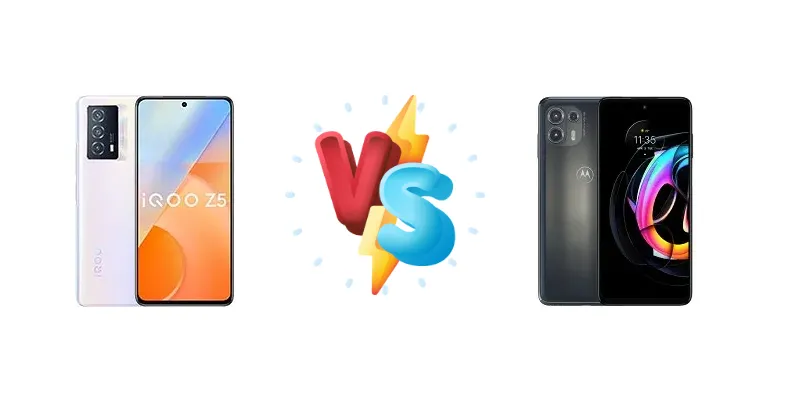
|
🏆 Quick Verdict
For most users, the iQOO Z5 emerges as the stronger contender. Its Snapdragon 778G chipset, built on a more efficient 6nm process, delivers superior CPU and GPU performance, translating to a smoother experience in demanding tasks and gaming. While the Edge 20 Fusion offers a respectable package, the iQOO Z5’s faster charging and performance edge make it the better all-around choice.
| PHONES | ||
|---|---|---|
| Phone Names | vivo iQOO Z5 | Motorola Edge 20 Fusion |
| Network | ||
|---|---|---|
| 2G bands | GSM 850 / 900 / 1800 / 1900 | GSM 850 / 900 / 1800 / 1900 |
| 3G bands | HSDPA 850 / 900 / 2100 | HSDPA 850 / 900 / 1700(AWS) / 1900 / 2100 |
| 4G bands | 1, 3, 5, 8, 28, 34, 38, 39, 40, 41 - China | 1, 2, 3, 4, 5, 7, 8, 12, 13, 17, 18, 19, 20, 26, 28, 32, 34, 38, 39, 40, 41, 42, 43, 66 |
| 5G bands | 1, 5, 8, 28, 41, 77, 78 SA/NSA - China | 1, 3, 5, 7, 8, 20, 28, 38, 40, 41, 77, 78, 66 SA/NSA/Sub6 |
| Speed | HSPA, LTE, 5G | HSPA 42.2/5.76 Mbps, LTE Cat18 1200/150 Mbps, 5G |
| Technology | GSM / CDMA / HSPA / CDMA2000 / LTE / 5G | GSM / HSPA / LTE / 5G |
| 77, 78 SA/NSA - India | - | |
| Launch | ||
|---|---|---|
| Announced | 2021, September 23 | 2021, August 17 |
| Status | Available. Released 2021, September 28 | Available. Released 2021, August 27 |
| Body | ||
|---|---|---|
| Build | Glass front (Panda Glass), plastic frame, plastic back | Glass front |
| Dimensions | 164.7 x 76.7 x 8.5 mm (6.48 x 3.02 x 0.33 in) | 166 x 76 x 8.3 mm (6.54 x 2.99 x 0.33 in) |
| SIM | Nano-SIM + Nano-SIM | Nano-SIM + Nano-SIM |
| Weight | 193 g (6.81 oz) | 185 g (6.53 oz) |
| - | Water-repellent design | |
| Display | ||
|---|---|---|
| Protection | Panda Glass | - |
| Resolution | 1080 x 2400 pixels, 20:9 ratio (~395 ppi density) | 1080 x 2400 pixels, 20:9 ratio (~393 ppi density) |
| Size | 6.67 inches, 107.4 cm2 (~85.0% screen-to-body ratio) | 6.7 inches, 108.4 cm2 (~85.9% screen-to-body ratio) |
| Type | IPS LCD, 120Hz, HDR10, 650 nits (typ) | OLED, 1B colors, 90Hz, HDR10+ |
| Platform | ||
|---|---|---|
| CPU | Octa-core (1x2.4 GHz Cortex-A78 & 3x2.2 GHz Cortex-A78 & 4x1.9 GHz Cortex-A55) | Octa-core (2x2.4 GHz Cortex-A76 & 6x2.0 GHz Cortex-A55) |
| Chipset | Qualcomm SM7325 Snapdragon 778G 5G (6 nm) | Mediatek Dimensity 800U (7 nm) |
| GPU | Adreno 642L | Mali-G57 MC3 |
| OS | Android 11, Funtouch 12 (International), OriginOS for iQOO 1.0 (China) | Android 11 |
| Memory | ||
|---|---|---|
| Card slot | No | microSDXC |
| Internal | 128GB 8GB RAM, 256GB 8GB RAM, 256GB 12GB RAM | 128GB 6GB RAM, 128GB 8GB RAM |
| UFS 3.1 | - | |
| Main Camera | ||
|---|---|---|
| Features | LED flash, HDR, panorama | LED flash, HDR, panorama |
| Single | 16 MP, f/2.5, (wide) | - |
| Triple | 64 MP, f/1.8, 26mm (wide), 1/1.97", 0.7µm, PDAF 8 MP, f/2.2, 120˚, 16mm (ultrawide), 1/4.0", 1.12µm 2 MP (macro) | 108 MP, f/1.9, (wide), 1/1.52", 0.7µm, PDAF 8 MP, f/2.2, 118˚ (ultrawide) Auxiliary lens |
| Video | 4K@30/60fps, 1080p@30/60fps, gyro-EIS | 4K@30fps, 1080p@30/60/120fps, gyro-EIS |
| Selfie camera | ||
|---|---|---|
| Features | HDR | HDR |
| Single | 16 MP, f/2.5, (wide) | 32 MP, f/2.3, (wide), 0.7µm |
| Video | 1080p@30fps | 1080p@30fps |
| Sound | ||
|---|---|---|
| 3.5mm jack | Yes | Yes |
| 35mm jack | Yes | Yes |
| Loudspeaker | Yes, with dual speakers | Yes |
| Comms | ||
|---|---|---|
| Bluetooth | 5.2, A2DP, LE, aptX HD, aptX Adaptive | 5.0, A2DP, LE |
| NFC | No | Yes |
| Positioning | GPS, GLONASS, GALILEO, BDS | GPS, GLONASS, GALILEO |
| Radio | No | FM radio |
| USB | USB Type-C, OTG | USB Type-C 2.0 |
| WLAN | Wi-Fi 802.11 a/b/g/n/ac, dual-band, Wi-Fi Direct | Wi-Fi 802.11 a/b/g/n/ac, dual-band, Wi-Fi Direct |
| Features | ||
|---|---|---|
| Sensors | Fingerprint (side-mounted), accelerometer, gyro, proximity, compass | Fingerprint (side-mounted), accelerometer, gyro, proximity, compass |
| Battery | ||
|---|---|---|
| Charging | 44W wired, 50% in 26 min | 30W wired |
| Type | 5000 mAh | Li-Po 5000 mAh |
| Misc | ||
|---|---|---|
| Colors | Arctic Dawn, Mystic Space, Cyber Grid, Aurora | Electric Graphite, Cyber Teal |
| Models | V2148A | - |
| Price | About 250 EUR | About 250 EUR |
vivo iQOO Z5
- Superior CPU and GPU performance with Snapdragon 778G
- Faster 44W wired charging
- More efficient 6nm fabrication process
- Software experience may be less refined than Motorola's
- Specific display details are unknown
Motorola Edge 20 Fusion
- Potentially cleaner software experience
- May be available at a lower price point
- Respectable performance for everyday tasks
- Dimensity 800U chipset is less powerful than Snapdragon 778G
- Slower 30W wired charging
Display Comparison
Neither device boasts a standout display. While specific display specs (resolution, refresh rate) are missing, the focus here is on the underlying chipsets. The display quality will likely be similar, with both targeting a smooth experience. However, the chipset’s ability to efficiently drive the display is where the iQOO Z5 has an advantage, potentially offering more consistent frame rates in games.
Camera Comparison
Without detailed camera specifications, a direct comparison is limited. However, the chipset plays a role in image processing speed and quality. The Snapdragon 778G’s ISP (Image Signal Processor) is generally more advanced, enabling faster processing and potentially better low-light performance. The Edge 20 Fusion likely relies more heavily on software algorithms to compensate for any hardware limitations. The absence of information on sensor sizes and OIS makes a definitive judgment impossible, but the iQOO Z5’s superior processing power gives it an edge.
Performance
The core difference lies in the chipsets. The iQOO Z5’s Snapdragon 778G 5G (6nm) features a more modern CPU architecture – a Cortex-A78 prime core – compared to the Edge 20 Fusion’s Dimensity 800U (7nm). The 778G’s Adreno 642L GPU also provides a significant uplift in graphics performance. The 6nm fabrication process of the Snapdragon 778G also contributes to better thermal efficiency, meaning sustained performance under load will be higher on the iQOO Z5. The Dimensity 800U’s Cortex-A76 cores are capable, but fall behind the A78 in single-core performance, impacting responsiveness in everyday tasks.
Battery Life
The iQOO Z5’s 44W wired charging is a clear advantage over the Edge 20 Fusion’s 30W charging. The iQOO Z5 can reach 50% charge in just 26 minutes, significantly faster than the Edge 20 Fusion. While battery capacity isn’t specified, the Snapdragon 778G’s 6nm efficiency should translate to better battery life for similar usage patterns, even with a comparable battery size. The faster charging also mitigates any potential battery life differences.
Buying Guide
Buy the vivo iQOO Z5 if you prioritize gaming performance, faster charging speeds, and a more future-proof chipset. It’s ideal for users who frequently play graphically intensive games or need a phone that can quickly top up its battery. Buy the Motorola Edge 20 Fusion if you prefer a cleaner software experience and a potentially lower price point, and your usage is primarily focused on everyday tasks like browsing, social media, and light multimedia consumption.