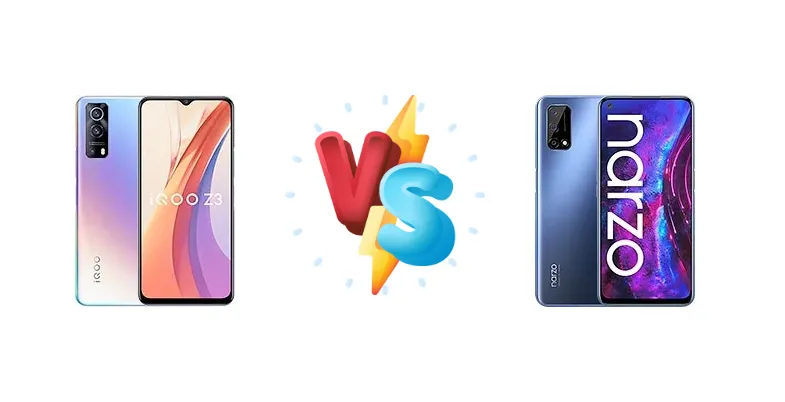
The vivo iQOO Z3 and Realme Narzo 30 Pro 5G represent compelling options in the increasingly competitive mid-range 5G smartphone market. Both aim to deliver strong performance without breaking the bank, but they achieve this through different approaches – Qualcomm’s Snapdragon 768G 5G in the iQOO Z3 versus MediaTek’s Dimensity 800U in the Narzo 30 Pro. This comparison dissects their key differences to determine which device best suits your needs.
🏆 Quick Verdict
For users prioritizing raw processing power and faster charging, the vivo iQOO Z3 emerges as the winner. Its Snapdragon 768G offers a noticeable performance edge, particularly in gaming, and the 55W charging significantly reduces downtime. However, the Narzo 30 Pro 5G provides a solid all-around experience at a potentially lower price point.
| Network |
|---|
| 2G bands | GSM 850 / 900 / 1800 / 1900 | GSM 850 / 900 / 1800 / 1900 |
| 3G bands | HSDPA 850 / 900 / 1700(AWS) / 2100 | HSDPA 800 / 850 / 900 / 1700(AWS) / 1900 / 2100 |
| 4G bands | 1, 3, 4, 5, 8, 38, 40, 41 - India | 1, 2, 3, 4, 5, 7, 8, 34, 38, 39, 40, 41 |
| 5G bands | 77, 78 SA/NSA - India | 1, 41, 77, 78, 79 SA/NSA |
| Speed | HSPA, LTE, 5G | HSPA, LTE, 5G |
| Technology | GSM / CDMA / HSPA / CDMA2000 / LTE / 5G | GSM / HSPA / LTE / 5G |
| | 1, 28, 41, 77, 78 SA/NSA - China | - |
| Launch |
|---|
| Announced | 2021, March 25 | 2021, February 24 |
| Status | Available. Released 2021, April 01 | Available. Released 2021, March 04 |
| Body |
|---|
| Dimensions | 164 x 75.3 x 8.5 mm (6.46 x 2.96 x 0.33 in) | 162.2 x 75.1 x 9.1 mm (6.39 x 2.96 x 0.36 in) |
| SIM | Nano-SIM + Nano-SIM | Nano-SIM + Nano-SIM |
| Weight | 185.5 g (6.56 oz) | 196 g (6.91 oz) |
| Display |
|---|
| Protection | - | Corning Gorilla Glass 3 |
| Resolution | 1080 x 2408 pixels, 20:9 ratio (~401 ppi density) | 1080 x 2400 pixels, 20:9 ratio (~405 ppi density) |
| Size | 6.58 inches, 104.3 cm2 (~84.5% screen-to-body ratio) | 6.5 inches, 102.0 cm2 (~83.7% screen-to-body ratio) |
| Type | IPS LCD, HDR10, 120Hz | IPS LCD, 120Hz , 480 nits (typ), 600 nits (peak) |
| Platform |
|---|
| CPU | Octa-core (1x2.8 GHz Kryo 475 Prime & 1x2.4 GHz Kryo 475 Gold & 6x1.8 GHz Kryo 475 Silver) | Octa-core (2x2.4 GHz Cortex-A76 & 6x2.0 GHz Cortex-A55) |
| Chipset | Qualcomm SDM768 Snapdragon 768G 5G (7 nm) | Mediatek Dimensity 800U (7 nm) |
| GPU | Adreno 620 | Mali-G57 MC3 |
| OS | Android 11, Funtouch 11.1 (International), OriginOS 1.0 for iQOO (China) | Android 10, Realme UI |
| Memory |
|---|
| Card slot | microSDXC (uses shared SIM slot) | microSDXC (uses shared SIM slot) |
| Internal | 128GB 6GB RAM, 128GB 8GB RAM, 256GB 8GB RAM, 256GB 12GB RAM | 64GB 6GB RAM, 128GB 8GB RAM |
| | UFS 2.2 | UFS 2.1 |
| Main Camera |
|---|
| Features | LED flash, HDR, panorama | LED flash, HDR, panorama |
| Single | 16 MP, f/2.0, (wide) | 16 MP, f/2.1, 26mm (wide), 1/3.09", 1.0µm |
| Triple | 64 MP, f/1.8, 26mm (wide), 1/1.97", 0.7µm, PDAF
8 MP, f/2.2, 120˚, 16mm (ultrawide), 1/4.0", 1.12µm
2 MP (macro) | 48 MP, f/1.8, 26mm (wide), 1/2.0", 0.8µm, PDAF
8 MP, f/2.3, 119˚ (ultrawide), 1/4.0", 1.12µm
2 MP (macro) |
| Video | 4K@30/60fps, 1080p@30/60fps, gyro-EIS | 4K@30fps, 1080p@30/60/120fps, gyro-EIS |
| Selfie camera |
|---|
| Features | HDR | HDR, panorama |
| Single | 16 MP, f/2.0, (wide) | 16 MP, f/2.1, 26mm (wide), 1/3.09", 1.0µm |
| Video | 1080p@30fps | 1080p@30fps, gyro-EIS |
| Sound |
|---|
| 3.5mm jack | Yes | Yes |
| 35mm jack | Yes | Yes |
| Loudspeaker | Yes | Yes |
| | - | 24-bit/192kHz audio |
| Comms |
|---|
| Bluetooth | 5.1, A2DP, LE, aptX HD | 5.1, A2DP, LE |
| NFC | No | No |
| Positioning | GPS, GLONASS, GALILEO, BDS | GPS, GLONASS, BDS, GALILEO |
| Radio | No | No |
| USB | USB Type-C, OTG | USB Type-C 2.0, OTG |
| WLAN | Wi-Fi 802.11 a/b/g/n/ac, dual-band, Wi-Fi Direct | Wi-Fi 802.11 a/b/g/n/ac, dual-band, Wi-Fi Direct |
| Features |
|---|
| Sensors | Fingerprint (side-mounted), accelerometer, gyro, proximity, compass | Fingerprint (side-mounted), accelerometer, gyro, proximity, compass |
| Battery |
|---|
| Charging | 55W wired | 30W wired, PD, 50% in 25 min, 100% in 65 min |
| Type | 4400 mAh | 5000 mAh |
| Misc |
|---|
| Colors | Ace Black, Cyber Blue, Silver | Sword Black, Blade Silver |
| Models | V2073A | RMX2117 |
| Price | About 220 EUR | About 200 EUR |
vivo iQOO Z3
- Faster Snapdragon 768G 5G processor
- Significantly faster 55W charging
- Potentially better gaming performance
- May be slightly more expensive
- Battery capacity not specified, potentially smaller than Narzo 30 Pro
Realme Narzo 30 Pro 5G
- Potentially lower price point
- 30W charging with PD support
- Solid all-around performance
- Dimensity 800U is less powerful than Snapdragon 768G
- Slower charging speed
Display Comparison
While both phones likely feature LCD panels (data not provided), the core difference lies in the processing power driving them. Display quality is likely similar, but the Snapdragon 768G in the iQOO Z3 will provide a smoother experience when paired with a high refresh rate display (if present), due to its superior GPU. The absence of detailed display specs necessitates focusing on the chipset's ability to render graphics efficiently.
Camera Comparison
Without detailed camera sensor information, a direct comparison is difficult. However, the market positioning suggests the iQOO Z3 may prioritize image processing speed leveraging the Snapdragon’s ISP, while the Narzo 30 Pro 5G might focus on software-based enhancements. The absence of OIS information on either device suggests reliance on electronic image stabilization. Users should expect competent daylight photography from both, but low-light performance will likely be a differentiating factor, potentially favoring the device with a larger primary sensor (if available).
Performance
The iQOO Z3’s Qualcomm Snapdragon 768G 5G (7nm) boasts a Kryo 475 Prime core clocked at 2.8 GHz, offering a clear advantage over the Narzo 30 Pro 5G’s MediaTek Dimensity 800U (7nm) with its 2.4 GHz Cortex-A76 cores. The Snapdragon’s architecture, with its distinct performance tiers (Prime, Gold, Silver), is designed for optimized task allocation. This translates to faster app loading times and a more responsive user interface on the iQOO Z3. While the Dimensity 800U is a capable chip, the Snapdragon 768G consistently benchmarks higher in CPU and GPU tests, making the iQOO Z3 the better choice for demanding applications and gaming. The 7nm process node is common to both, so thermal efficiency differences will be driven by implementation and cooling solutions.
Battery Life
The Realme Narzo 30 Pro 5G’s 30W charging, while supporting PD and offering a 50% charge in 25 minutes and 100% in 65 minutes, is significantly slower than the iQOO Z3’s 55W wired charging. This difference is substantial for users who frequently need to top up their battery quickly. While battery capacity isn’t specified, the faster charging of the iQOO Z3 effectively mitigates any potential disadvantage from a slightly smaller battery size, offering more usable uptime throughout the day.
Buying Guide
Buy the vivo iQOO Z3 if you are a mobile gamer who values sustained performance and quick charging to minimize interruptions. Buy the Realme Narzo 30 Pro 5G if you prioritize a balanced experience with a focus on value and are less demanding in terms of peak gaming performance, and appreciate a potentially lower initial cost.
Frequently Asked Questions
❓ Will the Dimensity 800U in the Narzo 30 Pro 5G struggle with graphically intensive games like Genshin Impact?
While the Dimensity 800U can run Genshin Impact, you'll likely need to lower the graphics settings to achieve a consistently smooth frame rate. The Snapdragon 768G in the iQOO Z3 offers a more comfortable experience with higher settings and sustained performance due to its more powerful GPU.
❓ How much faster is the 55W charging on the iQOO Z3 compared to the 30W charging on the Narzo 30 Pro 5G in real-world use?
The iQOO Z3's 55W charging can top up the battery from 0% to 100% significantly faster – likely under 40 minutes – compared to the Narzo 30 Pro 5G's 65-minute full charge time. This means less time tethered to a charger and more time using your phone.
❓ Does either phone support expandable storage via microSD card?
This information is not provided in the context data. However, given the market segment, it's likely that at least one of the phones offers microSD card support, but it's crucial to verify this before purchasing.