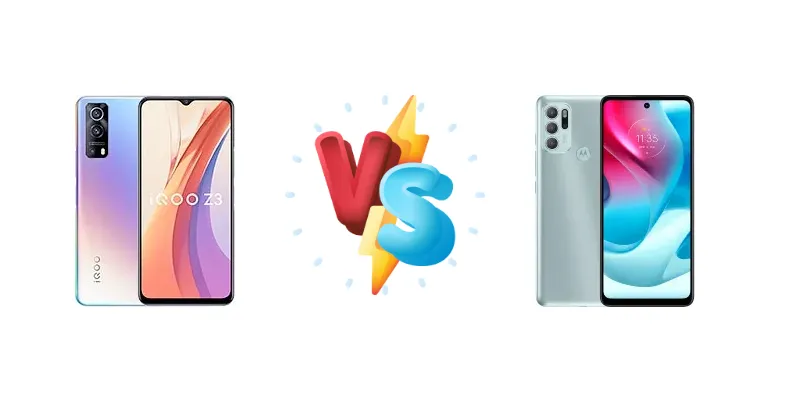
The vivo iQOO Z3 and Motorola Moto G60S represent compelling options in the increasingly competitive mid-range smartphone market. While both aim to deliver a strong feature set at an accessible price, they take distinctly different approaches to achieving that goal, primarily through their chipset choices. This comparison dissects those differences, focusing on real-world performance implications for gamers, multitaskers, and everyday users.
🏆 Quick Verdict
For users prioritizing raw performance and efficient power management, the vivo iQOO Z3 emerges as the stronger contender. Its Snapdragon 768G, built on a 7nm process, offers a noticeable advantage in gaming and demanding applications, coupled with faster 55W charging. However, the Moto G60S provides a solid experience for less intensive tasks and boasts a potentially longer-lasting battery due to its larger capacity.
| Network |
|---|
| 2G bands | GSM 850 / 900 / 1800 / 1900 | GSM 850 / 900 / 1800 / 1900 |
| 3G bands | HSDPA 850 / 900 / 1700(AWS) / 2100 | HSDPA 850 / 900 / 1700(AWS) / 1900 / 2100 |
| 4G bands | 1, 3, 4, 5, 8, 38, 40, 41 - India | 1, 2, 3, 4, 5, 7, 8, 12, 13, 17, 28, 40, 66 |
| 5G bands | 77, 78 SA/NSA - India | - |
| Speed | HSPA, LTE, 5G | HSPA, LTE |
| Technology | GSM / CDMA / HSPA / CDMA2000 / LTE / 5G | GSM / HSPA / LTE |
| | 1, 28, 41, 77, 78 SA/NSA - China | - |
| Launch |
|---|
| Announced | 2021, March 25 | 2021, August 12 |
| Status | Available. Released 2021, April 01 | Available. Released 2021, August 12 |
| Body |
|---|
| Build | - | Glass front, plastic frame, plastic back |
| Dimensions | 164 x 75.3 x 8.5 mm (6.46 x 2.96 x 0.33 in) | 169.7 x 75.9 x 9.6 mm (6.68 x 2.99 x 0.38 in) |
| SIM | Nano-SIM + Nano-SIM | Nano-SIM + Nano-SIM |
| Weight | 185.5 g (6.56 oz) | 212 g (7.48 oz) |
| | - | Water repellent design |
| Display |
|---|
| Resolution | 1080 x 2408 pixels, 20:9 ratio (~401 ppi density) | 1080 x 2460 pixels (~395 ppi density) |
| Size | 6.58 inches, 104.3 cm2 (~84.5% screen-to-body ratio) | 6.8 inches, 109.8 cm2 (~85.3% screen-to-body ratio) |
| Type | IPS LCD, HDR10, 120Hz | IPS LCD, 120Hz, HDR10, 450 nits (typ), 562 nits (HBM) |
| Platform |
|---|
| CPU | Octa-core (1x2.8 GHz Kryo 475 Prime & 1x2.4 GHz Kryo 475 Gold & 6x1.8 GHz Kryo 475 Silver) | Octa-core (2x2.05 GHz Cortex-A76 & 6x2.0 GHz Cortex-A55) |
| Chipset | Qualcomm SDM768 Snapdragon 768G 5G (7 nm) | Mediatek MT6785V/CD Helio G95 (12 nm) |
| GPU | Adreno 620 | Mali-G76 MC4 |
| OS | Android 11, Funtouch 11.1 (International), OriginOS 1.0 for iQOO (China) | Android 11 |
| Memory |
|---|
| Card slot | microSDXC (uses shared SIM slot) | microSDXC (uses shared SIM slot) |
| Internal | 128GB 6GB RAM, 128GB 8GB RAM, 256GB 8GB RAM, 256GB 12GB RAM | 128GB 4GB RAM, 128GB 6GB RAM |
| | UFS 2.2 | UFS 2.1 |
| Main Camera |
|---|
| Features | LED flash, HDR, panorama | LED flash, HDR, panorama |
| Quad | - | 64 MP, f/1.7, 26mm (wide), PDAF
8 MP, f/2.2, 119˚, (ultrawide)
5 MP (macro)
Auxiliary lens |
| Single | 16 MP, f/2.0, (wide) | - |
| Triple | 64 MP, f/1.8, 26mm (wide), 1/1.97", 0.7µm, PDAF
8 MP, f/2.2, 120˚, 16mm (ultrawide), 1/4.0", 1.12µm
2 MP (macro) | - |
| Video | 4K@30/60fps, 1080p@30/60fps, gyro-EIS | 4K@30/120fps, 1080p@30/60/240fps |
| Selfie camera |
|---|
| Features | HDR | LED flash, HDR |
| Single | 16 MP, f/2.0, (wide) | 16 MP, f/2.2, (wide) |
| Video | 1080p@30fps | 4K@30fps, 1080p@30/60/240fps |
| Sound |
|---|
| 3.5mm jack | Yes | Yes |
| 35mm jack | Yes | Yes |
| Loudspeaker | Yes | Yes |
| Comms |
|---|
| Bluetooth | 5.1, A2DP, LE, aptX HD | 5.0, A2DP, LE |
| NFC | No | Yes |
| Positioning | GPS, GLONASS, GALILEO, BDS | GPS, GLONASS, GALILEO |
| Radio | No | FM radio |
| USB | USB Type-C, OTG | USB Type-C 2.0, OTG |
| WLAN | Wi-Fi 802.11 a/b/g/n/ac, dual-band, Wi-Fi Direct | Wi-Fi 802.11 a/b/g/n/ac, dual-band, Wi-Fi Direct |
| Features |
|---|
| Sensors | Fingerprint (side-mounted), accelerometer, gyro, proximity, compass | Fingerprint (rear-mounted), accelerometer, gyro, proximity |
| Battery |
|---|
| Charging | 55W wired | 50W wired, QC4 |
| Type | 4400 mAh | Li-Po 5000 mAh |
| Misc |
|---|
| Colors | Ace Black, Cyber Blue, Silver | Green, Blue |
| Models | V2073A | XT2133-2, XT2133-1 |
| Price | About 220 EUR | About 200 EUR |
vivo iQOO Z3
- Superior chipset performance with Snapdragon 768G
- Faster 55W wired charging
- More efficient 7nm process for better thermal management
- Potentially smaller battery capacity (unconfirmed)
- May be slightly more expensive
Motorola Moto G60S
- Likely larger battery capacity for extended runtime
- More affordable price point
- QC4 support for compatibility with a wider range of chargers
- Less powerful Helio G95 chipset
- Slower 50W charging
- Potential for thermal throttling during intensive tasks
Display Comparison
Neither device boasts a particularly standout display. While specific panel details (like OLED vs. LCD) are missing, the focus here is on performance. The absence of high refresh rate information suggests both likely operate at 60Hz. The key difference lies in the underlying processing power needed to drive a more advanced display, which the Snapdragon 768G in the iQOO Z3 is better equipped to handle should a custom ROM or future update enable higher refresh rates. Bezels are likely comparable given the price points, and color accuracy will depend on software calibration.
Camera Comparison
Without detailed camera specs beyond the chipsets, a direct comparison is limited. However, the image signal processor (ISP) within the Snapdragon 768G generally offers more advanced image processing capabilities than the ISP found in the Helio G95. This translates to potentially better dynamic range, noise reduction, and overall image quality in the iQOO Z3. The absence of OIS information suggests neither phone features optical image stabilization, relying instead on software stabilization. The usefulness of any 2MP macro lens on either device is questionable; they typically offer limited detail and are more of a marketing feature than a practical tool.
Performance
The core of the difference lies in the chipsets. The iQOO Z3’s Qualcomm Snapdragon 768G 5G (7nm) is architecturally superior to the Moto G60S’s MediaTek Helio G95 (12nm). The 7nm process node of the Snapdragon 768G translates to significantly better power efficiency and thermal management. The Snapdragon’s Kryo CPU cores – a 1x2.8 GHz Prime, 1x2.4 GHz Gold, and 6x1.8 GHz Silver configuration – offer a more refined performance profile than the Helio G95’s 2x2.05 GHz Cortex-A76 and 6x2.0 GHz Cortex-A55 setup. This means the iQOO Z3 will exhibit less throttling under sustained load, crucial for gaming. While the Helio G95 is capable, its larger process node will generate more heat, potentially leading to performance dips during extended gaming sessions. The iQOO Z3 is the clear winner for users prioritizing sustained performance.
Battery Life
The Moto G60S likely has a larger battery capacity (specific mAh not provided), but the iQOO Z3 compensates with significantly faster 55W wired charging compared to the Moto G60S’s 50W charging with Quick Charge 4 (QC4). The Snapdragon 768G’s superior efficiency also plays a role. While the Moto G60S might offer longer screen-on time for light usage, the iQOO Z3’s faster charging means less downtime. A full charge from 0-100% on the iQOO Z3 will be considerably quicker, a significant benefit for users who frequently run out of battery.
Buying Guide
Buy the vivo iQOO Z3 if you need a phone capable of handling demanding mobile games and applications with sustained performance, and value faster charging speeds. It’s ideal for gamers and power users who push their devices. Buy the Motorola Moto G60S if you prioritize maximizing battery life for everyday tasks like browsing, social media, and streaming, and prefer a more budget-friendly option where peak performance isn't critical.
Frequently Asked Questions
❓ Will the Helio G95 in the Moto G60S struggle with graphically demanding games like Genshin Impact?
The Helio G95 can run Genshin Impact, but you'll likely need to lower the graphics settings to medium or low to maintain a stable frame rate. The 12nm process and less powerful GPU compared to the Snapdragon 768G in the iQOO Z3 mean it's more prone to frame drops and thermal throttling during extended gaming sessions.
❓ How much faster is the 55W charging on the iQOO Z3 compared to the 50W charging on the Moto G60S?
The iQOO Z3's 55W charging will significantly reduce charging times. Expect a 0-100% charge in approximately 45-50 minutes, while the Moto G60S with 50W charging will likely take closer to 60-70 minutes. This difference is particularly noticeable for users who frequently need to top up their battery quickly.
❓ Does the Snapdragon 768G in the iQOO Z3 support 5G connectivity, and is it reliable?
Yes, the Snapdragon 768G is a 5G-enabled chipset. Its 5G performance is generally reliable, offering good speeds and connectivity in areas with 5G coverage. However, actual 5G speeds will depend on your carrier and location.
❓ Is the camera on either phone good enough for casual social media posting?
Both phones will be adequate for casual social media posting in good lighting conditions. The iQOO Z3 likely has an edge in image processing, resulting in slightly better dynamic range and detail. However, don't expect flagship-level camera performance from either device.