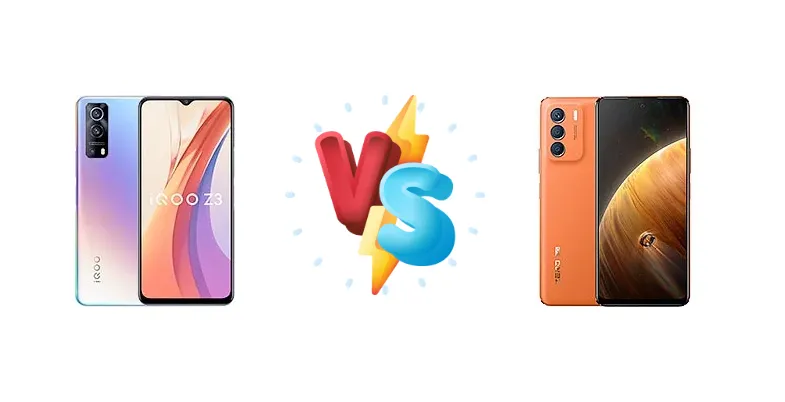
The mid-range 5G smartphone market is fiercely competitive. The vivo iQOO Z3, with its Snapdragon 768G, aimed for raw performance, while the Infinix Zero 5G 2023, powered by the Dimensity 1080, focuses on a balance of power and efficiency. This comparison dissects their key differences to help you choose the right device.
🏆 Quick Verdict
For users prioritizing peak gaming performance and faster charging, the vivo iQOO Z3 is the better choice. However, the Infinix Zero 5G 2023 offers a more modern chipset architecture and potentially better sustained performance due to its 6nm process, making it ideal for everyday use and moderate gaming.
| Network |
|---|
| 2G bands | GSM 850 / 900 / 1800 / 1900 | GSM 850 / 900 / 1800 / 1900 |
| 3G bands | HSDPA 850 / 900 / 1700(AWS) / 2100 | HSDPA 850 / 900 / 1700(AWS) / 1900 / 2100 |
| 4G bands | 1, 3, 4, 5, 8, 38, 40, 41 - India | 1, 2, 3, 4, 5, 7, 8, 20, 28, 38, 40, 41, 66 |
| 5G bands | 77, 78 SA/NSA - India | 1, 3, 5, 7, 8, 20, 28, 38, 40, 41, 66, 71, 77, 78 SA/NSA/Sub6 |
| Speed | HSPA, LTE, 5G | HSPA, LTE, 5G |
| Technology | GSM / CDMA / HSPA / CDMA2000 / LTE / 5G | GSM / HSPA / LTE / 5G |
| | 1, 28, 41, 77, 78 SA/NSA - China | - |
| Launch |
|---|
| Announced | 2021, March 25 | 2022, November 08 |
| Status | Available. Released 2021, April 01 | Available. Released 2022, December 01 |
| Body |
|---|
| Build | - | Glass front, plastic frame, plastic back |
| Dimensions | 164 x 75.3 x 8.5 mm (6.46 x 2.96 x 0.33 in) | 168.7 x 76.5 x 8.9 mm (6.64 x 3.01 x 0.35 in) |
| SIM | Nano-SIM + Nano-SIM | Nano-SIM + Nano-SIM |
| Weight | 185.5 g (6.56 oz) | 201 g (7.09 oz) |
| Display |
|---|
| Resolution | 1080 x 2408 pixels, 20:9 ratio (~401 ppi density) | 1080 x 2460 pixels (~396 ppi density) |
| Size | 6.58 inches, 104.3 cm2 (~84.5% screen-to-body ratio) | 6.78 inches, 109.2 cm2 (~84.6% screen-to-body ratio) |
| Type | IPS LCD, HDR10, 120Hz | IPS LCD, 120Hz, 500 nits (peak) |
| Platform |
|---|
| CPU | Octa-core (1x2.8 GHz Kryo 475 Prime & 1x2.4 GHz Kryo 475 Gold & 6x1.8 GHz Kryo 475 Silver) | Octa-core (2x2.6 GHz Cortex-A78 & 6x2.0 GHz Cortex-A55)Octa-core (2x2.5 GHz Cortex-A78 & 6x2.0 GHz Cortex-A55) - X6815D |
| Chipset | Qualcomm SDM768 Snapdragon 768G 5G (7 nm) | Mediatek Dimensity 1080Mediatek Dimensity 920 (6 nm) - X6815D |
| GPU | Adreno 620 | Mali-G68 MC4 |
| OS | Android 11, Funtouch 11.1 (International), OriginOS 1.0 for iQOO (China) | Android 12, upgradable to Android 13, XOS 13 |
| Memory |
|---|
| Card slot | microSDXC (uses shared SIM slot) | microSDXC (dedicated slot) |
| Internal | 128GB 6GB RAM, 128GB 8GB RAM, 256GB 8GB RAM, 256GB 12GB RAM | 256GB 8GB RAM |
| | UFS 2.2 | - |
| Main Camera |
|---|
| Features | LED flash, HDR, panorama | Quad-LED flash, HDR, panorama |
| Single | 16 MP, f/2.0, (wide) | 16 MP, f/2.0, (wide), 1/3", 1.0µm |
| Triple | 64 MP, f/1.8, 26mm (wide), 1/1.97", 0.7µm, PDAF
8 MP, f/2.2, 120˚, 16mm (ultrawide), 1/4.0", 1.12µm
2 MP (macro) | 50 MP, f/1.6, (wide), PDAF
2 MP (macro)
Auxiliary lens |
| Video | 4K@30/60fps, 1080p@30/60fps, gyro-EIS | 4K@30fps, 1080p@30/60fps |
| Selfie camera |
|---|
| Features | HDR | Dual-LED flash |
| Single | 16 MP, f/2.0, (wide) | 16 MP, f/2.0, (wide), 1/3", 1.0µm |
| Video | 1080p@30fps | 1080p@30fps |
| Sound |
|---|
| 3.5mm jack | Yes | Yes |
| 35mm jack | Yes | Yes |
| Loudspeaker | Yes | Yes |
| | - | 24-bit/192kHz audio |
| Comms |
|---|
| Bluetooth | 5.1, A2DP, LE, aptX HD | Yes |
| NFC | No | Yes |
| Positioning | GPS, GLONASS, GALILEO, BDS | GPS |
| Radio | No | FM radio |
| USB | USB Type-C, OTG | USB Type-C 2.0, OTG |
| WLAN | Wi-Fi 802.11 a/b/g/n/ac, dual-band, Wi-Fi Direct | Wi-Fi 802.11 a/b/g/n/ac/6, dual-band |
| Features |
|---|
| Sensors | Fingerprint (side-mounted), accelerometer, gyro, proximity, compass | Fingerprint (side-mounted), accelerometer, gyro, proximity, compass |
| Battery |
|---|
| Charging | 55W wired | 33W wired |
| Type | 4400 mAh | 5000 mAh |
| Misc |
|---|
| Colors | Ace Black, Cyber Blue, Silver | Pearly White, Coral Orange, Submarine Black |
| Models | V2073A | X6815C, X6815D |
| Price | About 220 EUR | About 250 EUR |
vivo iQOO Z3
- Faster 55W charging for quick top-ups
- Snapdragon 768G offers strong single-core performance
- Potentially better for short, intense gaming sessions
- Older 7nm process may lead to more thermal throttling
- Chipset architecture is less modern than the Dimensity 1080
Infinix Zero 5G 2023
- More efficient 6nm Dimensity 1080 processor
- Modern CPU architecture for sustained performance
- Potentially better image processing due to advanced ISP
- Slower 33W charging
- Lower peak CPU clock speed compared to the Snapdragon 768G
Display Comparison
Neither device boasts a standout display. While specific display specs (resolution, refresh rate) are missing, the focus here is on the underlying processors. Display quality will likely be similar, leaning towards adequate for the price point. Bezels are likely comparable, typical of this segment. Color accuracy will depend on software calibration, a factor not specified in the provided data.
Camera Comparison
Without detailed camera specifications, a direct comparison is limited. However, the chipset’s ISP (Image Signal Processor) plays a crucial role. The Dimensity 1080 generally offers more advanced ISP capabilities than the Snapdragon 768G, potentially leading to better image processing, especially in low-light conditions. The absence of information regarding sensor size and OIS makes it difficult to definitively declare a winner, but the Zero 5G has a slight edge due to its more modern ISP.
Performance
The core difference lies in the chipsets. The iQOO Z3’s Snapdragon 768G (7nm) features a Kryo 475 Prime core clocked at 2.8GHz, prioritizing single-core performance. Conversely, the Infinix Zero 5G 2023’s Dimensity 1080 (6nm) utilizes a more modern Cortex-A78 architecture with two cores at 2.6GHz. The 6nm process of the Dimensity 1080 suggests improved power efficiency and potentially better sustained performance under load, mitigating thermal throttling. While the Snapdragon 768G has a higher peak clock speed, the Dimensity 1080’s architecture is more efficient. The iQOO Z3's performance will shine in bursty tasks, while the Zero 5G will likely maintain performance longer during extended gaming sessions.
Battery Life
The iQOO Z3’s 55W wired charging is a significant advantage, enabling much faster top-ups compared to the Infinix Zero 5G 2023’s 33W charging. While battery capacity isn’t specified, the faster charging of the iQOO Z3 mitigates the impact of a potentially smaller battery. The Dimensity 1080’s 6nm process contributes to better power efficiency, potentially offsetting the charging speed difference in real-world usage, but the iQOO Z3 will still offer quicker bursts of power.
Buying Guide
Buy the vivo iQOO Z3 if you need a phone primarily for demanding mobile games and appreciate the fastest possible charging speeds. Its Snapdragon 768G delivers a noticeable performance edge in graphically intensive titles. Buy the Infinix Zero 5G 2023 if you prefer a phone with a more efficient processor for all-day use, and value a newer chipset architecture that may offer better long-term software support and thermal management.
Frequently Asked Questions
❓ Will the Dimensity 1080 in the Infinix Zero 5G 2023 overheat during prolonged gaming?
The Dimensity 1080's 6nm process is designed for improved thermal efficiency compared to the Snapdragon 768G's 7nm process. While all phones will heat up during extended gaming, the Zero 5G is likely to maintain higher sustained performance with less throttling due to its more efficient architecture.
❓ Is the 55W charging on the iQOO Z3 significantly faster in real-world use?
Yes, 55W charging is considerably faster than 33W. The iQOO Z3 can likely charge from 0-100% in around 45-60 minutes, while the Zero 5G will take closer to 75-90 minutes. This makes the iQOO Z3 ideal for users who frequently need to quickly top up their battery.
❓ Which phone is better for running demanding apps like video editors?
The Infinix Zero 5G 2023's Dimensity 1080, with its more modern CPU architecture, is better suited for sustained workloads like video editing. The Snapdragon 768G in the iQOO Z3 excels in burst performance, but may throttle more quickly during prolonged tasks.