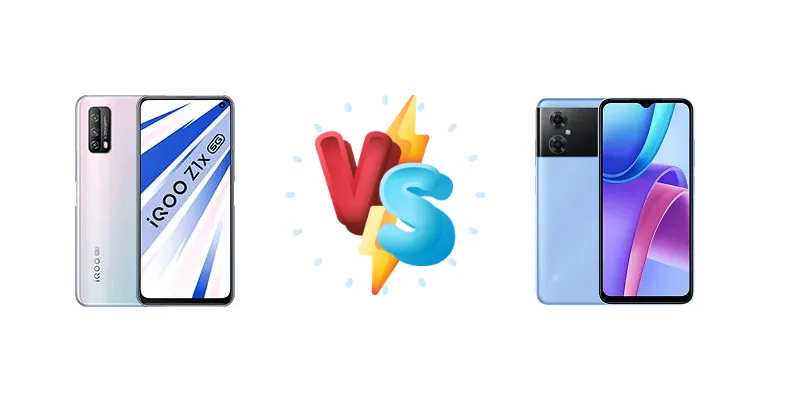
The budget smartphone market is fiercely competitive, offering incredible value for your money. Two contenders vying for your attention are the vivo iQOO Z1x and the Xiaomi Redmi Note 11R. But which one reigns supreme? Let's dive into a comprehensive comparison to help you decide.
🏆 Quick Verdict
The iQOO Z1x takes the lead thanks to its significantly faster Snapdragon 765G chipset and faster 33W charging. While the Redmi Note 11R offers a sleek design and potentially a better display, the iQOO Z1x provides a more powerful and efficient overall experience for the price.
| Network |
|---|
| 2G bands | GSM 850 / 900 / 1800 / 1900 | GSM 850 / 900 / 1800 / 1900 |
| 3G bands | HSDPA 850 / 900 / 1700(AWS) / 2100 | HSDPA 850 / 900 / 1900 / 2100 |
| 4G bands | 1, 3, 4, 5, 8, 34, 38, 39, 40, 41 | 1, 3, 5, 7, 8, 34, 38, 39, 40, 41 |
| 5G bands | 1, 3, 41, 77, 78 SA/NSA | 1, 5, 8, 28, 41, 78 |
| Speed | HSPA, LTE (2CA), 5G | HSPA, LTE, 5G |
| Technology | GSM / CDMA / HSPA / EVDO / LTE / 5G | GSM / CDMA / HSPA / LTE / 5G |
| | CDMA2000 1xEV-DO | CDMA 800 |
| Launch |
|---|
| Announced | 2020, July 09. Released 2020, July 25 | 2022, September 30 |
| Status | Discontinued | Available. Released 2022, September 30 |
| Body |
|---|
| Build | - | Glass front, plastic frame, plastic back |
| Dimensions | 164.2 x 76.5 x 9.1 mm (6.46 x 3.01 x 0.36 in) | 164 x 76.1 x 8.9 mm (6.46 x 3.00 x 0.35 in) |
| SIM | Nano-SIM + Nano-SIM | Nano-SIM + Nano-SIM |
| Weight | 199.5 g (7.05 oz) | 201 g (7.09 oz) |
| Display |
|---|
| Resolution | 1080 x 2408 pixels, 20:9 ratio (~400 ppi density) | 1080 x 2408 pixels, 20:9 ratio (~401 ppi density) |
| Size | 6.57 inches, 105.0 cm2 (~83.6% screen-to-body ratio) | 6.58 inches, 104.3 cm2 (~83.6% screen-to-body ratio) |
| Type | IPS LCD, 120Hz, HDR10 | IPS LCD, 90Hz, 400 nits (typ) |
| Platform |
|---|
| CPU | Octa-core (1x2.4 GHz Kryo 475 Prime & 1x2.2 GHz Kryo 475 Gold & 6x1.8 GHz Kryo 475 Silver) | Octa-core (2x2.2 GHz Cortex-A76 & 6x2.0 GHz Cortex-A55) |
| Chipset | Qualcomm SM7250 Snapdragon 765G 5G (7 nm) | Mediatek Dimensity 700 (7 nm) |
| GPU | Adreno 620 | Mali-G57 MC2 |
| OS | Android 10, iQOO UI 1.0 | Android 12, MIUI 13 |
| Memory |
|---|
| Card slot | No | microSDXC (dedicated slot) |
| Internal | 64GB 6GB RAM, 128GB 6GB RAM, 128GB 8GB RAM, 256GB 8GB RAM | 128GB 4GB RAM, 128GB 6GB RAM, 128GB 8GB RAM |
| | UFS 2.1 | UFS 2.2 |
| Main Camera |
|---|
| Dual | - | 13 MP, f/2.2, (wide), PDAF
Auxiliary lens |
| Features | LED flash, HDR, panorama | LED flash, HDR, panorama |
| Triple | 48 MP, f/1.8, 26mm (wide), 1/2.0", 0.8µm, PDAF
2 MP (macro)
Auxiliary lens | - |
| Video | 4K@30fps, 1080p@30fps; gyro-EIS | 1080p@30fps |
| Selfie camera |
|---|
| Features | HDR | HDR |
| Single | 16 MP, f/2.0, (wide) | 5 MP, f/2.2, (wide) |
| Video | 1080p@30fps | 1080p@30fps |
| Sound |
|---|
| 3.5mm jack | Yes | Yes |
| 35mm jack | Yes | Yes |
| Loudspeaker | Yes | Yes |
| | 24-bit/192kHz audio | 24-bit/192kHz audio |
| Comms |
|---|
| Bluetooth | 5.1, A2DP, LE, aptX HD | 5.1, A2DP, LE |
| Infrared port | - | Yes |
| NFC | Yes | No |
| Positioning | GPS, GLONASS, BDS, GALILEO | GPS, GLONASS, GALILEO, BDS |
| Radio | No | No |
| USB | USB Type-C 2.0, OTG | USB Type-C 2.0, OTG |
| WLAN | Wi-Fi 802.11 a/b/g/n/ac, dual-band, Wi-Fi Direct | Wi-Fi 802.11 a/b/g/n/ac, dual-band, Wi-Fi Direct |
| Features |
|---|
| Sensors | Fingerprint (side-mounted), accelerometer, proximity, compass | Fingerprint (side-mounted), accelerometer, proximity, compass |
| Battery |
|---|
| Charging | 33W wired | 18W wired |
| Type | 5000 mAh | Li-Po 5000 mAh |
| Misc |
|---|
| Colors | Black, Blue, White | Black, Blue, Gray |
| Models | V2012A | 22095RA98C |
| Price | About 220 EUR | About 160 EUR |
vivo iQOO Z1x
- Faster Processor (Snapdragon 765G)
- Faster Charging (33W)
- Potentially Higher Refresh Rate Display
- Good Value for Performance
- Design might be less premium
- Camera might not be the absolute best in low light
Xiaomi Redmi Note 11R
- Potentially Better Display Color Accuracy
- Sleek Design
- Good Battery Life
- Slower Processor (Dimensity 700)
- Slower Charging (18W)
- Lower Performance for Gaming
Display Comparison
Both phones likely feature LCD displays, with the Redmi Note 11R potentially having a slightly better color accuracy and brightness due to Xiaomi's display tuning. The iQOO Z1x might offer a higher refresh rate (likely 120Hz) for smoother scrolling and gaming, though this isn't confirmed for all Z1x variants. Resolution is likely FHD+ for both.
Camera Comparison
Camera performance is often a mixed bag in this price range. The Redmi Note 11R might have a slightly better primary sensor, potentially resulting in slightly better low-light performance. However, the iQOO Z1x's image processing could compensate, and the overall camera experience will likely be comparable. Both likely feature a standard triple camera setup.
Performance
The iQOO Z1x's Snapdragon 765G is a clear winner here. It's a more powerful chipset than the Redmi Note 11R's Dimensity 700, offering noticeably better performance in demanding games and applications. Expect smoother multitasking and faster app loading times on the iQOO Z1x.
Battery Life
The iQOO Z1x's 33W charging is a significant advantage. It will charge the battery much faster than the Redmi Note 11R's 18W charging. Battery capacity is likely similar (around 5000mAh) for both, so real-world battery life should be comparable, but the iQOO Z1x offers faster replenishment.
Buying Guide
The vivo iQOO Z1x is ideal for users prioritizing performance and fast charging, especially gamers or those who frequently multitask. The Xiaomi Redmi Note 11R is a good choice for users who value a potentially better display and a more streamlined, potentially more compact design, and are less concerned with raw processing power.
Frequently Asked Questions
❓ Is the iQOO Z1x good for gaming?
Yes, the iQOO Z1x's Snapdragon 765G chipset makes it a solid choice for mobile gaming, offering better performance than the Redmi Note 11R.
❓ Which phone has better battery life?
Both phones likely have similar battery life due to comparable battery capacities. However, the iQOO Z1x charges significantly faster.