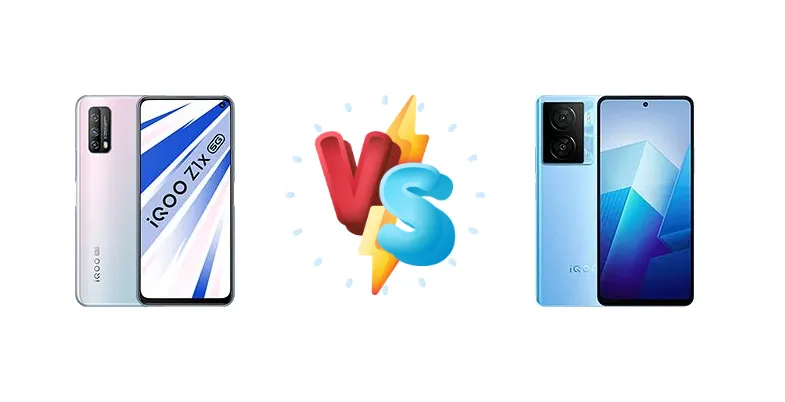
The vivo iQOO series consistently delivers impressive value in the budget smartphone market. Today, we're pitting two popular contenders against each other: the iQOO Z1x and the newer iQOO Z7x. Which one offers the best bang for your buck?
🏆 Quick Verdict
The iQOO Z7x is the clear winner thanks to its significantly faster 80W charging and more efficient 6nm Snapdragon 695 chipset. While the Z1x boasts a slightly more powerful Snapdragon 765G, the Z7x's charging speed and overall efficiency make it a more compelling choice for most users.
| Network |
|---|
| 2G bands | GSM 850 / 900 / 1800 / 1900 | GSM 850 / 900 / 1800 / 1900 |
| 3G bands | HSDPA 850 / 900 / 1700(AWS) / 2100 | HSDPA 850 / 900 / 2100 |
| 4G bands | 1, 3, 4, 5, 8, 34, 38, 39, 40, 41 | 1, 3, 5, 8, 28, 34, 38, 39, 40, 41 |
| 5G bands | 1, 3, 41, 77, 78 SA/NSA | 1, 5, 8, 28, 41, 77, 78 SA/NSA |
| Speed | HSPA, LTE (2CA), 5G | HSPA, LTE, 5G |
| Technology | GSM / CDMA / HSPA / EVDO / LTE / 5G | GSM / CDMA / HSPA / CDMA2000 / LTE / 5G |
| | CDMA2000 1xEV-DO | CDMA2000 1x |
| Launch |
|---|
| Announced | 2020, July 09. Released 2020, July 25 | 2023, March 20 |
| Status | Discontinued | Available. Released 2023, March 24 |
| Body |
|---|
| Dimensions | 164.2 x 76.5 x 9.1 mm (6.46 x 3.01 x 0.36 in) | 164.6 x 75.8 x 9.1 mm (6.48 x 2.98 x 0.36 in) |
| SIM | Nano-SIM + Nano-SIM | Nano-SIM + Nano-SIM |
| Weight | 199.5 g (7.05 oz) | 205 g (7.23 oz) |
| Display |
|---|
| Resolution | 1080 x 2408 pixels, 20:9 ratio (~400 ppi density) | 1080 x 2388 pixels (~395 ppi density) |
| Size | 6.57 inches, 105.0 cm2 (~83.6% screen-to-body ratio) | 6.64 inches, 106.8 cm2 (~85.6% screen-to-body ratio) |
| Type | IPS LCD, 120Hz, HDR10 | IPS LCD, 120Hz |
| Platform |
|---|
| CPU | Octa-core (1x2.4 GHz Kryo 475 Prime & 1x2.2 GHz Kryo 475 Gold & 6x1.8 GHz Kryo 475 Silver) | Octa-core (2x2.2 GHz Kryo 660 Gold & 6x1.7 GHz Kryo 660 Silver) |
| Chipset | Qualcomm SM7250 Snapdragon 765G 5G (7 nm) | Qualcomm SM6375 Snapdragon 695 5G (6 nm) |
| GPU | Adreno 620 | Adreno 619 |
| OS | Android 10, iQOO UI 1.0 | Android 13, Funtouch 13 (Global), Origin OS 3 (China) |
| Memory |
|---|
| Card slot | No | microSDXC |
| Internal | 64GB 6GB RAM, 128GB 6GB RAM, 128GB 8GB RAM, 256GB 8GB RAM | 128GB 6GB RAM, 128GB 8GB RAM, 256GB 8GB RAM, 256GB 12GB RAM |
| | UFS 2.1 | UFS 2.2 |
| Main Camera |
|---|
| Dual | - | 50 MP, f/1.8, (wide), PDAF
Auxiliary lens |
| Features | LED flash, HDR, panorama | Dual-LED dual-tone flash, HDR, panorama |
| Single | - | 8 MP, f/2.0, (wide) |
| Triple | 48 MP, f/1.8, 26mm (wide), 1/2.0", 0.8µm, PDAF
2 MP (macro)
Auxiliary lens | - |
| Video | 4K@30fps, 1080p@30fps; gyro-EIS | 1080p@30fps |
| Selfie camera |
|---|
| Features | HDR | - |
| Single | 16 MP, f/2.0, (wide) | 8 MP, f/2.0, (wide) |
| Video | 1080p@30fps | 1080p@30fps |
| Sound |
|---|
| 3.5mm jack | Yes | Yes |
| 35mm jack | Yes | Yes |
| Loudspeaker | Yes | Yes |
| | 24-bit/192kHz audio | - |
| Comms |
|---|
| Bluetooth | 5.1, A2DP, LE, aptX HD | 5.1, A2DP, LE, aptX HD |
| NFC | Yes | Yes (market/region dependent) |
| Positioning | GPS, GLONASS, BDS, GALILEO | GPS (L1), GLONASS (G1), BDS (B1I+B1c), GALILEO (E1), QZSS (L1) |
| Radio | No | No |
| USB | USB Type-C 2.0, OTG | USB Type-C 2.0, OTG |
| WLAN | Wi-Fi 802.11 a/b/g/n/ac, dual-band, Wi-Fi Direct | Wi-Fi 802.11 a/b/g/n/ac, dual-band, Wi-Fi Direct |
| Features |
|---|
| Sensors | Fingerprint (side-mounted), accelerometer, proximity, compass | Fingerprint (side-mounted), accelerometer, gyro, proximity, compass |
| Battery |
|---|
| Charging | 33W wired | 80W wired, 70% in 34 min |
| Type | 5000 mAh | 6000 mAh |
| Misc |
|---|
| Colors | Black, Blue, White | Tropical Blue, Metallic Grey, Orange |
| Models | V2012A | V2272A |
| Price | About 220 EUR | About 180 EUR |
vivo iQOO Z1x
- Slightly more powerful chipset (Snapdragon 765G)
- Good value for money
- Decent display
- Slower charging (33W)
- Older chipset
- Potentially less efficient
vivo iQOO Z7x
- Blazing-fast 80W charging
- More efficient chipset (Snapdragon 695 6nm)
- Likely improved image processing
- Modern design
- Slightly lower peak performance than Z1x
- May have slightly less RAM in some configurations
Display Comparison
Both phones likely feature similar display technology (likely an LCD) with a high refresh rate (likely 120Hz) for smooth scrolling. The Z7x might have slightly improved color accuracy due to advancements in display technology since the Z1x's release. Screen sizes are likely comparable, around 6.6-6.7 inches.
Camera Comparison
Camera specs are likely similar, with a primary sensor around 64MP. The Z7x may benefit from improved image processing algorithms due to its newer chipset, potentially resulting in slightly better image quality, especially in low light. Both will likely offer decent but not exceptional camera performance.
Performance
The iQOO Z1x holds a slight edge in raw CPU power thanks to the Snapdragon 765G. However, the iQOO Z7x's 6nm Snapdragon 695 is more power-efficient, leading to better real-world battery life despite the potentially lower peak performance. Gaming performance will be good on both, but the Z1x might handle more demanding titles slightly better.
Battery Life
This is where the iQOO Z7x truly shines. Its 80W wired charging is a game-changer, allowing for incredibly fast top-ups. The Z1x's 33W charging is considerably slower. Both phones likely have a similar battery capacity (around 5000mAh), but the Z7x's efficiency and faster charging make it the clear winner in this category.
Buying Guide
The iQOO Z1x is a good choice for users prioritizing raw processing power and are less concerned about charging speed. The iQOO Z7x is ideal for those who value fast charging, improved power efficiency, and a more modern chipset, even if it means a slight performance trade-off.
Frequently Asked Questions
❓ Is the iQOO Z7x worth upgrading from the iQOO Z1x?
Yes, especially if you prioritize fast charging and improved battery life. The Z7x's 80W charging is a significant upgrade.
❓ Which phone is better for gaming?
The iQOO Z1x might offer slightly better performance in demanding games due to its more powerful chipset, but both are capable of handling most games well.