
iQOO Z1x vs OnePlus 8T: A Deep Dive into Mid-Range 5G Contenders
| Phones Images | |||||
|---|---|---|---|---|---|
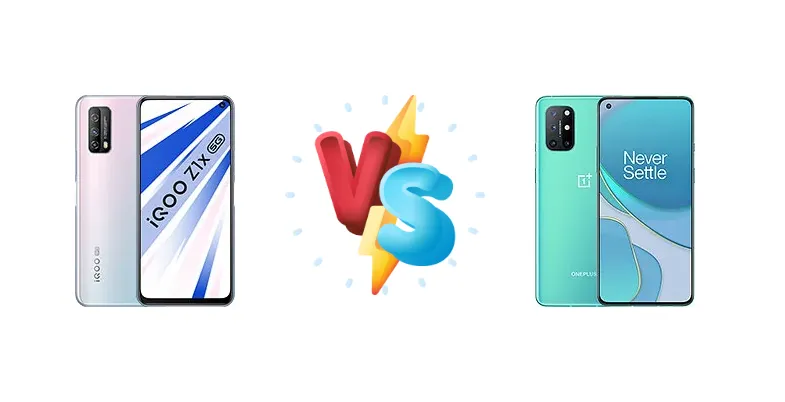
|
🏆 Quick Verdict
For most users, the OnePlus 8T is the superior choice. Its Snapdragon 865 chipset delivers significantly faster performance, and its 65W charging is a game-changer. While the iQOO Z1x offers a compelling price, the 8T’s overall experience justifies the price premium.
| PHONES | ||
|---|---|---|
| Phone Names | vivo iQOO Z1x | OnePlus 8T |
| Network | ||
|---|---|---|
| 2G bands | GSM 850 / 900 / 1800 / 1900 | GSM 850 / 900 / 1800 / 1900 |
| 3G bands | HSDPA 850 / 900 / 1700(AWS) / 2100 | HSDPA 800 / 850 / 900 / 1700(AWS) / 1800 / 1900 / 2100 |
| 4G bands | 1, 3, 4, 5, 8, 34, 38, 39, 40, 41 | 1, 2, 3, 4, 5, 7, 8, 12, 13, 17, 18, 19, 20, 25, 26, 28, 32, 34, 38, 39, 40, 41, 42, 66 - EU |
| 5G bands | 1, 3, 41, 77, 78 SA/NSA | 1, 3, 7, 28, 41, 78 SA/NSA - EU |
| Speed | HSPA, LTE (2CA), 5G | HSPA 42.2/5.76 Mbps, LTE (5CA) Cat18 1200/200 Mbps, 5G 7.5 Gbps DL |
| Technology | GSM / CDMA / HSPA / EVDO / LTE / 5G | GSM / CDMA / HSPA / LTE / 5G |
| CDMA2000 1xEV-DO | 41, 78, 79 SA/NSA - CN | |
| Launch | ||
|---|---|---|
| Announced | 2020, July 09. Released 2020, July 25 | 2020, October 14 |
| Status | Discontinued | Available. Released 2020, October 16 |
| Body | ||
|---|---|---|
| Build | - | Glass front (Gorilla Glass 5), glass back (Gorilla Glass 5), aluminum frame |
| Dimensions | 164.2 x 76.5 x 9.1 mm (6.46 x 3.01 x 0.36 in) | 160.7 x 74.1 x 8.4 mm (6.33 x 2.92 x 0.33 in) |
| SIM | Nano-SIM + Nano-SIM | Nano-SIM + Nano-SIM |
| Weight | 199.5 g (7.05 oz) | 188 g (6.63 oz) |
| Display | ||
|---|---|---|
| Protection | - | Corning Gorilla Glass 5 |
| Resolution | 1080 x 2408 pixels, 20:9 ratio (~400 ppi density) | 1080 x 2400 pixels, 20:9 ratio (~402 ppi density) |
| Size | 6.57 inches, 105.0 cm2 (~83.6% screen-to-body ratio) | 6.55 inches, 103.6 cm2 (~87.0% screen-to-body ratio) |
| Type | IPS LCD, 120Hz, HDR10 | Fluid AMOLED, 120Hz, HDR10+ |
| - | Always-on display | |
| Platform | ||
|---|---|---|
| CPU | Octa-core (1x2.4 GHz Kryo 475 Prime & 1x2.2 GHz Kryo 475 Gold & 6x1.8 GHz Kryo 475 Silver) | Octa-core (1x2.84 GHz Cortex-A77 & 3x2.42 GHz Cortex-A77 & 4x1.80 GHz Cortex-A55) |
| Chipset | Qualcomm SM7250 Snapdragon 765G 5G (7 nm) | Qualcomm SM8250 Snapdragon 865 5G (7 nm+) |
| GPU | Adreno 620 | Adreno 650 |
| OS | Android 10, iQOO UI 1.0 | Android 11, upgradable to Android 14, OxygenOS 14 |
| Memory | ||
|---|---|---|
| Card slot | No | No |
| Internal | 64GB 6GB RAM, 128GB 6GB RAM, 128GB 8GB RAM, 256GB 8GB RAM | 128GB 8GB RAM, 256GB 12GB RAM |
| UFS 2.1 | UFS 3.1 | |
| Main Camera | ||
|---|---|---|
| Features | LED flash, HDR, panorama | Dual-LED flash, HDR, panorama |
| Quad | - | 48 MP, f/1.7, 26mm (wide), 1/2.0", 0.8µm, PDAF, OIS 16 MP, f/2.2, 14mm, 123˚ (ultrawide), 1/3.6", 1.0µm 5 MP (macro) 2 MP, f/2.4, (monochrome) |
| Triple | 48 MP, f/1.8, 26mm (wide), 1/2.0", 0.8µm, PDAF 2 MP (macro) Auxiliary lens | - |
| Video | 4K@30fps, 1080p@30fps; gyro-EIS | 4K@30/60fps, 1080p@30/60/240fps, Auto HDR, gyro-EIS |
| Selfie camera | ||
|---|---|---|
| Features | HDR | HDR |
| Single | 16 MP, f/2.0, (wide) | 16 MP, f/2.4, (wide), 1/3.06", 1.0µm |
| Video | 1080p@30fps | 1080p@30fps, gyro-EIS |
| Sound | ||
|---|---|---|
| 3.5mm jack | Yes | No |
| 35mm jack | Yes | No |
| Loudspeaker | Yes | Yes, with stereo speakers |
| 24-bit/192kHz audio | - | |
| Comms | ||
|---|---|---|
| Bluetooth | 5.1, A2DP, LE, aptX HD | 5.1, A2DP, LE, aptX HD |
| NFC | Yes | Yes |
| Positioning | GPS, GLONASS, BDS, GALILEO | GPS (L1+L5), GLONASS (G1), BDS (B1), GALILEO (E1+E5a) |
| Radio | No | No |
| USB | USB Type-C 2.0, OTG | USB Type-C 3.1, OTG |
| WLAN | Wi-Fi 802.11 a/b/g/n/ac, dual-band, Wi-Fi Direct | Wi-Fi 802.11 a/b/g/n/ac/6, dual-band, Wi-Fi Direct, DLNA |
| Features | ||
|---|---|---|
| Sensors | Fingerprint (side-mounted), accelerometer, proximity, compass | Fingerprint (under display, optical), accelerometer, gyro, proximity, compass, barometer (market dependant) |
| Battery | ||
|---|---|---|
| Charging | 33W wired | 65W wired, 100% in 39 min |
| Type | 5000 mAh | Li-Po 4500 mAh |
| Misc | ||
|---|---|---|
| Colors | Black, Blue, White | Aquamarine Green, Lunar Silver, Cyberpunk 2077 Edition |
| Models | V2012A | KB2001, KB2000, KB2003, KB2005 |
| Price | About 220 EUR | € 130.75 |
| Tests | ||
|---|---|---|
| Battery life | - | Endurance rating 104h |
| Camera | - | Photo / Video |
| Display | - | Contrast ratio: Infinite (nominal) |
| Loudspeaker | - | -24.0 LUFS (Very good) |
| Performance | - | AnTuTu: 586000 (v8) GeekBench: 3126 (v5.1) GFXBench: 46fps (ES 3.1 onscreen) |
vivo iQOO Z1x
- More affordable price point
- 5G connectivity
- Decent performance for everyday tasks
- Significantly slower processor than the OnePlus 8T
- Slower charging speed
- Less detailed display specifications
OnePlus 8T
- Flagship-level Snapdragon 865 processor
- Ultra-fast 65W charging
- Brighter and higher-quality display
- Higher price tag
- May be harder to find new due to its age
- Potentially larger physical size
Display Comparison
The OnePlus 8T boasts a brighter display, reaching a measured 802 nits, compared to an unspecified brightness for the iQOO Z1x. While both likely utilize AMOLED panels (based on brand history), the 8T’s higher peak brightness translates to better visibility in direct sunlight. The 8T’s ‘Infinite’ contrast ratio (nominal) suggests excellent black levels, typical of AMOLED technology. The iQOO Z1x’s display specs are less defined, suggesting a more cost-optimized panel.
Camera Comparison
Both phones offer photo and video capabilities, but detailed sensor information is lacking for the iQOO Z1x. The OnePlus 8T likely features a more sophisticated camera system, leveraging the processing power of the Snapdragon 865 for improved image quality and features. Without specific sensor details for the Z1x, it’s difficult to make a direct comparison, but the 8T’s flagship chipset provides a clear advantage in image processing and potentially, low-light performance. We can assume the 8T has a more capable main sensor.
Performance
The core difference lies in the chipsets. The OnePlus 8T’s Snapdragon 865 (7nm+) is a significant step up from the iQOO Z1x’s Snapdragon 765G (7nm). The 865 features a more powerful CPU configuration – a 2.84 GHz Cortex-A77 prime core versus the Z1x’s 2.4 GHz Kryo 475 Prime. This, combined with the 865’s superior GPU, results in noticeably faster app loading, smoother multitasking, and a better gaming experience. The 865 also benefits from a more advanced 7nm+ fabrication process, potentially offering better thermal efficiency under sustained load. The Z1x’s 765G is still capable, but will struggle with graphically intensive tasks.
Battery Life
Both devices achieve an endurance rating of 104 hours, suggesting similar overall battery life despite the iQOO Z1x’s unspecified battery capacity. However, the charging speeds are drastically different. The OnePlus 8T’s 65W wired charging can fully charge the phone in just 39 minutes, a massive advantage over the iQOO Z1x’s 33W charging. This faster charging significantly reduces downtime and makes the 8T more convenient for users who frequently need to top up their battery.
Buying Guide
Buy the vivo iQOO Z1x if you prioritize affordability and are willing to compromise on raw processing power and charging speed. It’s ideal for everyday tasks and light gaming. Buy the OnePlus 8T if you demand smoother performance for demanding apps and games, value incredibly fast charging, and appreciate a more polished software experience. It’s the better option for power users and those who want a phone that will last longer.