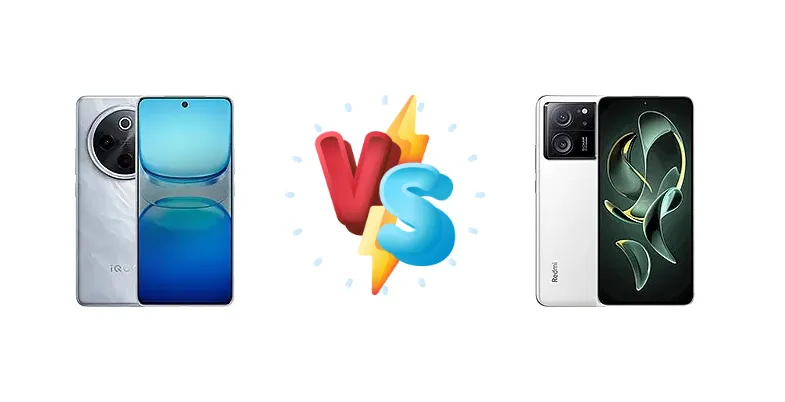
The iQOO Z10 and Xiaomi Redmi K60 Ultra represent compelling options in the increasingly competitive mid-range smartphone market. The Z10 aims for a balance of performance and affordability, while the K60 Ultra pushes the boundaries with a flagship-level chipset and blazing-fast charging. This comparison dissects their key differences to determine which device delivers the best experience for your needs.
🏆 Quick Verdict
For most users, the Xiaomi Redmi K60 Ultra emerges as the stronger contender. Its Dimensity 9200+ chipset provides a significant performance uplift over the Snapdragon 7s Gen 3 in the iQOO Z10, translating to smoother multitasking and superior gaming capabilities. While the Z10 offers respectable 90W charging, the K60 Ultra’s 120W charging is noticeably faster.
| Network |
|---|
| 2G bands | GSM 850 / 900 / 1800 / 1900 | GSM 850 / 900 / 1800 / 1900 |
| 3G bands | HSDPA 800 / 850 / 900 / 2100 | HSDPA 800 / 850 / 900 / 1700(AWS) / 2100 |
| 4G bands | 1, 3, 5, 8, 28, 38, 40, 41 - India | 1, 3, 4, 5, 8, 18, 19, 26, 34, 38, 39, 40, 41, 42, 66 |
| 5G bands | 1, 3, 5, 8, 28, 38, 40, 41, 77, 78 SA/NSA - India | 1, 3, 5, 8, 28, 38, 41, 66, 77, 78 SA/NSA |
| Speed | HSPA, LTE, 5G | HSPA, LTE, 5G |
| Technology | GSM / HSPA / LTE / 5G | GSM / CDMA / HSPA / CDMA2000 / LTE / 5G |
| Launch |
|---|
| Announced | 2025, April 11 | 2023, August 15 |
| Status | Available. Released 2025, April 16 | Available. Released 2023, August 15 |
| Body |
|---|
| Dimensions | 163.4 x 76.4 x 7.9 mm (6.43 x 3.01 x 0.31 in) | 162.2 x 75.7 x 8.5 mm (6.39 x 2.98 x 0.33 in) |
| SIM | Nano-SIM + Nano-SIM | Nano-SIM + Nano-SIM |
| Weight | 199 g (7.02 oz) | 204 g (7.20 oz) |
| Display |
|---|
| Protection | - | Unspecified |
| Resolution | 1080 x 2392 pixels (~388 ppi density) | 1220 x 2712 pixels, 20:9 ratio (~446 ppi density) |
| Size | 6.77 inches, 110.9 cm2 (~88.8% screen-to-body ratio) | 6.67 inches, 107.4 cm2 (~87.5% screen-to-body ratio) |
| Type | AMOLED, 120Hz, 3840Hz PWM, 1300 nits (HBM), 5000 nits (peak) | OLED, 68B colors, 144Hz, Dolby Vision, HDR10+, 2600 nits (peak) |
| Platform |
|---|
| CPU | Octa-core (1x2.5 GHz Cortex-A720 & 3x2.4 GHz Cortex-A720 & 4x1.8 GHz Cortex-A520) | Octa-core (1x3.35 GHz Cortex-X3 & 3x3.0 GHz Cortex-A715 & 4x2.0 GHz Cortex-A510) |
| Chipset | Qualcomm SM7635 Snapdragon 7s Gen 3 (4 nm) | Mediatek Dimensity 9200+ (4 nm) |
| GPU | Adreno 810 | Immortalis-G715 MC11 |
| OS | Android 15, up to 2 major Android upgrades, Funtouch 15 | Android 13, MIUI 14 |
| Memory |
|---|
| Card slot | No | No |
| Internal | 128GB 8GB RAM, 256GB 8GB RAM, 256GB 12GB RAM, 512GB 12GB RAM | 256GB 12GB RAM, 256GB 16GB RAM, 512GB 16GB RAM, 1TB 16GB RAM, 1TB 24GB RAM |
| Main Camera |
|---|
| Dual | 50 MP, f/1.8, (wide), 1/1.95", 0.8µm, PDAF, OIS
Auxiliary lens | - |
| Features | LED flash, HDR, panorama | Color spectrum sensor, Dual-LED dual-tone flash, HDR, panorama |
| Triple | - | 50 MP, f/1.7, (wide), 1/1.49", 1.0µm, PDAF, OIS
8 MP, 119˚ (ultrawide), 1/4.0", 1.12µm
2 MP (macro) |
| Video | 4K@30fps, 1080p@30/60fps, gyro-EIS | 8K@24fps, 4K@30/60fps, 1080p@30/60/120/240/960fps, gyro-EIS, HDR10+, 10-bit |
| Selfie camera |
|---|
| Features | - | HDR |
| Single | 32 MP, f/2.0, (wide) | 20 MP, (wide), 1/2.0", 0.8µm |
| Video | 1080p@30fps | 1080p@30/120fps |
| Sound |
|---|
| 35mm jack | No | No |
| Loudspeaker | Yes | Yes, with stereo speakers |
| Comms |
|---|
| Bluetooth | 5.2(IN), 5.4(IDN), A2DP, LE | 5.4, A2DP, LE |
| Infrared port | Yes | Yes |
| NFC | Yes (market/region dependent) | Yes |
| Positioning | GPS, GLONASS, GALILEO, BDS, QZSS | GPS (L1+L5), GLONASS (G1), BDS (B1I+B1C+B2a+B2b), GALILEO (E1+E5a), QZSS (L1+L5), NavIC |
| Radio | No | Unspecified |
| USB | USB Type-C 2.0, OTG | USB Type-C, OTG |
| WLAN | Wi-Fi 802.11 a/b/g/n/ac, dual-band - IndiaWi-Fi 802.11 a/b/g/n/ac/6/7, dual-band - Indonesia | Wi-Fi 802.11 a/b/g/n/ac/6e, dual-band, Wi-Fi Direct |
| Features |
|---|
| Sensors | Fingerprint (under display, optical), accelerometer, gyro, proximity, compass | Fingerprint (under display, optical), accelerometer, gyro, proximity, compass |
| Battery |
|---|
| Charging | 90W wired
Reverse wired | 120W wired, PD3.0, 100% in 19 min |
| Type | Si/C Li-Ion 7300 mAh | Li-Po 5000 mAh |
| Misc |
|---|
| Colors | Stellar Black, Glacier Silver | Black, White, Green |
| Models | - | 23078RKD5C |
| Price | ₹ 20,998 | About 330 EUR |
| SAR | 0.99 W/kg (head) 0.87 W/kg (body) | - |
vivo iQOO Z10
- More affordable price point
- Respectable performance for everyday tasks
- 90W fast charging is still quick
- Significantly less powerful chipset than the K60 Ultra
- Likely a less advanced camera system
- May exhibit more throttling under sustained load
Xiaomi Redmi K60 Ultra
- Flagship-level Dimensity 9200+ chipset
- Blazing-fast 120W charging
- Likely superior camera performance
- Higher price tag
- Potentially more heat generation under heavy load
- May be overkill for basic users
Display Comparison
Neither device's display specifications are provided, so we must infer. Given the K60 Ultra's positioning, it likely features a higher-quality AMOLED panel with a higher refresh rate (potentially 144Hz) and peak brightness compared to the Z10. The Z10, targeting a lower price point, likely utilizes a standard AMOLED with a 120Hz refresh rate. Bezels are expected to be minimal on both, but the K60 Ultra may have a slightly more refined design. Color accuracy will likely be excellent on both, but the K60 Ultra may offer wider color gamut support.
Camera Comparison
Without specific camera specs, analysis is limited. However, the K60 Ultra, being a more premium device, likely features a larger main sensor with optical image stabilization (OIS) and a more sophisticated image processing pipeline. The Z10 likely employs a more basic camera setup, potentially lacking OIS. Lens apertures will be crucial; wider apertures (lower f-number) on the K60 Ultra will improve low-light performance. We can expect both phones to offer acceptable image quality in good lighting conditions, but the K60 Ultra should excel in challenging scenarios.
Performance
The core difference lies in the chipsets. The Redmi K60 Ultra’s MediaTek Dimensity 9200+ (4nm) boasts a Cortex-X3 prime core clocked at 3.35 GHz, alongside three Cortex-A715 cores at 3.0 GHz and four Cortex-A510 cores at 2.0 GHz. This configuration significantly outperforms the iQOO Z10’s Qualcomm Snapdragon 7s Gen 3 (4nm) which features a 2.5 GHz Cortex-A720 prime core, three 2.4 GHz Cortex-A720 cores, and four 1.8 GHz Cortex-A520 cores. The Dimensity 9200+’s architectural advantage and higher clock speeds will result in faster app loading times, smoother multitasking, and substantially better gaming performance. Both utilize a 4nm process, offering good efficiency, but the Dimensity 9200+ is expected to generate more heat under sustained load, requiring robust thermal management. Both likely feature LPDDR5X RAM, but the K60 Ultra may benefit from faster storage speeds.
Battery Life
The Redmi K60 Ultra’s 120W wired charging is a standout feature, capable of charging the device from 0-100% in a claimed 19 minutes. The iQOO Z10’s 90W wired charging is still fast, but noticeably slower. While battery capacity isn’t specified, the K60 Ultra’s more efficient chipset and optimized power management could offset any potential capacity difference. The K60 Ultra also supports PD3.0, offering wider compatibility with chargers.
Buying Guide
Buy the vivo iQOO Z10 if you prioritize a more budget-friendly option and still require solid everyday performance for social media, browsing, and casual gaming. Buy the Xiaomi Redmi K60 Ultra if you demand top-tier performance for demanding games, intensive multitasking, and appreciate the convenience of incredibly fast charging – even if it comes at a slightly higher price.
Frequently Asked Questions
❓ Will the Dimensity 9200+ in the Redmi K60 Ultra get noticeably hot during prolonged gaming sessions?
The Dimensity 9200+ is a powerful chip and will generate heat under sustained load. However, Xiaomi typically implements robust thermal management solutions, including vapor chamber cooling, to mitigate throttling. Expect some warmth, but likely not to the point of severely impacting performance.
❓ Is the 90W charging on the iQOO Z10 fast enough for daily use, or is the 120W on the K60 Ultra a must-have?
90W charging is still very fast and will top up the iQOO Z10 quickly. However, the 120W charging on the K60 Ultra is a significant step up, reducing charging times by a noticeable margin. If you frequently find yourself needing to quickly recharge your phone, the K60 Ultra’s charging speed is a compelling advantage.
❓ How does the Snapdragon 7s Gen 3 handle graphically intensive games like Genshin Impact or Call of Duty Mobile?
The Snapdragon 7s Gen 3 can run these games, but you'll likely need to lower graphics settings to achieve consistently smooth frame rates. The Dimensity 9200+ in the K60 Ultra will provide a much more comfortable experience, allowing for higher graphics settings and more stable performance.