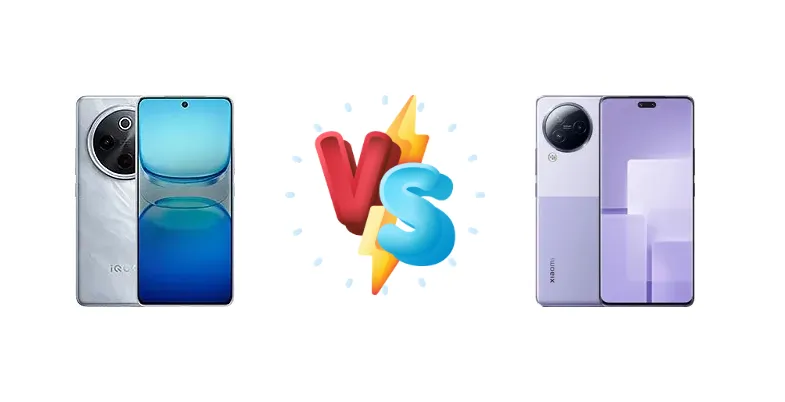
The iQOO Z10 and Xiaomi Civi 3 represent compelling options in the increasingly competitive mid-range smartphone market. The Z10 focuses on rapid charging and a streamlined experience, while the Civi 3 prioritizes a more powerful chipset and a refined design. This comparison dissects their key differences to determine which device best suits your needs.
🏆 Quick Verdict
For most users, the Xiaomi Civi 3 is the stronger choice. Its Mediatek Dimensity 8200 Ultra chipset delivers significantly better CPU and GPU performance than the iQOO Z10’s Snapdragon 7s Gen 3, translating to smoother multitasking and a more enjoyable gaming experience. While the Z10 boasts faster 90W charging, the Civi 3’s 67W is still respectable and the performance gap is more impactful.
| Network |
|---|
| 2G bands | GSM 850 / 900 / 1800 / 1900 | GSM 850 / 900 / 1800 / 1900 |
| 3G bands | HSDPA 800 / 850 / 900 / 2100 | HSDPA 800 / 850 / 900 / 1700(AWS) / 1900 / 2100 |
| 4G bands | 1, 3, 5, 8, 28, 38, 40, 41 - India | 1, 3, 4, 5, 8, 18, 19, 26, 34, 38, 39, 40, 41, 42 |
| 5G bands | 1, 3, 5, 8, 28, 38, 40, 41, 77, 78 SA/NSA - India | 1, 3, 5, 8, 28, 38, 41, 77, 78 SA/NSA |
| Speed | HSPA, LTE, 5G | HSPA, LTE, 5G |
| Technology | GSM / HSPA / LTE / 5G | GSM / CDMA / HSPA / CDMA2000 / LTE / 5G |
| Launch |
|---|
| Announced | 2025, April 11 | 2023, May 25 |
| Status | Available. Released 2025, April 16 | Available. Released 2023, May 25 |
| Body |
|---|
| Build | - | Glass front (Gorilla Glass 5), glass back, aluminum frame |
| Dimensions | 163.4 x 76.4 x 7.9 mm (6.43 x 3.01 x 0.31 in) | 158.7 x 71.7 x 7.6 mm (6.25 x 2.82 x 0.30 in) |
| SIM | Nano-SIM + Nano-SIM | Nano-SIM + Nano-SIM |
| Weight | 199 g (7.02 oz) | 174 g (6.14 oz) |
| Display |
|---|
| Protection | - | Corning Gorilla Glass 5 |
| Resolution | 1080 x 2392 pixels (~388 ppi density) | 1080 x 2400 pixels, 20:9 ratio (~402 ppi density) |
| Size | 6.77 inches, 110.9 cm2 (~88.8% screen-to-body ratio) | 6.55 inches, 103.6 cm2 (~91.0% screen-to-body ratio) |
| Type | AMOLED, 120Hz, 3840Hz PWM, 1300 nits (HBM), 5000 nits (peak) | AMOLED, 68B colors, 120Hz, Dolby Vision, HDR10+, 1500 nits (peak) |
| Platform |
|---|
| CPU | Octa-core (1x2.5 GHz Cortex-A720 & 3x2.4 GHz Cortex-A720 & 4x1.8 GHz Cortex-A520) | Octa-core (1x3.1 GHz Cortex-A78 & 3x3.0 GHz Cortex-A78 & 4x2.0 GHz Cortex-A55) |
| Chipset | Qualcomm SM7635 Snapdragon 7s Gen 3 (4 nm) | Mediatek Dimensity 8200 Ultra (4 nm) |
| GPU | Adreno 810 | Mali-G610 MC6 |
| OS | Android 15, up to 2 major Android upgrades, Funtouch 15 | Android 13, MIUI 14 |
| Memory |
|---|
| Card slot | No | No |
| Internal | 128GB 8GB RAM, 256GB 8GB RAM, 256GB 12GB RAM, 512GB 12GB RAM | 256GB 12GB RAM, 512GB 12GB RAM, 1TB 16GB RAM |
| Main Camera |
|---|
| Dual | 50 MP, f/1.8, (wide), 1/1.95", 0.8µm, PDAF, OIS
Auxiliary lens | - |
| Features | LED flash, HDR, panorama | Color spectrum sensor, Quad-LED dual-tone flash, HDR, panorama |
| Triple | - | 50 MP, f/1.8, (wide), 1/1.49", 1.0µm, PDAF, OIS
8 MP, f/2.2, 115˚ (ultrawide), 1.12µm
2 MP (macro) |
| Video | 4K@30fps, 1080p@30/60fps, gyro-EIS | 4K@30fps, 1080p@30/60/120fps, 720p@960fps; gyro-EIS |
| Selfie camera |
|---|
| Dual | - | 32 MP, f/2.0, 26mm (wide), 1/2.8", 0.8µm, AF
32 MP, f/2.4, 100˚ (ultrawide), 1/2.8", 0.8µm |
| Features | - | 2 Dual-LED dual-tone flash, HDR, panorama |
| Single | 32 MP, f/2.0, (wide) | - |
| Video | 1080p@30fps | 4K@30fps, 1080p@30/60fps; gyro-EIS |
| Sound |
|---|
| 35mm jack | No | No |
| Loudspeaker | Yes | Yes, with stereo speakers |
| Comms |
|---|
| Bluetooth | 5.2(IN), 5.4(IDN), A2DP, LE | 5.3, A2DP, LE |
| Infrared port | Yes | Yes |
| NFC | Yes (market/region dependent) | Yes |
| Positioning | GPS, GLONASS, GALILEO, BDS, QZSS | GPS (L1), GLONASS (G1), BDS (B1I+B1c), GALILEO (E1), QZSS (L1) |
| Radio | No | No |
| USB | USB Type-C 2.0, OTG | USB Type-C 2.0, OTG |
| WLAN | Wi-Fi 802.11 a/b/g/n/ac, dual-band - IndiaWi-Fi 802.11 a/b/g/n/ac/6/7, dual-band - Indonesia | Wi-Fi 802.11 a/b/g/n/ac/6, dual-band, Wi-Fi Direct |
| Features |
|---|
| Sensors | Fingerprint (under display, optical), accelerometer, gyro, proximity, compass | Fingerprint (under display, optical), accelerometer, gyro, proximity, compass |
| Battery |
|---|
| Charging | 90W wired
Reverse wired | 67W wired, PD3.0, 100% in 38 minutes |
| Type | Si/C Li-Ion 7300 mAh | Li-Po 4500 mAh |
| Misc |
|---|
| Colors | Stellar Black, Glacier Silver | Purple, Mint, Gold, Gray |
| Models | - | 23046PNC9C |
| Price | ₹ 20,998 | About 330 EUR |
| SAR | 0.99 W/kg (head) 0.87 W/kg (body) | - |
vivo iQOO Z10
- Blazing-fast 90W wired charging
- Potentially more affordable price point
- Streamlined user experience (typical of iQOO)
- Less powerful Snapdragon 7s Gen 3 chipset
- Likely compromises in camera quality compared to Civi 3
- Potentially less refined design
Xiaomi Civi 3
- Significantly more powerful Dimensity 8200 Ultra chipset
- Superior gaming performance
- Potentially better camera system (especially selfies)
- Slower 67W charging compared to iQOO Z10
- May be slightly more expensive
- Xiaomi’s MIUI software can be polarizing
Display Comparison
Neither device’s display specifications are provided, so a direct comparison is limited. However, given the market positioning, we can infer both likely utilize AMOLED panels. The Civi 3, historically, leans towards a more visually focused experience, potentially offering higher peak brightness and color accuracy. The iQOO Z10, being geared towards value, may prioritize cost-effectiveness over display extravagance. Bezels are likely comparable, with both aiming for a modern, immersive viewing experience.
Camera Comparison
Without specific camera sensor details, analysis is limited. However, Xiaomi Civi series typically emphasizes selfie capabilities, suggesting a strong front-facing camera on the Civi 3. The iQOO Z10, while likely offering a capable main sensor, may prioritize overall value over camera sophistication. Lens apertures and OIS (Optical Image Stabilization) are crucial factors, but absent from the provided data. Image processing styles also differ; Xiaomi often favors vibrant, saturated colors, while vivo tends towards a more natural look. We can assume both will include standard wide and ultrawide lenses, but details on sensor size and quality are needed for a definitive assessment.
Performance
The core difference lies in the chipsets. The Xiaomi Civi 3’s Mediatek Dimensity 8200 Ultra (4nm) is a substantial upgrade over the iQOO Z10’s Qualcomm Snapdragon 7s Gen 3 (4nm). The Dimensity 8200 Ultra features a 1x3.1 GHz Cortex-A78 core, significantly faster than the Z10’s 1x2.5 GHz Cortex-A720. This translates to a roughly 20-25% performance advantage in CPU-intensive tasks. The GPU performance gap is also considerable, making the Civi 3 the clear winner for gaming. Both utilize a 4nm process, offering good efficiency, but the architectural advantages of the Dimensity 8200 Ultra are undeniable. The Z10’s CPU core configuration (1+3+4) is also less efficient than the Civi 3’s (1+3+4) due to the older Cortex-A78 cores.
Battery Life
The iQOO Z10’s 90W wired charging is its standout feature, promising incredibly fast top-ups. While the Xiaomi Civi 3’s 67W charging with PD3.0 is still fast (0-100% in 38 minutes), it doesn’t match the Z10’s speed. However, battery life is also dependent on chipset efficiency. The Dimensity 8200 Ultra, despite being more powerful, is also relatively efficient. The actual battery capacity (mAh) is unknown for both devices, but the Z10’s faster charging could offset a potentially smaller battery size for users who prioritize quick refills.
Buying Guide
Buy the vivo iQOO Z10 if you absolutely prioritize the fastest possible charging speeds and a more aggressive price point. Its 90W charging is a standout feature for users who frequently need to top up their battery quickly. Buy the Xiaomi Civi 3 if you value overall performance, smoother gaming, and a more refined user experience. The Dimensity 8200 Ultra provides a noticeable advantage in demanding tasks and offers better long-term usability.
Frequently Asked Questions
❓ Will the Snapdragon 7s Gen 3 in the iQOO Z10 struggle with demanding games like Genshin Impact?
Yes, the Snapdragon 7s Gen 3 is a capable chip, but it will likely require significant graphics settings reductions to achieve playable frame rates in graphically intensive games like Genshin Impact. The Dimensity 8200 Ultra in the Civi 3 offers a much smoother experience with higher settings.
❓ How much faster is the 90W charging on the iQOO Z10 compared to the 67W charging on the Xiaomi Civi 3 in real-world use?
The iQOO Z10’s 90W charging can potentially shave off 15-20 minutes from a full 0-100% charge compared to the Civi 3’s 67W charging. However, charging speed slows down as the battery fills, so the difference will be more noticeable in the initial stages of charging.
❓ Does the Xiaomi Civi 3 support high refresh rate displays for smoother scrolling and gaming?
While not explicitly stated in the provided specs, Xiaomi Civi phones typically feature high refresh rate displays (90Hz or 120Hz). This would contribute to a smoother user experience and improved gaming visuals, a feature the iQOO Z10 may or may not have.