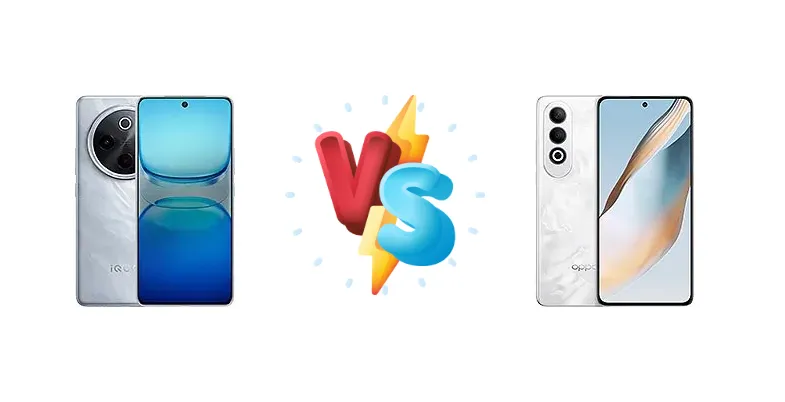
The iQOO Z10 and Oppo K12 Plus represent compelling options in the increasingly competitive mid-range smartphone market. Both leverage Qualcomm's 4nm Snapdragon 7-series chipsets, but diverge in CPU architecture and charging speeds. This comparison dissects these differences to determine which device delivers the best experience for demanding users.
🏆 Quick Verdict
For users prioritizing raw processing power and the fastest charging, the iQOO Z10 emerges as the winner. Its Snapdragon 7s Gen 3, while subtly different, offers a slight edge in CPU performance, coupled with 90W charging. However, the Oppo K12 Plus provides a well-rounded package with efficient charging and a competitive feature set.
| Network |
|---|
| 2G bands | GSM 850 / 900 / 1800 / 1900 | GSM 850 / 900 / 1800 / 1900 |
| 3G bands | HSDPA 800 / 850 / 900 / 2100 | HSDPA 850 / 900 / 1700(AWS) / 1900 / 2100 |
| 4G bands | 1, 3, 5, 8, 28, 38, 40, 41 - India | 1, 3, 4, 5, 8, 28, 34, 38, 39, 40, 41 |
| 5G bands | 1, 3, 5, 8, 28, 38, 40, 41, 77, 78 SA/NSA - India | 1, 5, 8, 28, 41, 77, 78 SA/NSA |
| Speed | HSPA, LTE, 5G | HSPA, LTE, 5G |
| Technology | GSM / HSPA / LTE / 5G | GSM / CDMA / HSPA / LTE / 5G |
| Launch |
|---|
| Announced | 2025, April 11 | 2024, October 12 |
| Status | Available. Released 2025, April 16 | Available. Released 2024, October 15 |
| Body |
|---|
| Dimensions | 163.4 x 76.4 x 7.9 mm (6.43 x 3.01 x 0.31 in) | 162.5 x 75.3 x 8.4 mm (6.40 x 2.96 x 0.33 in) |
| SIM | Nano-SIM + Nano-SIM | Nano-SIM + Nano-SIM |
| Weight | 199 g (7.02 oz) | 192 g (6.77 oz) |
| Display |
|---|
| Resolution | 1080 x 2392 pixels (~388 ppi density) | 1080 x 2412 pixels, 20:9 ratio (~394 ppi density) |
| Size | 6.77 inches, 110.9 cm2 (~88.8% screen-to-body ratio) | 6.7 inches, 108.0 cm2 (~88.3% screen-to-body ratio) |
| Type | AMOLED, 120Hz, 3840Hz PWM, 1300 nits (HBM), 5000 nits (peak) | AMOLED, 1B colors, 120Hz, 500 nits (typ), 900 nits (HBM), 1100 nits (peak) |
| Platform |
|---|
| CPU | Octa-core (1x2.5 GHz Cortex-A720 & 3x2.4 GHz Cortex-A720 & 4x1.8 GHz Cortex-A520) | Octa-core (1x2.63 GHz Cortex-A715 & 4x2.4 GHz Cortex-A715 & 3x1.8 GHz Cortex-A510) |
| Chipset | Qualcomm SM7635 Snapdragon 7s Gen 3 (4 nm) | Qualcomm SM7550-AB Snapdragon 7 Gen 3 (4 nm) |
| GPU | Adreno 810 | Adreno 720 |
| OS | Android 15, up to 2 major Android upgrades, Funtouch 15 | Android 14, ColorOS 14.0 |
| Memory |
|---|
| Card slot | No | microSDXC (uses shared SIM slot) |
| Internal | 128GB 8GB RAM, 256GB 8GB RAM, 256GB 12GB RAM, 512GB 12GB RAM | 256GB 8GB RAM, 256GB 12GB RAM, 512GB 12GB RAM |
| Main Camera |
|---|
| Dual | 50 MP, f/1.8, (wide), 1/1.95", 0.8µm, PDAF, OIS
Auxiliary lens | 50 MP, f/1.8, 26mm (wide), 1/1.95", 0.8µm, PDAF, OIS
8 MP, f/2.2, 16mm, 112˚ (ultrawide), 1/4.0", 1.12µm |
| Features | LED flash, HDR, panorama | Dual-LED flash, HDR, panorama |
| Video | 4K@30fps, 1080p@30/60fps, gyro-EIS | 4K@30fps, 1080p@30/60/120fps, gyro-EIS, OIS |
| Selfie camera |
|---|
| Features | - | Panorama |
| Single | 32 MP, f/2.0, (wide) | 16 MP, f/2.4, 26mm (wide), 1/3.0", 1.0µm |
| Video | 1080p@30fps | 1080p@30fps |
| Sound |
|---|
| 35mm jack | No | No |
| Loudspeaker | Yes | Yes, with stereo speakers |
| Comms |
|---|
| Bluetooth | 5.2(IN), 5.4(IDN), A2DP, LE | 5.4, A2DP, LE, aptX HD, LHDC |
| Infrared port | Yes | Yes |
| NFC | Yes (market/region dependent) | Yes |
| Positioning | GPS, GLONASS, GALILEO, BDS, QZSS | GPS, GALILEO, GLONASS, BDS, QZSS |
| Radio | No | No |
| USB | USB Type-C 2.0, OTG | USB Type-C 2.0, OTG |
| WLAN | Wi-Fi 802.11 a/b/g/n/ac, dual-band - IndiaWi-Fi 802.11 a/b/g/n/ac/6/7, dual-band - Indonesia | Wi-Fi 802.11 a/b/g/n/ac/6, dual-band |
| Features |
|---|
| Sensors | Fingerprint (under display, optical), accelerometer, gyro, proximity, compass | Fingerprint (under display, optical), accelerometer, gyro, proximity, compass |
| Battery |
|---|
| Charging | 90W wired
Reverse wired | 80W wired, PD, UFCS, 50% in 20 min
10W reverse wired |
| Type | Si/C Li-Ion 7300 mAh | 6400 mAh |
| Misc |
|---|
| Colors | Stellar Black, Glacier Silver | Black, White |
| Models | - | PKS110 |
| Price | ₹ 20,998 | About 250 EUR |
| SAR | 0.99 W/kg (head) 0.87 W/kg (body) | - |
vivo iQOO Z10
- Faster 90W wired charging
- Potentially slightly better CPU performance with Snapdragon 7s Gen 3
- Reverse wired charging
- Software experience may be less refined than Oppo's ColorOS
- No information on display quality
Oppo K12 Plus
- 80W charging with PD and UFCS support
- Potentially better multi-core performance
- Oppo's ColorOS offers a polished user experience
- Slower charging compared to iQOO Z10
- No information on display quality
Display Comparison
Neither device's display specifications are provided, so a direct comparison is limited. However, given their price points, both likely utilize AMOLED panels. The key differentiator will be peak brightness and color accuracy. Oppo generally prioritizes color science, potentially offering a more visually appealing display out of the box. The absence of LTPO technology suggests neither will offer adaptive refresh rates for significant power savings.
Camera Comparison
Without camera specifications, analysis is limited. Both brands typically employ a multi-camera setup, but the sensor sizes and lens apertures are crucial. The presence or absence of Optical Image Stabilization (OIS) will significantly impact low-light performance. Image processing algorithms also play a vital role; Oppo's ColorOS is known for its vibrant, sometimes oversaturated, image style, while iQOO tends towards a more natural look. We can assume both will offer acceptable image quality for social media, but detailed analysis requires specific sensor information.
Performance
The core difference lies in the chipsets: the iQOO Z10 features the Snapdragon 7s Gen 3, while the Oppo K12 Plus uses the Snapdragon 7 Gen 3. While both are 4nm, the CPU architectures differ. The iQOO Z10 utilizes a 1x2.5 GHz Cortex-A720 prime core alongside 3x2.4 GHz Cortex-A720 cores and 4x1.8 GHz Cortex-A520 cores. The K12 Plus has a 1x2.63 GHz Cortex-A715 prime core, 4x2.4 GHz Cortex-A715 cores, and 3x1.8 GHz Cortex-A510 cores. The A720 cores in the iQOO Z10 are a newer generation, potentially offering slightly improved single-core performance. The K12 Plus's four A715 cores may provide better multi-core performance. Both devices will likely perform similarly in most tasks, but the iQOO Z10 may have a slight edge in CPU-bound applications. Both devices will benefit from the efficiency of the 4nm process, minimizing thermal throttling during sustained loads.
Battery Life
The iQOO Z10 boasts 90W wired charging, significantly faster than the Oppo K12 Plus's 80W charging. The iQOO Z10 can likely achieve a full charge in under 40 minutes, while the K12 Plus takes closer to 45-50 minutes. The K12 Plus supports PD and UFCS, offering broader compatibility with chargers. The 10W reverse wired charging on both devices is a convenient feature for topping up accessories. The actual battery life will depend on the battery capacity (not provided), but the faster charging of the iQOO Z10 is a clear advantage for users who frequently need to quickly replenish their battery.
Buying Guide
Buy the vivo iQOO Z10 if you need maximum CPU performance for multitasking and gaming, and value the absolute fastest wired charging available. Buy the Oppo K12 Plus if you prefer a balanced experience with a focus on efficient power delivery and a potentially more refined software experience, typical of Oppo's ColorOS.
Frequently Asked Questions
❓ Will the Snapdragon 7s Gen 3 in the iQOO Z10 handle demanding games like Genshin Impact at high settings?
The Snapdragon 7s Gen 3 is capable of running Genshin Impact, but expect to make some compromises. You'll likely need to lower graphics settings to achieve a consistently smooth frame rate. The 4nm process helps with thermal management, but prolonged gaming sessions may still result in some throttling.
❓ How much faster is the 90W charging on the iQOO Z10 compared to the 80W charging on the Oppo K12 Plus in real-world use?
The 90W charging on the iQOO Z10 can shave off approximately 10-15 minutes from a full 0-100% charge compared to the 80W charging on the Oppo K12 Plus. More noticeably, the iQOO Z10 will gain a significant percentage of battery life in a shorter amount of time – a 20-minute charge will yield more usable power on the iQOO Z10.
❓ Does the Oppo K12 Plus's support for PD and UFCS charging standards mean I can use a wider range of chargers with it?
Yes, the inclusion of PD (Power Delivery) and UFCS (Universal Fast Charging Standard) on the Oppo K12 Plus increases charger compatibility. You'll be able to use chargers from various brands and devices, ensuring you're not limited to Oppo's proprietary charging solutions.