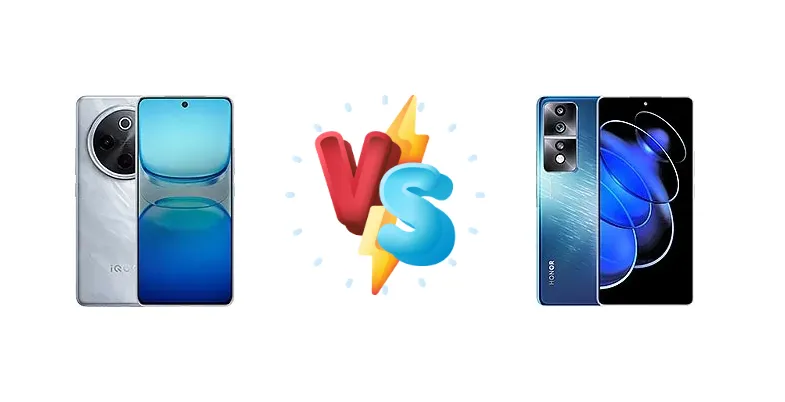
The iQOO Z10 and Honor 80 GT represent compelling options in the increasingly competitive mid-range smartphone market. While both devices utilize Qualcomm chipsets, they target slightly different priorities: the iQOO Z10 emphasizes rapid charging and efficiency with the Snapdragon 7s Gen 3, while the Honor 80 GT aims for raw performance with the older, but still potent, Snapdragon 8+ Gen 1. This comparison will dissect their strengths and weaknesses to determine which phone best suits your needs.
🏆 Quick Verdict
For the average user prioritizing gaming and sustained performance, the Honor 80 GT is the clear winner thanks to its Snapdragon 8+ Gen 1. However, the iQOO Z10’s 90W charging and efficient chipset make it a strong contender for those who value speed and battery longevity over absolute peak power.
| Network |
|---|
| 2G bands | GSM 850 / 900 / 1800 / 1900 | GSM 850 / 900 / 1800 / 1900 |
| 3G bands | HSDPA 800 / 850 / 900 / 2100 | HSDPA 800 / 850 / 900 / 1700(AWS) / 2100 |
| 4G bands | 1, 3, 5, 8, 28, 38, 40, 41 - India | 1, 3, 4, 5, 8, 19, 28, 34, 38, 39, 40, 41 |
| 5G bands | 1, 3, 5, 8, 28, 38, 40, 41, 77, 78 SA/NSA - India | 1, 5, 8, 28, 41, 77, 78 SA/NSA |
| Speed | HSPA, LTE, 5G | HSPA, LTE, 5G |
| Technology | GSM / HSPA / LTE / 5G | GSM / CDMA / HSPA / CDMA2000 / LTE / 5G |
| | - | CDMA2000 1x |
| Launch |
|---|
| Announced | 2025, April 11 | 2022, December 26 |
| Status | Available. Released 2025, April 16 | Available. Released 2022, December 26 |
| Body |
|---|
| Dimensions | 163.4 x 76.4 x 7.9 mm (6.43 x 3.01 x 0.31 in) | 162.5 x 75.3 x 7.9 mm (6.40 x 2.96 x 0.31 in) |
| SIM | Nano-SIM + Nano-SIM | Nano-SIM + Nano-SIM |
| Weight | 199 g (7.02 oz) | 187 g or 195 g (6.60 oz) |
| Display |
|---|
| Resolution | 1080 x 2392 pixels (~388 ppi density) | 1080 x 2400 pixels, 20:9 ratio (~395 ppi density) |
| Size | 6.77 inches, 110.9 cm2 (~88.8% screen-to-body ratio) | 6.67 inches, 107.4 cm2 (~87.8% screen-to-body ratio) |
| Type | AMOLED, 120Hz, 3840Hz PWM, 1300 nits (HBM), 5000 nits (peak) | AMOLED, 1B colors, 120Hz, HDR10, 1400 nits (peak) |
| Platform |
|---|
| CPU | Octa-core (1x2.5 GHz Cortex-A720 & 3x2.4 GHz Cortex-A720 & 4x1.8 GHz Cortex-A520) | Octa-core (1x3.0 GHz Cortex-X2 & 3x2.5 GHz Cortex-A710 & 4x1.80 GHz Cortex-A510) |
| Chipset | Qualcomm SM7635 Snapdragon 7s Gen 3 (4 nm) | Qualcomm SM8475 Snapdragon 8+ Gen 1 (4 nm) |
| GPU | Adreno 810 | Adreno 730 |
| OS | Android 15, up to 2 major Android upgrades, Funtouch 15 | Android 12, MagicOS 7 |
| Memory |
|---|
| Card slot | No | No |
| Internal | 128GB 8GB RAM, 256GB 8GB RAM, 256GB 12GB RAM, 512GB 12GB RAM | 256GB 12GB RAM, 256GB 16GB RAM, 512GB 12GB RAM |
| Main Camera |
|---|
| Dual | 50 MP, f/1.8, (wide), 1/1.95", 0.8µm, PDAF, OIS
Auxiliary lens | - |
| Features | LED flash, HDR, panorama | LED flash, HDR, panorama |
| Single | - | 16 MP, f/2.4, (wide) |
| Triple | - | 54 MP, f/1.9, (wide), 1/1.49", PDAF
8 MP, f/2.2, (ultrawide)
2 MP (macro) |
| Video | 4K@30fps, 1080p@30/60fps, gyro-EIS | 4K@30fps, 1080p@30/60fps, gyro-EIS |
| Selfie camera |
|---|
| Single | 32 MP, f/2.0, (wide) | 16 MP, f/2.4, (wide) |
| Video | 1080p@30fps | 1080p@30fps, gyro-EIS |
| Sound |
|---|
| 3.5mm jack | - | No |
| 35mm jack | No | No |
| Loudspeaker | Yes | Yes |
| Comms |
|---|
| Bluetooth | 5.2(IN), 5.4(IDN), A2DP, LE | 5.2, A2DP, LE, aptX HD |
| Infrared port | Yes | Yes |
| NFC | Yes (market/region dependent) | Yes |
| Positioning | GPS, GLONASS, GALILEO, BDS, QZSS | GPS, GALILEO, GLONASS, BDS, QZSS |
| Radio | No | No |
| USB | USB Type-C 2.0, OTG | USB Type-C 2.0, OTG |
| WLAN | Wi-Fi 802.11 a/b/g/n/ac, dual-band - IndiaWi-Fi 802.11 a/b/g/n/ac/6/7, dual-band - Indonesia | Wi-Fi 802.11 a/b/g/n/ac/6, dual-band, Wi-Fi Direct |
| Features |
|---|
| Sensors | Fingerprint (under display, optical), accelerometer, gyro, proximity, compass | Fingerprint (under display, optical), accelerometer, gyro, compass |
| | - | Virtual proximity sensing |
| Battery |
|---|
| Charging | 90W wired
Reverse wired | 66W wired, 3-50% in 15 min
5W reverse wired |
| Type | Si/C Li-Ion 7300 mAh | Li-Po 4800 mAh |
| Misc |
|---|
| Colors | Stellar Black, Glacier Silver | Black, Blue, White |
| Models | - | AGT-AN00 |
| Price | ₹ 20,998 | About 450 EUR |
| SAR | 0.99 W/kg (head) 0.87 W/kg (body) | - |
vivo iQOO Z10
- 90W Superfast Charging: Significantly faster charging times.
- Efficient Snapdragon 7s Gen 3: Good balance of performance and battery life.
- Potentially Lower Price: Likely more affordable than the Honor 80 GT.
- Less Powerful Processor: Snapdragon 7s Gen 3 is not as capable as the 8+ Gen 1.
- Potentially Lower Camera Quality: May lack the advanced camera features of the Honor 80 GT.
Honor 80 GT
- Flagship Snapdragon 8+ Gen 1: Excellent performance for gaming and multitasking.
- Likely Superior Camera System: Expect better image quality and features.
- Potentially Better Display: Higher quality panel with potentially higher refresh rate.
- Slower Charging: 66W charging is slower than the iQOO Z10’s 90W.
- Potentially Higher Price: Flagship chipset usually comes with a higher price tag.
- Higher Power Consumption: Snapdragon 8+ Gen 1 can generate more heat.
Display Comparison
Neither device's display specifications are provided, so a direct comparison is limited. However, given the Honor 80 GT's positioning, it likely features a higher-quality panel with potentially a higher refresh rate and peak brightness. The iQOO Z10, focusing on value, may utilize a slightly more basic LCD or OLED panel. Color accuracy will likely be good on both, but the 80 GT is expected to have the edge in overall visual fidelity.
Camera Comparison
Without specific camera sensor details, it's difficult to make a definitive judgment. However, Honor typically invests more in camera technology. The 80 GT likely features a larger main sensor and more sophisticated image processing algorithms. The iQOO Z10 will likely offer a competent camera experience, but may fall short in low-light performance and dynamic range compared to the Honor 80 GT. We can assume both will have standard wide and ultrawide lenses, but the 80 GT may include additional features like OIS (Optical Image Stabilization).
Performance
The core difference lies in the chipsets. The Honor 80 GT’s Snapdragon 8+ Gen 1 (4nm) boasts a Cortex-X2 prime core clocked at 3.0 GHz, alongside three Cortex-A710 performance cores at 2.5 GHz, and four Cortex-A510 efficiency cores at 1.8 GHz. This configuration delivers significantly higher peak performance than the iQOO Z10’s Snapdragon 7s Gen 3 (4nm). The 7s Gen 3 features a Cortex-A720 prime core at 2.5 GHz, three Cortex-A720 performance cores at 2.4 GHz, and four Cortex-A520 efficiency cores at 1.8 GHz. While both are built on a 4nm process for efficiency, the 8+ Gen 1’s architecture is a generation ahead, offering superior GPU performance and sustained CPU clock speeds. This translates to smoother gameplay in demanding titles and faster processing of complex tasks. The Honor 80 GT will likely benefit from better thermal management solutions to handle the increased heat output.
Battery Life
The Honor 80 GT offers 66W wired charging, claiming a 3-50% charge in 15 minutes. The iQOO Z10, however, significantly ups the ante with 90W wired charging. This faster charging speed will dramatically reduce charging times, potentially reaching a full charge in under 40 minutes. While battery capacity isn't specified, the iQOO Z10’s more efficient chipset may offset a potentially smaller battery size, providing comparable or even better real-world battery life. The 90W charging is a major advantage for users who frequently need to top up their phone quickly.
Buying Guide
Buy the vivo iQOO Z10 if you need blazing-fast charging, prioritize battery life, and play mostly casual games or less demanding titles. Buy the Honor 80 GT if you prefer a more powerful processor for demanding games, heavier multitasking, and don't mind slightly slower charging speeds. The 80 GT is the choice for power users.
Frequently Asked Questions
❓ Will the Snapdragon 8+ Gen 1 in the Honor 80 GT get noticeably hotter during extended gaming sessions compared to the iQOO Z10?
Yes, the Snapdragon 8+ Gen 1 is a more powerful chip and will generate more heat under sustained load. While Honor likely implements thermal management solutions, the iQOO Z10’s Snapdragon 7s Gen 3 will generally run cooler, potentially offering more consistent performance during long gaming sessions without significant throttling.
❓ How much faster is the 90W charging on the iQOO Z10 compared to the 66W charging on the Honor 80 GT in real-world use?
The iQOO Z10’s 90W charging will likely shave off around 15-20 minutes from a full 0-100% charge compared to the Honor 80 GT’s 66W charging. The difference will be most noticeable when charging from lower battery percentages, allowing you to quickly top up your phone when you're short on time.
❓ Is the Snapdragon 7s Gen 3 in the iQOO Z10 capable of running demanding games like Genshin Impact or Call of Duty Mobile at high settings?
The Snapdragon 7s Gen 3 can run these games, but you may need to compromise on graphics settings to maintain a stable frame rate. Expect to play at medium or high settings with a target of 30-60 FPS. The Honor 80 GT’s Snapdragon 8+ Gen 1 will provide a smoother experience at higher settings.