
iQOO Z10 Turbo vs Samsung Galaxy S23 FE: A Deep Dive into Performance and Value
| Phones Images | |||||
|---|---|---|---|---|---|
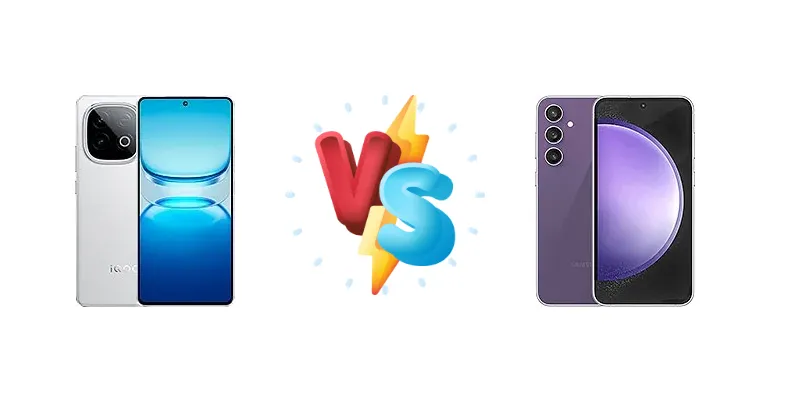
|
🏆 Quick Verdict
For users prioritizing raw gaming performance and incredibly fast charging, the iQOO Z10 Turbo is the clear winner. However, the Samsung Galaxy S23 FE offers a more refined experience with a brighter display, a more versatile camera system, and Samsung’s robust software support, making it the better all-rounder for most users.
| PHONES | ||
|---|---|---|
| Phone Names | vivo iQOO Z10 Turbo | Samsung Galaxy S23 FE |
| Network | ||
|---|---|---|
| 2G bands | GSM 850 / 900 / 1800 / 1900 | GSM 850 / 900 / 1800 / 1900 |
| 3G bands | HSDPA 800 / 850 / 900 / 2100 | HSDPA 850 / 900 / 1700(AWS) / 1900 / 2100 |
| 4G bands | 1, 3, 5, 8, 19, 28, 34, 38, 39, 40, 41, 42, 48 | 1, 2, 3, 4, 5, 7, 8, 12, 13, 17, 20, 26, 28, 38, 40, 41, 66 - International |
| 5G bands | 1, 3, 5, 8, 28, 34, 38, 39, 40, 41, 48, 77, 78 SA/NSA | 1, 2, 3, 5, 7, 8, 20, 28, 38, 40, 41, 66, 77, 78 SA/NSA/Sub6 - International |
| Speed | HSPA, LTE, 5G | HSPA, LTE, 5G |
| Technology | GSM / HSPA / LTE / 5G | GSM / HSPA / LTE / 5G |
| Launch | ||
|---|---|---|
| Announced | 2025, April 28 | 2023, October 04 |
| Status | Available. Released 2025, April 28 | Available. Released 2023, October 05 |
| Body | ||
|---|---|---|
| Build | Glass front, plastic back, plastic frame | Glass front (Gorilla Glass 5), glass back (Gorilla Glass 5), aluminum frame |
| Dimensions | 163.7 x 75.9 x 8.1 mm (6.44 x 2.99 x 0.32 in) | 158 x 76.5 x 8.2 mm (6.22 x 3.01 x 0.32 in) |
| SIM | Nano-SIM + Nano-SIM | · Nano-SIM· Nano-SIM + Nano-SIM· Nano-SIM + Nano-SIM + eSIM (max 2 at a time) |
| Weight | 212 g (7.48 oz) | 209 g (7.37 oz) |
| Display | ||
|---|---|---|
| Protection | - | Corning Gorilla Glass 5 |
| Resolution | 1260 x 2800 pixels, 20:9 ratio (~453 ppi density) | 1080 x 2340 pixels, 19.5:9 ratio (~403 ppi density) |
| Size | 6.78 inches, 111.0 cm2 (~89.3% screen-to-body ratio) | 6.4 inches, 100.5 cm2 (~83.2% screen-to-body ratio) |
| Type | AMOLED, 1B colors, 144Hz, HDR, 2000 nits (HBM), 4400 nits (peak) | Dynamic AMOLED 2X, 120Hz, HDR10+, 1450 nits (peak) |
| Platform | ||
|---|---|---|
| CPU | Octa-core (1x3.25 GHz Cortex-A725 & 3x3.0 GHz Cortex-A725 & 4x2.1 GHz Cortex-A725) | Octa-core (1x2.8 GHz Cortex-X2 & 3x2.50 GHz Cortex-A710 & 4x1.8 GHz Cortex-A510) - InternationalOcta-core (1x3.00 GHz Cortex-X2 & 3x2.50 GHz Cortex-A710 & 4x1.80 GHz Cortex-A510) - USA |
| Chipset | Mediatek Dimensity 8400 (4 nm) | Exynos 2200 (4 nm) - InternationalQualcomm SM8450 Snapdragon 8 Gen 1 (4 nm) - USA |
| GPU | G720 MC7 | Xclipse 920 - InternationalAdreno 730 - USA |
| OS | Android 15, OriginOS 5 | Android 13, up to 4 major Android upgrades, One UI 8 |
| Memory | ||
|---|---|---|
| Card slot | No | No |
| Internal | 256GB 12GB RAM, 256GB 16GB RAM, 512GB 12GB RAM, 512GB 16GB RAM | 128GB 8GB RAM, 256GB 8GB RAM |
| Main Camera | ||
|---|---|---|
| Dual | 50 MP, f/1.8, (wide), 1/1.95", 0.8µm, PDAF, OIS Auxiliary lens | - |
| Features | Color spectrum sensor, LED flash, HDR, panorama | LED flash, HDR, panorama |
| Triple | - | 50 MP, f/1.8, 23mm (wide), 1/1.57", 1.0µm, dual pixel PDAF, OIS 8 MP, f/2.4, 76mm (telephoto), 1/4.5", 1.0µm, PDAF, OIS, 3x optical zoom 12 MP, f/2.2, 13mm, 123˚ (ultrawide), 1/3.0", 1.12µm |
| Video | 4K, 1080p, gyro-EIS, OIS | 8K@24fps, 4K@30/60fps, 1080p@30/60/120/240fps |
| Selfie camera | ||
|---|---|---|
| Single | 16 MP, f/2.5, (wide), 1/3.0", 1.0µm | 10 MP, f/2.4, 25mm (wide), 1/3.0", 1.22µm |
| Video | 1080p@30fps, gyro-EIS | 4K@30/60fps, 1080p@30/60fps; gyro-EIS |
| Sound | ||
|---|---|---|
| 35mm jack | No | No |
| Loudspeaker | Yes, with stereo speakers | Yes, with stereo speakers |
| Comms | ||
|---|---|---|
| Bluetooth | 6.0, A2DP, LE, aptX HD | 5.3, A2DP, LE |
| Infrared port | Yes | - |
| NFC | Yes | Yes |
| Positioning | GPS (L1+L5), BDS (B1I+B1C+B2a), GALILEO (E1+E5a), QZSS (L1+L5), NavIC (L5), GLONASS | GPS, GLONASS, GALILEO, BDS |
| Radio | No | Unspecified |
| USB | USB Type-C 2.0, OTG | USB Type-C, OTG |
| WLAN | Wi-Fi 802.11 a/b/g/n/ac/6, dual-band | Wi-Fi 802.11 a/b/g/n/ac/6e, dual-band, Wi-Fi Direct |
| Features | ||
|---|---|---|
| Sensors | Fingerprint (under display, optical), accelerometer, gyro, proximity, compass | Fingerprint (under display, optical), accelerometer, gyro, compass |
| Battery | ||
|---|---|---|
| Charging | 90W wired, 100% in 55 min Reverse wired | 25W wired, PD3.0, 50% in 30 min 15W wireless Reverse wireless |
| Type | Si/C Li-Ion 7620 mAh | Li-Ion 4500 mAh |
| Misc | ||
|---|---|---|
| Colors | White, Black, Orange, Gold | Mint, Cream, Graphite, Purple, Indigo, Tangerine |
| Models | V2452A | SM-S711B, SM-S711B/DS, SM-S711U1, SM-S711U, SM-S711W, SM-S7110, SM-S711N |
| Price | About 220 EUR | $ 219.95 / C$ 327.90 / £ 248.99 / € 272.00 / ₹ 34,999 |
| SAR | - | 0.80 W/kg (head) 0.72 W/kg (body) |
| SAR EU | - | 0.76 W/kg (head) 1.04 W/kg (body) |
vivo iQOO Z10 Turbo
- Incredibly fast 90W charging
- Potentially better sustained gaming performance due to Dimensity 8400 efficiency
- Aggressive pricing for the hardware offered
- Likely less refined camera system
- Less established brand reputation
Samsung Galaxy S23 FE
- Brighter and more color-accurate display
- More versatile camera system with OIS
- Samsung’s software ecosystem and long-term support
- Slower 25W charging
- Chipset performance varies by region (Exynos vs Snapdragon)
Display Comparison
The Samsung Galaxy S23 FE boasts a significantly brighter display, reaching a measured 985 nits, crucial for outdoor visibility. While the iQOO Z10 Turbo’s display specs are not provided, Samsung’s panel technology typically offers superior color accuracy and viewing angles. The S23 FE’s brightness advantage is particularly noticeable in direct sunlight, making it the better choice for outdoor users. The absence of LTPO technology in either device suggests both will rely on adaptive refresh rate switching rather than variable refresh rates for power efficiency.
Camera Comparison
The Galaxy S23 FE’s camera system is expected to be more versatile, offering a wider range of shooting modes and potentially better image processing. While specific sensor details are missing for the iQOO Z10 Turbo, Samsung’s flagship-level image processing algorithms and optical image stabilization (OIS) provide a significant advantage in low-light conditions and video recording. The S23 FE’s camera is likely to excel in dynamic range and detail capture, while the iQOO Z10 Turbo may focus on speed and simplicity. The presence of a 2MP macro camera on the S23 FE is unlikely to be a significant differentiator, as these sensors often lack the quality of the main sensor.
Performance
The iQOO Z10 Turbo’s Mediatek Dimensity 8400 (4nm) is a formidable chip, featuring a unique core configuration with a 3.25 GHz Cortex-A725 prime core. This contrasts with the Samsung Galaxy S23 FE’s Exynos 2200 (International) or Snapdragon 8 Gen 1 (USA), both also 4nm chips. While the Snapdragon 8 Gen 1 offers slightly higher peak CPU performance, the Dimensity 8400 is known for its excellent efficiency and sustained performance, potentially leading to less thermal throttling during extended gaming sessions. The iQOO Z10 Turbo’s focus on gaming is further reinforced by its likely optimized thermal design. The S23 FE’s performance will vary based on the chipset region.
Battery Life
The Samsung Galaxy S23 FE delivers a solid 8:28h of active use, demonstrating good battery life. The iQOO Z10 Turbo compensates for a potentially smaller battery with its blazing-fast 90W wired charging, achieving 100% charge in just 55 minutes. The S23 FE’s 25W charging is considerably slower, taking 30 minutes to reach 50%. This difference is substantial for users who prioritize quick top-ups. The iQOO Z10 Turbo also offers reverse wired charging, a feature absent in the S23 FE’s wireless reverse charging.
Buying Guide
Buy the vivo iQOO Z10 Turbo if you are a mobile gamer who demands high frame rates and minimal throttling, and values extremely fast charging speeds above all else. Buy the Samsung Galaxy S23 FE if you prioritize a well-rounded experience with a superior display, a more capable camera system, and the long-term software support and ecosystem benefits of the Samsung brand.