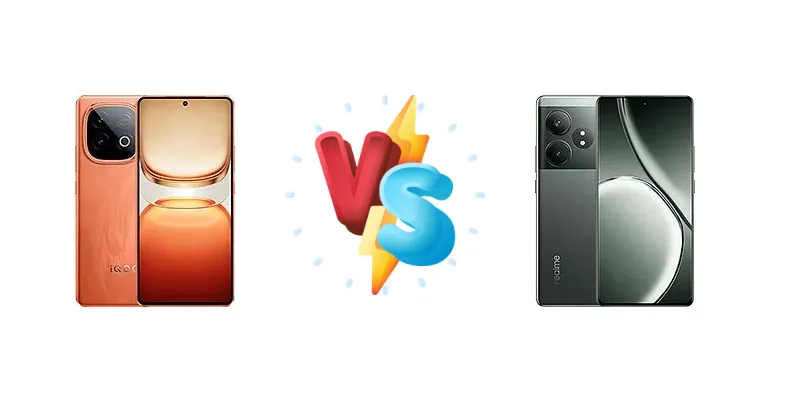
The iQOO Z10 Turbo Pro and Realme GT Neo6 SE represent a fascinating intersection in the mid-range smartphone market. Both leverage Qualcomm's latest silicon, but target slightly different priorities. The iQOO prioritizes raw processing power with the Snapdragon 8s Gen 4, while the Realme focuses on a balanced experience with the Snapdragon 7+ Gen 3, aiming for efficiency and value. This comparison will dissect their strengths and weaknesses to determine which device reigns supreme.
🏆 Quick Verdict
For users prioritizing peak performance and future-proofing, the iQOO Z10 Turbo Pro is the clear winner. Its Snapdragon 8s Gen 4 offers a significant performance advantage, especially in demanding tasks. However, the Realme GT Neo6 SE provides excellent value and a refined experience for everyday use, making it a strong contender for budget-conscious buyers.
| Network |
|---|
| 2G bands | GSM 850 / 900 / 1800 / 1900 | GSM 850 / 900 / 1800 / 1900 |
| 3G bands | HSDPA 800 / 850 / 900 / 2100 | HSDPA 850 / 900 / 2100 |
| 4G bands | 1, 3, 5, 8, 18, 19, 26, 28, 34, 38, 39, 40, 41, 42, 48 | 1, 3, 5, 7, 8, 28, 34, 38, 39, 40, 41 |
| 5G bands | 1, 3, 5, 8, 18, 26, 28, 38, 40, 41, 48, 77, 78 SA/NSA | 1, 3, 5, 8, 28, 41, 77, 78 SA/NSA |
| Speed | HSPA, LTE, 5G | HSPA, LTE, 5G |
| Technology | GSM / HSPA / LTE / 5G | GSM / CDMA / HSPA / CDMA2000 / LTE / 5G |
| Launch |
|---|
| Announced | 2025, April 28 | 2024, April 11 |
| Status | Available. Released 2025, April 28 | Available. Released 2024, April 17 |
| Body |
|---|
| Build | Glass front, plastic back, plastic frame | - |
| Dimensions | 163.7 x 75.9 x 8.1 mm (6.44 x 2.99 x 0.32 in) | 162 x 75.1 x 8.7 mm (6.38 x 2.96 x 0.34 in) |
| SIM | Nano-SIM + Nano-SIM | Nano-SIM + Nano-SIM |
| Weight | 206 g (7.27 oz) | 191 g (6.74 oz) |
| Display |
|---|
| Resolution | 1260 x 2800 pixels, 20:9 ratio (~453 ppi density) | 1264 x 2780 pixels (~450 ppi density) |
| Size | 6.78 inches, 111.0 cm2 (~89.3% screen-to-body ratio) | 6.78 inches, 111.7 cm2 (~91.8% screen-to-body ratio) |
| Type | AMOLED, 1B colors, 144Hz, 4320Hz PWM, HDR, 2000 nits (HBM), 4400 nits (peak) | LTPO AMOLED, 1B colors, 120Hz, HDR, 1600 nits (HBM), 6000 nits (peak) |
| Platform |
|---|
| CPU | Octa-core (1x3.21 GHz Cortex-X4 & 3x3.0 GHz Cortex-A720 & 2x2.8 GHz Cortex-A720 & 2x2.0 GHz Cortex-A720) | Octa-core (1x2.8 GHz Cortex-X4 & 4x2.6 GHz Cortex-A720 & 3x1.9 GHz Cortex-A520) |
| Chipset | Qualcomm SM8735 Snapdragon 8s Gen 4 (4 nm) | Qualcomm SM7675 Snapdragon 7+ Gen 3 (4 nm) |
| GPU | Adreno 825 | Adreno 732 |
| OS | Android 15, OriginOS 5 | Android 14, Realme UI 5.0 |
| Memory |
|---|
| Card slot | No | No |
| Internal | 256GB 12GB RAM, 256GB 16GB RAM, 512GB 12GB RAM, 512GB 16GB RAM | 256GB 8GB RAM, 256GB 12GB RAM, 256GB 16GB RAM, 512GB 16GB RAM |
| Main Camera |
|---|
| Dual | 50 MP, f/1.8, (wide), 1/1.95", 0.8µm, PDAF, OIS
8 MP, f/2.2, (ultrawide) | 50 MP, f/1.9, 26mm (wide), 1/1.95", PDAF, OIS
8 MP, f/2.2, 16mm, 112˚ (ultrawide), 1/4.0", 1.12µm |
| Features | Color spectrum sensor, LED flash, HDR, panorama | Color spectrum sensor, Dual-LED flash, HDR, panorama |
| Video | 4K@30/60fps, 1080p, gyro-EIS, OIS | 4K@30/60fps, 1080p@30/60/120fps |
| Selfie camera |
|---|
| Features | - | Panorama |
| Single | 16 MP, f/2.5, (wide), 1/3.0", 1.0µm | 32 MP, f/2.5, 22mm (wide), 1/2.74" |
| Video | 1080p@30fps, gyro-EIS | 4K@30fps, 1080p@30fps |
| Sound |
|---|
| 35mm jack | No | No |
| Loudspeaker | Yes, with stereo speakers | Yes, with stereo speakers |
| Comms |
|---|
| Bluetooth | 6.0, A2DP, LE, aptX HD, aptX Adaptive, aptX Lossless, LHDC 5 | 5.4, A2DP, LE, aptX HD, LHDC |
| Infrared port | Yes | Yes |
| NFC | Yes | Yes |
| Positioning | GPS (L1+L5), BDS (B1I+B1C+B2a), GALILEO (E1+E5a), QZSS (L1+L5), GLONASS | GPS (L1+L5), BDS (B1I+B1c+B2a), GALILEO (E1+E5a), QZSS (L1+L5), NavIC, GLONASS |
| Radio | No | No |
| USB | USB Type-C 2.0, OTG | USB Type-C 2.0 |
| WLAN | Wi-Fi 802.11 a/b/g/n/ac/6/7, dual-band | Wi-Fi 802.11 a/b/g/n/ac/6, dual-band |
| Features |
|---|
| Sensors | Fingerprint (under display, optical), accelerometer, gyro, proximity, compass | Fingerprint (under display, optical), accelerometer, gyro, proximity, compass |
| Battery |
|---|
| Charging | 120W wired, 100W PD, 100W PPS, 50% in 15 min, 100% in 33 min
Reverse wired | 100W wired, 50% in 12 min |
| Type | Si/C Li-Ion 7000 mAh | 5500 mAh |
| Misc |
|---|
| Colors | White, Black, Orange, Gold | Silver, Green |
| Models | V2453A | RMX3850 |
| Price | About 240 EUR | About 250 EUR |
vivo iQOO Z10 Turbo Pro
- Significantly more powerful Snapdragon 8s Gen 4 processor
- Faster 120W wired charging with PD/PPS support
- Potential for longer software support due to flagship-level chipset
- Potentially higher price point
- May run hotter under sustained load
Realme GT Neo6 SE
- Excellent value for money
- Efficient Snapdragon 7+ Gen 3 processor
- Fast 100W wired charging
- Less powerful processor compared to the iQOO
- May not age as gracefully as the iQOO
Display Comparison
While both devices likely feature high refresh rate AMOLED panels (data not provided), the core difference lies in the processing power driving them. The iQOO Z10 Turbo Pro’s Snapdragon 8s Gen 4 will handle graphically intensive games at higher settings with greater consistency. The Realme GT Neo6 SE, with its Snapdragon 7+ Gen 3, will still deliver a smooth visual experience, but may require slightly lower settings for optimal frame rates. Without specific display specs, it's difficult to assess color accuracy or peak brightness, but both brands typically offer vibrant and well-calibrated displays in this segment.
Camera Comparison
Without detailed camera specifications, a direct comparison is limited. However, both phones likely employ similar sensor configurations targeting the mid-range market. The iQOO Z10 Turbo Pro’s superior processing power *could* translate to faster image processing and potentially better low-light performance, but this depends heavily on software optimization. We can assume both will offer capable main sensors, but the Realme GT Neo6 SE might prioritize computational photography to compensate for its less powerful chipset. The inclusion of Optical Image Stabilization (OIS) on either device would be a significant advantage, but is currently unknown.
Performance
The iQOO Z10 Turbo Pro’s Snapdragon 8s Gen 4 (4nm) is the key differentiator. Its octa-core configuration, featuring a 3.21 GHz Cortex-X4 prime core, provides a substantial performance uplift over the Realme GT Neo6 SE’s Snapdragon 7+ Gen 3 (4nm). The 7+ Gen 3, with its 2.8 GHz Cortex-X4, is still a capable chip, but the iQOO’s processor boasts higher clock speeds across most cores (3x3.0 GHz Cortex-A720 vs 4x2.6 GHz Cortex-A720). This translates to faster app loading times, smoother multitasking, and significantly improved gaming performance. The iQOO also benefits from potentially faster LPDDR5x RAM, further enhancing responsiveness. Thermal management will be crucial; the 8s Gen 4 generates more heat, requiring robust cooling solutions to prevent throttling.
Battery Life
The Realme GT Neo6 SE’s 100W wired charging (50% in 12 min) is impressive, but the iQOO Z10 Turbo Pro’s 120W wired charging (50% in 15 min, 100% in 33 min) is even faster. The iQOO also supports 100W PD and PPS, offering greater compatibility with various chargers. While battery capacity isn’t specified, the faster charging of the iQOO mitigates any potential disadvantage from a slightly smaller battery. The Snapdragon 8s Gen 4’s higher power draw will likely result in slightly shorter battery life compared to the more efficient Snapdragon 7+ Gen 3 in the Realme, but the charging speed advantage is substantial.
Buying Guide
Buy the vivo iQOO Z10 Turbo Pro if you need uncompromising gaming performance, faster charging speeds, and a chipset that will remain competitive for longer. Buy the Realme GT Neo6 SE if you prefer a more balanced device with excellent efficiency, a slightly more approachable price point, and a smooth, responsive user experience for daily tasks and casual gaming.
Frequently Asked Questions
❓ Will the iQOO Z10 Turbo Pro overheat during extended gaming sessions?
The Snapdragon 8s Gen 4 is a powerful chip and generates more heat than the Snapdragon 7+ Gen 3. While iQOO likely incorporates a robust cooling system, prolonged gaming at maximum settings *could* lead to thermal throttling. Monitoring temperatures during gameplay is recommended.
❓ Is the Snapdragon 7+ Gen 3 in the Realme GT Neo6 SE sufficient for playing demanding games like Genshin Impact?
Yes, the Snapdragon 7+ Gen 3 is capable of running Genshin Impact, but you may need to adjust graphics settings to medium or low to maintain a stable frame rate. It's a very capable chip for most mobile games, but won't deliver the same peak performance as the iQOO Z10 Turbo Pro.
❓ Does the iQOO Z10 Turbo Pro support reverse wireless charging?
The provided specs indicate the iQOO Z10 Turbo Pro supports reverse *wired* charging, allowing you to charge other devices using the phone's battery. Whether it supports reverse *wireless* charging is not specified and would require further investigation.