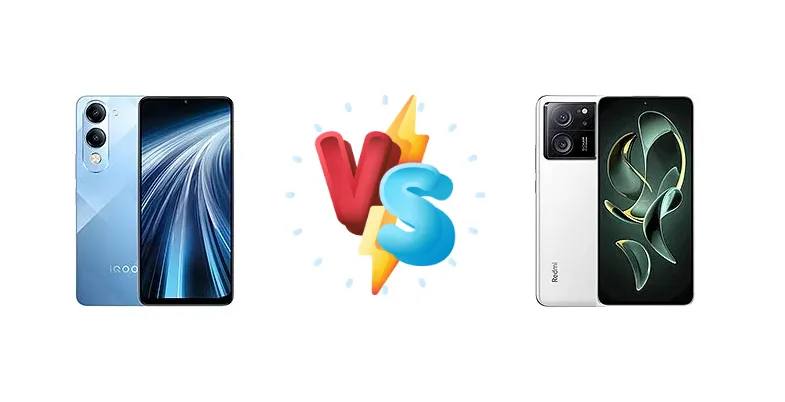
The Xiaomi Redmi K60 Ultra and the vivo iQOO Z10 Lite represent distinct approaches to the mid-range smartphone market. The K60 Ultra aims for near-flagship performance at a competitive price, while the Z10 Lite focuses on delivering a solid, everyday experience. This comparison dissects their key differences, focusing on the impact of their respective chipsets and charging capabilities.
🏆 Quick Verdict
For users prioritizing raw performance and ultra-fast charging, the Xiaomi Redmi K60 Ultra is the clear winner. Its Dimensity 9200+ chipset offers a substantial leap in processing power compared to the iQOO Z10 Lite’s Dimensity 6300. However, the iQOO Z10 Lite remains a viable option for budget-conscious users who don't demand top-tier performance.
| Network |
|---|
| 2G bands | GSM 850 / 900 / 1800 / 1900 | GSM 850 / 900 / 1800 / 1900 |
| 3G bands | HSDPA 850 / 900 / 2100 | HSDPA 800 / 850 / 900 / 1700(AWS) / 2100 |
| 4G bands | 1, 3, 5, 8, 28, 38, 40, 41 | 1, 3, 4, 5, 8, 18, 19, 26, 34, 38, 39, 40, 41, 42, 66 |
| 5G bands | 1, 3, 5, 8, 28, 38, 40, 77, 78 SA/NSA | 1, 3, 5, 8, 28, 38, 41, 66, 77, 78 SA/NSA |
| Speed | HSPA, LTE | HSPA, LTE, 5G |
| Technology | GSM / HSPA / LTE / 5G | GSM / CDMA / HSPA / CDMA2000 / LTE / 5G |
| Launch |
|---|
| Announced | 2025, June 18 | 2023, August 15 |
| Status | Available. Released 2025, June 25 | Available. Released 2023, August 15 |
| Body |
|---|
| Build | Glass front, plastic frame, plastic back | - |
| Dimensions | 167.3 x 77 x 8.2 mm (6.59 x 3.03 x 0.32 in) | 162.2 x 75.7 x 8.5 mm (6.39 x 2.98 x 0.33 in) |
| SIM | Nano-SIM + Nano-SIM | Nano-SIM + Nano-SIM |
| Weight | 202 g (7.13 oz) | 204 g (7.20 oz) |
| Display |
|---|
| Protection | - | Unspecified |
| Resolution | 720 x 1600 pixels, 20:9 ratio (~260 ppi density) | 1220 x 2712 pixels, 20:9 ratio (~446 ppi density) |
| Size | 6.74 inches, 109.7 cm2 (~85.1% screen-to-body ratio) | 6.67 inches, 107.4 cm2 (~87.5% screen-to-body ratio) |
| Type | IPS LCD, 90Hz, 1000 nits (HBM) | OLED, 68B colors, 144Hz, Dolby Vision, HDR10+, 2600 nits (peak) |
| Platform |
|---|
| CPU | Octa-core (2x2.4 GHz Cortex-A76 & 6x2.0 GHz Cortex-A55) | Octa-core (1x3.35 GHz Cortex-X3 & 3x3.0 GHz Cortex-A715 & 4x2.0 GHz Cortex-A510) |
| Chipset | Mediatek Dimensity 6300 (6 nm) | Mediatek Dimensity 9200+ (4 nm) |
| GPU | Mali-G57 MC2 | Immortalis-G715 MC11 |
| OS | Android 15, up to 2 major Android upgrades, Funtouch 15 | Android 13, MIUI 14 |
| Memory |
|---|
| Card slot | microSDXC (dedicated slot) | No |
| Internal | 128GB 4GB RAM, 128GB 6GB RAM, 256GB 8GB RAM | 256GB 12GB RAM, 256GB 16GB RAM, 512GB 16GB RAM, 1TB 16GB RAM, 1TB 24GB RAM |
| Main Camera |
|---|
| Dual | 50 MP, f/1.8, (wide), PDAF
Auxiliary lens | - |
| Features | LED flash, panorama | Color spectrum sensor, Dual-LED dual-tone flash, HDR, panorama |
| Triple | - | 50 MP, f/1.7, (wide), 1/1.49", 1.0µm, PDAF, OIS
8 MP, 119˚ (ultrawide), 1/4.0", 1.12µm
2 MP (macro) |
| Video | 1080p@30fps | 8K@24fps, 4K@30/60fps, 1080p@30/60/120/240/960fps, gyro-EIS, HDR10+, 10-bit |
| Selfie camera |
|---|
| Features | - | HDR |
| Single | 5 MP, f/2.2, (wide) | 20 MP, (wide), 1/2.0", 0.8µm |
| Video | Yes | 1080p@30/120fps |
| Sound |
|---|
| 35mm jack | Yes | No |
| Loudspeaker | Yes, with stereo speakers | Yes, with stereo speakers |
| Comms |
|---|
| Bluetooth | 5.4, A2DP, LE | 5.4, A2DP, LE |
| Infrared port | - | Yes |
| NFC | No | Yes |
| Positioning | GPS, GALILEO, GLONASS, BDS, QZSS | GPS (L1+L5), GLONASS (G1), BDS (B1I+B1C+B2a+B2b), GALILEO (E1+E5a), QZSS (L1+L5), NavIC |
| Radio | FM radio | Unspecified |
| USB | USB Type-C 2.0, OTG | USB Type-C, OTG |
| WLAN | Wi-Fi 802.11 a/b/g/n/ac, dual-band | Wi-Fi 802.11 a/b/g/n/ac/6e, dual-band, Wi-Fi Direct |
| Features |
|---|
| Sensors | Fingerprint (side-mounted), accelerometer, proximity, compass | Fingerprint (under display, optical), accelerometer, gyro, proximity, compass |
| Battery |
|---|
| Charging | 15W wired | 120W wired, PD3.0, 100% in 19 min |
| Type | 6000 mAh | Li-Po 5000 mAh |
| Misc |
|---|
| Colors | Titanium Blue, Cyber Green | Black, White, Green |
| Models | I2409 | 23078RKD5C |
| Price | ₹ 10,498 | About 330 EUR |
vivo iQOO Z10 Lite
- More affordable price point
- Decent performance for everyday tasks
- Reliable and efficient chipset
- Significantly slower charging speed
- Less powerful processor for demanding tasks
- Likely inferior camera performance
Xiaomi Redmi K60 Ultra
- Ultra-fast 120W charging
- Flagship-level Dimensity 9200+ performance
- Superior gaming capabilities
- Higher price tag
- Potentially more heat generation under load
- May be overkill for basic users
Display Comparison
While display specifications aren't provided, the Redmi K60 Ultra, given its positioning, likely features a higher-quality panel with a higher refresh rate and potentially better color accuracy than the iQOO Z10 Lite. The K60 Ultra's target market expects a more immersive viewing experience. Bezels are likely comparable, but the K60 Ultra may benefit from a slightly more refined design. The absence of LTPO information suggests neither phone prioritizes variable refresh rate for power saving.
Camera Comparison
Without detailed camera specs, it's difficult to make a definitive comparison. However, the Redmi K60 Ultra, being a more premium device, likely features a larger main sensor and more sophisticated image processing algorithms. The Dimensity 9200+ also includes a more powerful ISP (Image Signal Processor) capable of handling higher resolution images and more complex computational photography tasks. The iQOO Z10 Lite will likely rely on software optimization to compensate for potentially less capable hardware. We can assume the K60 Ultra will perform better in low-light conditions and offer more detailed images.
Performance
The core difference lies in the chipsets. The Xiaomi Redmi K60 Ultra’s Dimensity 9200+ (4nm) is a significant upgrade over the iQOO Z10 Lite’s Dimensity 6300 (6nm). The 9200+ boasts a prime Cortex-X3 core clocked at 3.35 GHz, alongside three Cortex-A715 cores and four Cortex-A510 cores, offering substantially higher CPU and GPU performance. The 6300’s configuration of two Cortex-A76 cores and six Cortex-A55 cores is geared towards efficiency rather than outright speed. This translates to faster app loading, smoother multitasking, and a better gaming experience on the K60 Ultra. The 4nm process node of the 9200+ also contributes to better thermal efficiency, reducing throttling during sustained workloads. RAM speed (likely LPDDR5X in the K60 Ultra) further enhances performance.
Battery Life
The Redmi K60 Ultra’s 120W wired charging is a game-changer, capable of fully charging the device in just 19 minutes. This is a massive advantage over the iQOO Z10 Lite’s 15W charging, which will take considerably longer. While battery capacity isn't specified, the faster charging of the K60 Ultra mitigates the impact of a potentially smaller battery. The inclusion of PD3.0 support on the K60 Ultra also adds versatility, allowing it to charge with a wider range of chargers.
Buying Guide
Buy the vivo iQOO Z10 Lite if you need a reliable daily driver for basic tasks, social media, and light gaming, and prioritize affordability. Buy the Xiaomi Redmi K60 Ultra if you prefer a phone capable of handling demanding games, multitasking, and benefit from significantly faster charging speeds, even if it means spending more.
Frequently Asked Questions
❓ Is the Dimensity 6300 in the iQOO Z10 Lite sufficient for playing games like Call of Duty Mobile?
The Dimensity 6300 can handle Call of Duty Mobile, but you'll likely need to lower the graphics settings to achieve a smooth frame rate. It's not designed for consistently high frame rates at maximum settings, unlike the Dimensity 9200+ in the K60 Ultra.
❓ How much faster is the 120W charging on the Redmi K60 Ultra compared to the 15W charging on the iQOO Z10 Lite in real-world use?
The 120W charging on the K60 Ultra can take a phone from 0% to 100% in around 19 minutes. The iQOO Z10 Lite’s 15W charging will likely take over 2 hours to achieve the same result. This difference is substantial and caters to users who need to quickly top up their battery.
❓ Will the Dimensity 9200+ in the Redmi K60 Ultra overheat during prolonged gaming sessions?
While the Dimensity 9200+ is a powerful chip, the Redmi K60 Ultra incorporates thermal management solutions to mitigate overheating. However, it's still possible to experience some heat during extended gaming. The 4nm process helps, but sustained peak performance will generate heat.