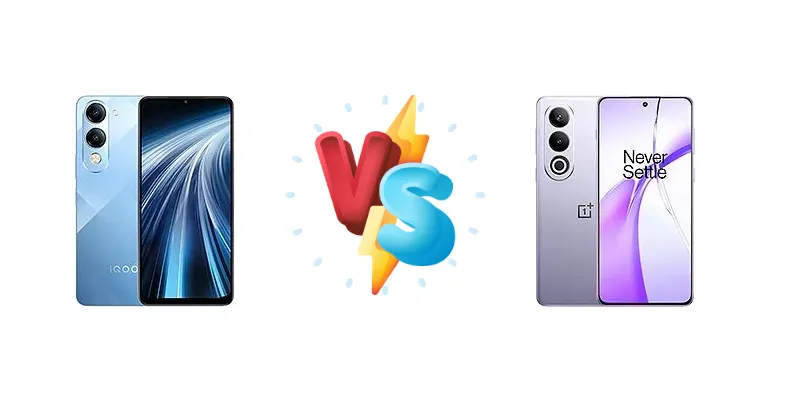
The iQOO Z10 Lite and OnePlus Ace 3V represent compelling options in the increasingly competitive mid-range smartphone market. The Z10 Lite aims for affordability, while the Ace 3V pushes the boundaries of what's possible at its price point, particularly in charging speed and processing power. This comparison dissects their key differences to determine which device best suits your needs.
🏆 Quick Verdict
For the average user prioritizing speed and convenience, the OnePlus Ace 3V is the clear winner. Its Snapdragon 7+ Gen 3 chipset and blazing-fast 100W charging significantly outperform the iQOO Z10 Lite. However, the Z10 Lite remains a viable option for budget-conscious buyers who don't demand top-tier performance.
| Network |
|---|
| 2G bands | GSM 850 / 900 / 1800 / 1900 | GSM 850 / 900 / 1800 / 1900 |
| 3G bands | HSDPA 850 / 900 / 2100 | HSDPA 850 / 900 / 1700(AWS) / 2100 |
| 4G bands | 1, 3, 5, 8, 28, 38, 40, 41 | 1, 3, 4, 5, 8, 28, 34, 38, 39, 40, 41 |
| 5G bands | 1, 3, 5, 8, 28, 38, 40, 77, 78 SA/NSA | 1, 5, 8, 28, 41, 77, 78 SA/NSA |
| Speed | HSPA, LTE | HSPA, LTE, 5G |
| Technology | GSM / HSPA / LTE / 5G | GSM / CDMA / HSPA / LTE / 5G |
| Launch |
|---|
| Announced | 2025, June 18 | 2024, March 21 |
| Status | Available. Released 2025, June 25 | Available. Released 2024, March 25 |
| Body |
|---|
| Build | Glass front, plastic frame, plastic back | Glass front, glass back, plastic frame |
| Dimensions | 167.3 x 77 x 8.2 mm (6.59 x 3.03 x 0.32 in) | 162.7 x 75.2 x 8.5 mm (6.41 x 2.96 x 0.33 in) |
| SIM | Nano-SIM + Nano-SIM | Nano-SIM + Nano-SIM |
| Weight | 202 g (7.13 oz) | 200 g (7.05 oz) |
| Display |
|---|
| Resolution | 720 x 1600 pixels, 20:9 ratio (~260 ppi density) | 1240 x 2772 pixels, 20:9 ratio (~451 ppi density) |
| Size | 6.74 inches, 109.7 cm2 (~85.1% screen-to-body ratio) | 6.74 inches, 109.2 cm2 (~89.3% screen-to-body ratio) |
| Type | IPS LCD, 90Hz, 1000 nits (HBM) | AMOLED, 1B colors, 120Hz, 1100 nits (HBM), 2150 nits (peak) |
| Platform |
|---|
| CPU | Octa-core (2x2.4 GHz Cortex-A76 & 6x2.0 GHz Cortex-A55) | Octa-core (1x2.8 GHz Cortex-X4 & 4x2.6 GHz Cortex-A720 & 3x1.9 GHz Cortex-A520) |
| Chipset | Mediatek Dimensity 6300 (6 nm) | Qualcomm SM7675 Snapdragon 7+ Gen 3 (4 nm) |
| GPU | Mali-G57 MC2 | Adreno 732 |
| OS | Android 15, up to 2 major Android upgrades, Funtouch 15 | Android 14, ColorOS 14 |
| Memory |
|---|
| Card slot | microSDXC (dedicated slot) | No |
| Internal | 128GB 4GB RAM, 128GB 6GB RAM, 256GB 8GB RAM | 256GB 12GB RAM, 512GB 12GB RAM, 512GB 16GB RAM |
| Main Camera |
|---|
| Dual | 50 MP, f/1.8, (wide), PDAF
Auxiliary lens | 50 MP, f/1.8, 26mm (wide), 1/1.95", 0.8µm, PDAF, OIS
8 MP, f/2.2, 16mm, 112˚ (ultrawide), 1/4.0", 1.12µm |
| Features | LED flash, panorama | LED flash, HDR, panorama |
| Video | 1080p@30fps | 4K@30/60fps, 1080p@30/60/120fps, gyro-EIS, OIS |
| Selfie camera |
|---|
| Single | 5 MP, f/2.2, (wide) | 16 MP, f/2.4, 26mm (wide), 1/3", 1.0µm |
| Video | Yes | 1080p@30fps |
| Sound |
|---|
| 35mm jack | Yes | No |
| Loudspeaker | Yes, with stereo speakers | Yes, with stereo speakers |
| Comms |
|---|
| Bluetooth | 5.4, A2DP, LE | 5.4, A2DP, LE, aptX HD, LHDC |
| Infrared port | - | Yes |
| NFC | No | Yes |
| Positioning | GPS, GALILEO, GLONASS, BDS, QZSS | GPS (L1+L5), BDS (B1I+B1c+B2a), GALILEO (E1+E5a), QZSS (L1+L5), GLONASS |
| Radio | FM radio | No |
| USB | USB Type-C 2.0, OTG | USB Type-C 2.0 |
| WLAN | Wi-Fi 802.11 a/b/g/n/ac, dual-band | Wi-Fi 802.11 a/b/g/n/ac/6, dual-band |
| Features |
|---|
| Sensors | Fingerprint (side-mounted), accelerometer, proximity, compass | Fingerprint (under display, optical), accelerometer, gyro, proximity, compass |
| Battery |
|---|
| Charging | 15W wired | 100W wired, 100% in 26 min |
| Type | 6000 mAh | 5500 mAh |
| Misc |
|---|
| Colors | Titanium Blue, Cyber Green | Purple, Gray |
| Models | I2409 | PJF110 |
| Price | ₹ 10,498 | About 260 EUR |
vivo iQOO Z10 Lite
- More affordable price point
- Acceptable performance for everyday tasks
- Functional and reliable
- Slow 15W charging
- Less powerful chipset compared to the Ace 3V
- Likely lower-quality display
OnePlus Ace 3V
- Blazing-fast 100W charging
- Powerful Snapdragon 7+ Gen 3 chipset
- Superior performance for gaming and multitasking
- Higher price tag
- Potentially less battery life due to higher performance
- May require more frequent charging despite fast speeds
Display Comparison
Neither device's display specifications are provided, so a direct comparison is limited. However, given the Ace 3V's positioning, it likely features a higher-quality panel with potentially higher peak brightness and color accuracy. The Z10 Lite, aiming for cost savings, may utilize a simpler LCD panel. Bezels are likely comparable, but the Ace 3V may benefit from slightly thinner bezels due to its higher price bracket.
Camera Comparison
Without detailed camera specs, analysis is limited. However, the Ace 3V, being a more premium device, likely features a larger main sensor and potentially optical image stabilization (OIS). The Z10 Lite likely relies on a more basic camera system. Image processing algorithms will also differ, with OnePlus typically prioritizing vibrant, social media-ready images, while iQOO may lean towards a more natural look. The presence or absence of features like 4K video recording will also be a differentiating factor.
Performance
The core difference lies in the chipsets. The OnePlus Ace 3V’s Qualcomm SM7675 Snapdragon 7+ Gen 3 (4nm) is a significant leap ahead of the iQOO Z10 Lite’s Mediatek Dimensity 6300 (6nm). The 4nm process node of the Snapdragon offers superior power efficiency and thermal performance, translating to less throttling during sustained workloads. The Snapdragon 7+ Gen 3’s CPU configuration – a 1x2.8 GHz Cortex-X4 prime core alongside 4x2.6 GHz Cortex-A720 performance cores – provides a substantial advantage in single-core and multi-core performance compared to the Z10 Lite’s 2x2.4 GHz Cortex-A76 and 6x2.0 GHz Cortex-A55 setup. This means faster app launches, smoother multitasking, and a better gaming experience on the Ace 3V.
Battery Life
The iQOO Z10 Lite’s 15W wired charging is a significant disadvantage compared to the OnePlus Ace 3V’s 100W wired charging, capable of a full charge in just 26 minutes. While battery capacity isn't specified, the Ace 3V’s faster charging mitigates the impact of a potentially smaller battery. Users who frequently top up their phones or need a quick boost will greatly benefit from the Ace 3V’s charging speed. The Z10 Lite will require considerably longer to reach a full charge.
Buying Guide
Buy the vivo iQOO Z10 Lite if you need a functional, everyday smartphone with acceptable performance for basic tasks and light gaming, and your budget is the primary concern. Buy the OnePlus Ace 3V if you prioritize a smoother user experience, faster app loading times, more demanding mobile games, and the convenience of incredibly rapid charging – even if it means spending a bit more.
Frequently Asked Questions
❓ Will the Dimensity 6300 in the iQOO Z10 Lite struggle with graphically demanding games like Genshin Impact?
The Dimensity 6300 is a capable chip, but it will likely require significant graphics settings reductions to achieve playable frame rates in demanding titles like Genshin Impact. Expect noticeable frame drops and potential stuttering. The Snapdragon 7+ Gen 3 in the Ace 3V will provide a much smoother and more consistent gaming experience.
❓ How much faster is the 100W charging on the OnePlus Ace 3V compared to the 15W charging on the iQOO Z10 Lite in real-world use?
The difference is substantial. The Ace 3V can go from 0% to 100% in approximately 26 minutes. The Z10 Lite will take well over two hours to achieve a full charge. This means you can quickly top up the Ace 3V during short breaks, while the Z10 Lite requires overnight charging for optimal use.
❓ Is the Snapdragon 7+ Gen 3 in the Ace 3V likely to overheat during prolonged gaming sessions?
The Snapdragon 7+ Gen 3's 4nm process is designed for efficiency, and OnePlus typically implements effective thermal management solutions. While some heat is inevitable during intense gaming, the Ace 3V is less prone to significant throttling compared to devices with less efficient chipsets. The Z10 Lite's Dimensity 6300 may throttle more noticeably under sustained load.