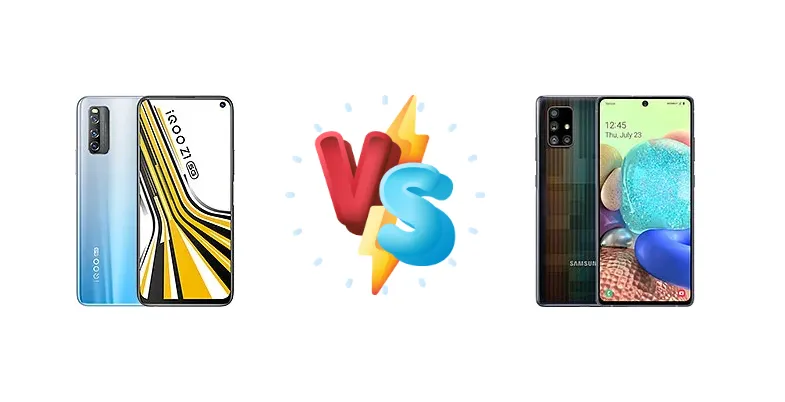
The iQOO Z1 and Samsung Galaxy A71 5G UW represent distinct approaches to the mid-range 5G market. The iQOO Z1 prioritizes raw performance with its Mediatek Dimensity 1000+ chipset, while the Galaxy A71 5G UW aims for a balance of features and Samsung’s established software experience. This comparison dissects their key differences to determine which phone delivers the best value.
🏆 Quick Verdict
For the average user prioritizing performance and fast charging, the iQOO Z1 is the clear winner. Its Dimensity 1000+ chipset offers a noticeable performance advantage over the Snapdragon 765G, and its 44W charging significantly reduces downtime. However, Samsung’s software and brand recognition may appeal to some.
| Network |
|---|
| 2G bands | GSM 850 / 900 / 1800 / 1900 | GSM 850 / 900 / 1800 / 1900 |
| 3G bands | HSDPA 850 / 900 / 1700(AWS) / 1900 / 2100 | HSDPA 850 / 900 / 1900 / 2100 |
| 4G bands | 1, 2, 3, 4, 5, 8, 18, 19, 25, 26, 34, 38, 39, 40, 41 | 2, 3, 4, 5, 7, 12, 13, 20, 28, 66 |
| 5G bands | 1, 3, 41, 77, 78, 79 SA/NSA | 260, 261 SA/NSA/mmWave |
| Speed | HSPA, LTE, 5G | HSPA, LTE, 5G |
| Technology | GSM / CDMA / HSPA / LTE / 5G | GSM / HSPA / LTE / 5G |
| | CDMA 800 / 1900 & TD-SCDMA | - |
| Launch |
|---|
| Announced | 2020, May 19. Released 2020, June 01 | 2020, July 07 |
| Status | Discontinued | Available. Released 2020, July 16 |
| Body |
|---|
| Build | - | Glass front (Gorilla Glass 3), plastic back, aluminum frame |
| Dimensions | 164 x 75.6 x 8.9 mm (6.46 x 2.98 x 0.35 in) | 162.8 x 75.7 x 8.4 mm (6.41 x 2.98 x 0.33 in) |
| SIM | Nano-SIM + Nano-SIM | Nano-SIM (pre-installed) |
| Weight | 195 g (6.88 oz) | 188 g (6.63 oz) |
| Display |
|---|
| Protection | - | Corning Gorilla Glass 3 |
| Resolution | 1080 x 2408 pixels, 20:9 ratio (~402 ppi density) | 1080 x 2400 pixels, 20:9 ratio (~393 ppi density) |
| Size | 6.57 inches, 104.0 cm2 (~83.9% screen-to-body ratio) | 6.7 inches, 108.4 cm2 (~87.9% screen-to-body ratio) |
| Type | IPS LCD, 144Hz, HDR10 | Super AMOLED Plus |
| Platform |
|---|
| CPU | Octa-core (4x2.6 GHz Cortex-A77 & 4x2.0 GHz Cortex-A55) | Octa-core (1x2.4 GHz Kryo 475 Prime & 1x2.2 GHz Kryo 475 Gold & 6x1.8 GHz Kryo 475 Silver) |
| Chipset | Mediatek Dimensity 1000+ (7 nm) | Qualcomm SM7250 Snapdragon 765G 5G (7 nm) |
| GPU | Mali-G77 MC9 | Adreno 620 |
| OS | Android 10, iQOO UI 1.0 | Android 10, One UI 2.1 |
| Memory |
|---|
| Card slot | No | microSDXC (dedicated slot) |
| Internal | 128GB 6GB RAM, 128GB 8GB RAM, 128GB 12GB RAM, 256GB 8GB RAM | 128GB 8GB RAM |
| | UFS 2.1 | UFS 2.1 |
| Main Camera |
|---|
| Features | LED flash, HDR, panorama | LED flash, panorama, HDR |
| Quad | - | 64 MP, f/1.8, 26mm (wide), 1/1.72", 0.8µm, PDAF
12 MP, f/2.2, 123˚ (ultrawide)
5 MP (macro)
Auxiliary lens |
| Single | 8 MP, AF | - |
| Triple | 48 MP, f/1.8, 26mm (wide), 1/2.0", 0.8µm, PDAF
8 MP, f/2.2, 16mm, 112˚ (ultrawide), 1/4.0", 1.12µm
2 MP (macro) | - |
| Video | 4K@30fps, 1080p@30fps; gyro-EIS | 4K@30fps, 1080p@30/240fps, 1080p@960fps; gyro-EIS |
| Selfie camera |
|---|
| Features | HDR | HDR |
| Single | 16 MP, f/2.0, (wide) | 32 MP, f/2.2, 26mm (wide), 1/2.8", 0.8µm |
| Video | 1080p@30fps | 4K@30fps, 1080p@30fps |
| Sound |
|---|
| 3.5mm jack | Yes | Yes |
| 35mm jack | Yes | Yes |
| Loudspeaker | Yes | Yes |
| | 24-bit/192kHz audio | - |
| Comms |
|---|
| Bluetooth | 5.0, A2DP, LE, aptX HD | 5.0, A2DP, LE |
| NFC | Yes | No |
| Positioning | GPS, GLONASS, BDS, GALILEO | GPS, GLONASS, GALILEO, BDS |
| Radio | No | No |
| USB | USB Type-C 2.0, OTG | USB Type-C 2.0, OTG |
| WLAN | Wi-Fi 802.11 a/b/g/n/ac/6, dual-band, Wi-Fi Direct | Wi-Fi 802.11 a/b/g/n/ac, dual-band, Wi-Fi Direct |
| Features |
|---|
| Browser | HTML, Adobe Flash | - |
| Sensors | Fingerprint (side-mounted), accelerometer, proximity, compass | Fingerprint (under display, optical), accelerometer, gyro, proximity, compass |
| | - | ANT+ |
| Battery |
|---|
| Charging | 44W wired, 50% in 23 min, 100% in 59 min | 25W wired |
| Type | 4500 mAh | Li-Po 4500 mAh |
| Misc |
|---|
| Colors | Galaxy Silver, Space blue | Prism Bricks Black |
| Models | V1986A | SM-A716V |
| Price | About 280 EUR | - |
| SAR | - | 0.50 W/kg (head) 0.78 W/kg (body) |
vivo iQOO Z1
- Significantly faster 44W charging
- More powerful Dimensity 1000+ chipset for gaming and multitasking
- Potentially smoother experience with a higher refresh rate display (unconfirmed)
- Software experience may not be as refined as Samsung’s One UI
- Brand recognition is lower than Samsung
Samsung Galaxy A71 5G UW
- Familiar and polished Samsung One UI software
- Strong brand reputation and customer support
- Likely optimized camera software for pleasing images
- Slower 25W charging
- Less powerful Snapdragon 765G chipset
- May struggle with demanding games and applications
Display Comparison
While both phones likely feature LCD panels (data unavailable), the focus here is on performance. Display quality is less of a differentiator. The iQOO Z1’s potential for a higher refresh rate (based on iQOO’s typical offerings) would provide a smoother user experience, though this isn’t confirmed. The A71 5G UW’s display is likely tuned for Samsung’s vibrant color profile, which some users may prefer.
Camera Comparison
Without detailed camera specs, it’s difficult to make a definitive judgment. However, the chipset’s ISP (Image Signal Processor) plays a crucial role. The Dimensity 1000+ generally offers robust image processing capabilities. The A71 5G UW benefits from Samsung’s well-regarded camera software, which often prioritizes vibrant colors and pleasing aesthetics. The absence of information on sensor sizes and apertures makes a direct comparison impossible, but the iQOO Z1’s more powerful processor could potentially handle more complex computational photography tasks.
Performance
The core difference lies in the chipsets. The iQOO Z1’s Mediatek Dimensity 1000+ (7nm) boasts a more powerful CPU configuration – octa-core (4x2.6 GHz Cortex-A77 & 4x2.0 GHz Cortex-A55) – compared to the Samsung Galaxy A71 5G UW’s Qualcomm SM7250 Snapdragon 765G 5G (7 nm) with its octa-core (1x2.4 GHz Kryo 475 Prime & 1x2.2 GHz Kryo 475 Gold & 6x1.8 GHz Kryo 475 Silver). The Cortex-A77 cores in the Dimensity 1000+ offer superior single-core performance, translating to snappier app launches and smoother multitasking. The Snapdragon 765G is still capable, but will show its limitations in graphically intensive games or demanding applications. The iQOO Z1 is likely to maintain higher sustained performance due to the Dimensity 1000+'s more efficient architecture.
Battery Life
The iQOO Z1’s 44W wired charging is a significant advantage, achieving 50% charge in 23 minutes and 100% in 59 minutes. The Galaxy A71 5G UW’s 25W charging is considerably slower. While battery capacity isn’t specified, the faster charging of the iQOO Z1 mitigates any potential disadvantage in mAh size. Users who frequently top up their phones will greatly benefit from the iQOO Z1’s charging speed.
Buying Guide
Buy the vivo iQOO Z1 if you need a phone for demanding tasks like mobile gaming, video editing, or frequent multitasking, and value rapid charging. Buy the Samsung Galaxy A71 5G UW if you prefer a more polished software experience, a well-known brand, and prioritize a balanced feature set over outright performance. The A71 5G UW is better suited for users who don't push their phones to the limit.
Frequently Asked Questions
❓ Will the Snapdragon 765G in the Galaxy A71 5G UW struggle with graphically intensive games like Genshin Impact?
The Snapdragon 765G is capable of running Genshin Impact, but you’ll likely need to lower the graphics settings to medium or low to maintain a stable frame rate. The iQOO Z1’s Dimensity 1000+ will provide a significantly smoother experience at higher settings.
❓ How much faster is the 44W charging on the iQOO Z1 compared to the 25W charging on the Galaxy A71 5G UW in real-world use?
The iQOO Z1 can go from 0-50% in just 23 minutes, while the Galaxy A71 5G UW will take considerably longer – likely over an hour to reach 50%. This difference is substantial for users who need a quick power boost.
❓ Does the iQOO Z1 support carrier aggregation for improved 5G speeds?
While not explicitly stated, the Dimensity 1000+ chipset supports extensive 5G carrier aggregation, meaning it can combine multiple 5G bands for faster and more reliable speeds, provided your carrier supports it. The Snapdragon 765G also supports carrier aggregation, but the Dimensity 1000+ generally offers broader compatibility.