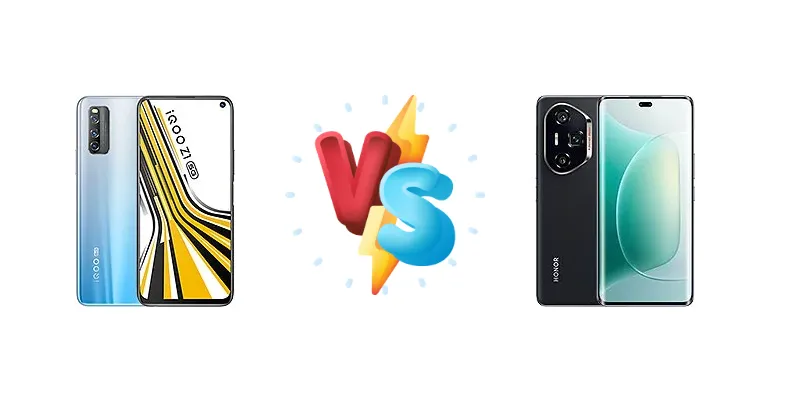
The iQOO Z1, powered by the Mediatek Dimensity 1000+, represents a compelling value proposition in the mid-range. However, the Honor 300 Ultra arrives with Qualcomm’s flagship Snapdragon 8 Gen 3, promising a significant leap in performance. This comparison dissects the key differences, helping you determine if the Ultra’s premium chipset justifies its likely higher price point.
🏆 Quick Verdict
For the average user prioritizing raw performance and future-proofing, the Honor 300 Ultra is the clear winner thanks to the Snapdragon 8 Gen 3. However, the iQOO Z1 remains a strong contender for budget-conscious users who value a balanced experience and don't require the absolute latest in processing power.
| Network |
|---|
| 2G bands | GSM 850 / 900 / 1800 / 1900 | GSM 850 / 900 / 1800 / 1900 |
| 3G bands | HSDPA 850 / 900 / 1700(AWS) / 1900 / 2100 | HSDPA 800 / 850 / 900 / 1700(AWS) / 1900 / 2100 |
| 4G bands | 1, 2, 3, 4, 5, 8, 18, 19, 25, 26, 34, 38, 39, 40, 41 | LTE |
| 5G bands | 1, 3, 41, 77, 78, 79 SA/NSA | SA/NSA |
| Speed | HSPA, LTE, 5G | HSPA, LTE, 5G |
| Technology | GSM / CDMA / HSPA / LTE / 5G | GSM / HSPA / LTE / 5G |
| | CDMA 800 / 1900 & TD-SCDMA | - |
| Launch |
|---|
| Announced | 2020, May 19. Released 2020, June 01 | 2024, December 02 |
| Status | Discontinued | Available. Released 2024, December 07 |
| Body |
|---|
| Build | - | Glass front, glass back or silicone polymer back (eco leather) |
| Dimensions | 164 x 75.6 x 8.9 mm (6.46 x 2.98 x 0.35 in) | 163.8 x 75.3 x 8.2 mm (6.45 x 2.96 x 0.32 in) |
| SIM | Nano-SIM + Nano-SIM | Nano-SIM + Nano-SIM |
| Weight | 195 g (6.88 oz) | 198 g (6.98 oz) |
| Display |
|---|
| Protection | - | Giant rhino glass |
| Resolution | 1080 x 2408 pixels, 20:9 ratio (~402 ppi density) | 1224 x 2700 pixels (~437 ppi density) |
| Size | 6.57 inches, 104.0 cm2 (~83.9% screen-to-body ratio) | 6.78 inches, 111.5 cm2 (~90.4% screen-to-body ratio) |
| Type | IPS LCD, 144Hz, HDR10 | AMOLED, 1B colors, 120Hz, HDR, 1200 nits (HBM), 4000 nits (peak) |
| Platform |
|---|
| CPU | Octa-core (4x2.6 GHz Cortex-A77 & 4x2.0 GHz Cortex-A55) | Octa-core (1x3.0 GHz Cortex-X4 & 5x2.95 GHz Cortex-A720 & 2x2.0 GHz Cortex-A520) |
| Chipset | Mediatek Dimensity 1000+ (7 nm) | Qualcomm SM8650-AB Snapdragon 8 Gen 3 (4 nm) |
| GPU | Mali-G77 MC9 | Adreno 750 |
| OS | Android 10, iQOO UI 1.0 | Android 15, MagicOS 9 |
| Memory |
|---|
| Card slot | No | No |
| Internal | 128GB 6GB RAM, 128GB 8GB RAM, 128GB 12GB RAM, 256GB 8GB RAM | 512GB 12GB RAM, 1TB 16GB RAM |
| | UFS 2.1 | - |
| Main Camera |
|---|
| Features | LED flash, HDR, panorama | LED flash, HDR, panorama |
| Single | 8 MP, AF | - |
| Triple | 48 MP, f/1.8, 26mm (wide), 1/2.0", 0.8µm, PDAF
8 MP, f/2.2, 16mm, 112˚ (ultrawide), 1/4.0", 1.12µm
2 MP (macro) | 50 MP, f/2.0, (wide), 1/1.56", 1.0µm, PDAF, OIS
50 MP, f/3.0, (periscope telephoto), 1/2.51", 0.7µm, PDAF, OIS, 3.8x optical zoom
12 MP, f/2.2, 112˚ (ultrawide), AF |
| Video | 4K@30fps, 1080p@30fps; gyro-EIS | 4K, 1080p, gyro-EIS, OIS |
| Selfie camera |
|---|
| Dual | - | 50 MP, f/2.1, (wide)
2 MP, f/2.4, (depth) |
| Features | HDR | HDR |
| Single | 16 MP, f/2.0, (wide) | - |
| Video | 1080p@30fps | 4K, 1080p, gyro-EIS |
| Sound |
|---|
| 3.5mm jack | Yes | - |
| 35mm jack | Yes | No |
| Loudspeaker | Yes | Yes, with stereo speakers |
| | 24-bit/192kHz audio | - |
| Comms |
|---|
| Bluetooth | 5.0, A2DP, LE, aptX HD | 5.3, A2DP, LE, aptX HD |
| Infrared port | - | Yes |
| NFC | Yes | Yes |
| Positioning | GPS, GLONASS, BDS, GALILEO | GPS, GALILEO, GLONASS, QZSS, BDS (B1I+B1c) |
| Radio | No | No |
| USB | USB Type-C 2.0, OTG | USB Type-C 2.0, OTG |
| WLAN | Wi-Fi 802.11 a/b/g/n/ac/6, dual-band, Wi-Fi Direct | Wi-Fi 802.11 a/b/g/n/ac/6/7, dual-band, Wi-Fi Direct |
| Features |
|---|
| Browser | HTML, Adobe Flash | - |
| Sensors | Fingerprint (side-mounted), accelerometer, proximity, compass | Fingerprint (under display, ultrasonic), accelerometer, gyro, compass, ultrasound proximity |
| Battery |
|---|
| Charging | 44W wired, 50% in 23 min, 100% in 59 min | 100W wired, 59% in 15 min
80W wireless, 39% in 15 min
5W reverse wired
Reverse wireless |
| Type | 4500 mAh | Si/C Li-Ion 5300 mAh |
| Misc |
|---|
| Colors | Galaxy Silver, Space blue | Black, White |
| Models | V1986A | - |
| Price | About 280 EUR | About 550 EUR |
vivo iQOO Z1
- More affordable price point
- Decent performance for everyday tasks
- Reliable and established brand
- Older chipset and less efficient architecture
- Slower charging speeds
- Likely inferior camera performance
Honor 300 Ultra
- Flagship-level performance with Snapdragon 8 Gen 3
- Ultra-fast 100W wired and 80W wireless charging
- Superior camera capabilities
- Higher price tag
- Potential for increased heat generation under heavy load (mitigated by 4nm process)
- May be overkill for basic users
Display Comparison
Context data lacks display specifics. Given the iQOO Z1’s market positioning, it likely features an LCD or lower-tier AMOLED panel with a standard refresh rate. The Honor 300 Ultra, being a flagship, is expected to boast a high-resolution AMOLED display with a 120Hz or higher refresh rate, potentially utilizing LTPO technology for variable refresh rate and improved power efficiency. This would translate to smoother scrolling and animations on the Honor, and potentially better color accuracy and peak brightness.
Camera Comparison
Without specific camera specs, we can infer based on brand strategy. The Honor 300 Ultra, as a flagship, likely features a larger main sensor with optical image stabilization (OIS) and a more sophisticated image processing pipeline. The iQOO Z1 likely employs a more modest camera setup, potentially prioritizing quantity of lenses over quality. The Snapdragon 8 Gen 3’s ISP (Image Signal Processor) is also significantly more advanced, enabling features like improved low-light performance, faster autofocus, and higher-quality video recording on the Honor 300 Ultra.
Performance
The core difference lies in the chipsets. The Honor 300 Ultra’s Snapdragon 8 Gen 3 (4nm) is a generational leap over the iQOO Z1’s Dimensity 1000+ (7nm). The 4nm process node inherently offers better power efficiency, reducing heat generation and minimizing performance throttling during sustained workloads. The Snapdragon 8 Gen 3’s CPU architecture – featuring a Cortex-X4 prime core – provides significantly improved single-core performance, crucial for responsive app launches and UI navigation. The iQOO Z1’s Cortex-A77 cores, while capable, are older and less efficient. The Snapdragon’s Adreno GPU will also deliver a substantially superior graphics experience, particularly in demanding games. While the iQOO Z1 is adequate for most tasks, the Honor 300 Ultra is built for power users.
Battery Life
The iQOO Z1’s 44W wired charging is respectable, achieving a full charge in under an hour. However, the Honor 300 Ultra’s 100W wired charging is a game-changer, reaching 59% charge in just 15 minutes. The addition of 80W wireless charging and reverse wireless charging further expands the Honor’s versatility. While the iQOO Z1 may have a slightly larger battery capacity (spec not provided), the Honor 300 Ultra’s significantly faster charging speeds minimize downtime and offer greater convenience. The efficiency gains of the 4nm Snapdragon also contribute to potentially better real-world battery life despite potentially having a smaller battery.
Buying Guide
Buy the vivo iQOO Z1 if you need a capable all-rounder for everyday tasks, moderate gaming, and appreciate a more affordable price. It’s ideal for users who prioritize value and don’t demand the highest possible frame rates in demanding titles. Buy the Honor 300 Ultra if you prioritize top-tier performance for gaming, content creation, and demanding applications, and are willing to pay a premium for the Snapdragon 8 Gen 3’s capabilities and faster charging.
Frequently Asked Questions
❓ Will the Dimensity 1000+ in the iQOO Z1 struggle with graphically intensive games like Genshin Impact?
The Dimensity 1000+ can run Genshin Impact, but you'll likely need to lower graphics settings to maintain a stable frame rate. The Snapdragon 8 Gen 3 in the Honor 300 Ultra will handle these games at maximum settings with ease, offering a smoother and more immersive gaming experience.
❓ How much faster is the 100W charging on the Honor 300 Ultra compared to the iQOO Z1's 44W charging in real-world use?
The Honor 300 Ultra's 100W charging can add roughly 60% battery in the time it takes the iQOO Z1 to reach 100%. This means significantly less downtime and the ability to quickly top up your battery during short breaks.
❓ Is the Snapdragon 8 Gen 3 prone to overheating in the Honor 300 Ultra?
While powerful, the Snapdragon 8 Gen 3 is built on a 4nm process, which improves thermal efficiency compared to older chipsets. Honor likely incorporates advanced cooling solutions to mitigate heat, ensuring sustained performance even during demanding tasks. However, prolonged gaming at maximum settings will still generate some heat.