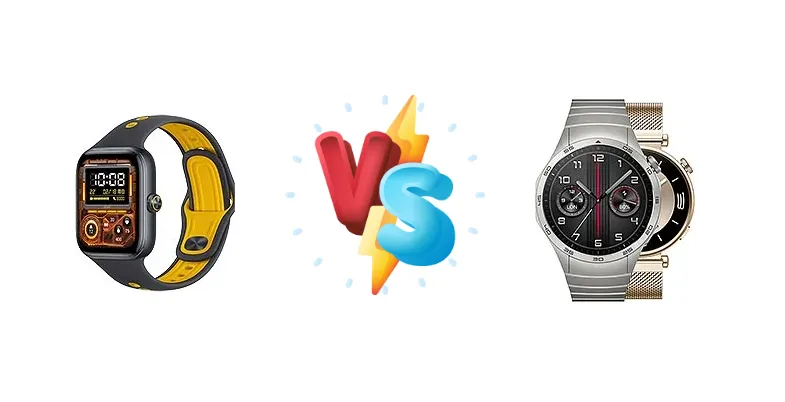
The smartwatch market is increasingly competitive, with brands like vivo (through iQOO) and Huawei vying for dominance. We're pitting the iQOO Watch GT against the Huawei Watch GT 4, two devices positioned as strong contenders in the mid-range, focusing on their core strengths: long battery life and fitness tracking. The key differentiator here is Huawei's inclusion of wireless charging, a feature absent from any confirmed iQOO Watch GT specifications.
🏆 Quick Verdict
For the average user prioritizing convenience and a potentially richer software ecosystem, the Huawei Watch GT 4 emerges as the winner. Its wireless charging capability and established brand reputation in wearables offer a more polished experience. However, the iQOO Watch GT may present a compelling value proposition if priced significantly lower.
| Network |
|---|
| 2G bands | N/A | N/A |
| 3G bands | HSDPA 850 / 900 / 2100 | N/A |
| 4G bands | LTE | N/A |
| EDGE | - | No |
| GPRS | - | No |
| Speed | HSPA, LTE | No |
| Technology | HSPA / LTE | No cellular connectivity |
| Launch |
|---|
| Announced | 2024, July 11 | 2023, September 14 |
| Status | Available. Released 2024, July 16 | Available. Released 2023, October 02 |
| Body |
|---|
| Build | Glass front, aluminum frame, plastic back | Glass front, plastic back, stainless steel frame |
| Dimensions | 45.8 x 39.6 x 11.2 mm (1.80 x 1.56 x 0.44 in) | 46 x 46 x 10.9 mm (1.81 x 1.81 x 0.43 in) |
| SIM | eSIM | No |
| Weight | 33 g (1.16 oz) | 37 g (41mm) / 48 g (46mm) (1.31 oz) |
| Display |
|---|
| Resolution | 390 x 450 pixels (~322 ppi density) | 466 x 466 pixels (~326 ppi density) |
| Size | 1.85 inches | 1.43 inches |
| Type | AMOLED | AMOLED |
| Platform |
|---|
| OS | Blue OS | HarmonyOS 4.0 |
| Memory |
|---|
| Card slot | No | No |
| Internal | - | Unspecified |
| Sound |
|---|
| 35mm jack | No | No |
| Loudspeaker | Yes | Yes |
| Comms |
|---|
| Bluetooth | 5.3, A2DP, LE | 5.2, A2DP, LE |
| NFC | Yes | Yes |
| Positioning | GPS, GLONASS, GALILEO, BDS, QZSS | GPS (L1+L5), GLONASS, BDS, GALILEO, QZSS |
| Radio | No | No |
| USB | No | No |
| WLAN | No | No |
| Features |
|---|
| Sensors | Accelerometer, gyro, heart rate, compass, SpO2 | Accelerometer, gyro, heart rate, barometer, compass, SpO2, thermometer (body temperature) |
| Battery |
|---|
| Charging | - | Wireless |
| Type | 505 mAh | Li-Ion 524 mAh |
| Misc |
|---|
| Colors | Black | Black, Steel, Silver, Gold |
| Models | - | ARA-B19, PNX-B19 |
| Price | About 60 EUR | About 270 EUR |
vivo iQOO Watch GT
- Potentially lower price point
- Likely long battery life
- Focus on core fitness tracking
- Lack of wireless charging
- Unknown chipset performance
- Limited feature set compared to Huawei
Huawei Watch GT 4
- Wireless charging convenience
- Established brand reputation
- Potentially richer software features
- Higher price point
- Battery life may be slightly shorter than iQOO
- Huawei ecosystem lock-in
Display Comparison
Given the lack of specific iQOO Watch GT display details, we can infer it likely utilizes an AMOLED panel, common in this price segment, to maximize battery efficiency. The Huawei Watch GT 4’s display benefits from Huawei’s experience in wearable technology, potentially offering superior color accuracy and brightness. The GT 4’s display size is likely larger, catering to users who prefer more screen real estate for viewing notifications and fitness data. Bezels are a critical factor; smaller bezels on the GT 4 contribute to a more modern aesthetic.
Camera Comparison
Neither device is expected to feature a camera, aligning with the current trend of focusing on core smartwatch functionality. The absence of a camera simplifies the design and contributes to longer battery life. Both devices will rely on smartphone connectivity for photography.
Performance
Without chipset information for the iQOO Watch GT, it’s difficult to assess its processing power. However, given its focus on battery life, it likely employs a power-efficient processor optimized for basic fitness tracking and notification handling. The Huawei Watch GT 4, benefiting from Huawei’s Kirin chipset expertise, likely offers smoother animations and faster app loading times. RAM capacity is also crucial; more RAM allows for more background processes and quicker multitasking, a potential advantage for the GT 4.
Battery Life
The Huawei Watch GT 4’s wireless charging is a significant advantage, simplifying the charging process and reducing cable clutter. While the iQOO Watch GT’s battery capacity remains unknown, it’s likely optimized for extended use. The GT 4’s charging wattage, while not specified, is likely sufficient for a full charge within a reasonable timeframe. The real-world impact of battery size will depend on usage patterns, but Huawei’s power management algorithms are generally well-regarded.
Buying Guide
Buy the vivo iQOO Watch GT if you need a potentially more affordable smartwatch focused primarily on core fitness tracking and extended battery life, and are comfortable with wired charging. Buy the Huawei Watch GT 4 if you prefer the convenience of wireless charging, a more refined user interface, and a broader range of health and fitness features, even if it comes at a slightly higher price point.
Frequently Asked Questions
❓ Does the Huawei Watch GT 4's wireless charging work with all Qi-compatible chargers?
Yes, the Huawei Watch GT 4 supports Qi wireless charging, meaning it's compatible with a wide range of wireless charging pads adhering to the Qi standard. However, charging speeds may vary depending on the charger's output.
❓ How does the iQOO Watch GT handle smartphone notifications compared to the Huawei Watch GT 4?
Given iQOO's relatively new entry into the smartwatch market, the notification handling on the Watch GT may be more basic than the Huawei Watch GT 4. Huawei's watchOS offers more granular control over notifications, allowing users to customize which apps can send alerts and how they are displayed.
❓ What health tracking features are likely to be exclusive to the Huawei Watch GT 4?
Huawei typically includes advanced health tracking features like SpO2 monitoring, stress tracking, and sleep analysis with detailed insights. The iQOO Watch GT may offer basic versions of these features, but the depth of analysis and accuracy are likely to be superior on the Huawei device.